Participating in 2026 World Climate Industry Expo
Showcasing Korean smelting, Australian renewable energy and US recycling projects
Critical minerals including antimony and indium on display
![Korea Zinc President Baek Soon-heum (front row, third from left) poses for a photo with Ministry of Climate, Environment and Energy Minister Kim Sung-hwan (fourth from left) and other dignitaries at the company's booth at the 2026 World Climate Industry Expo. [Korea Zinc]](https://wimg.heraldcorp.com/news/cms/2026/09/21/news-p.v1.20260921.a2ba1a47feb34a9a822851d758934b54_P1.jpg)
Korea Zinc has unveiled a "triangular value chain" linking its non-ferrous metal smelting operations in Korea with renewable energy projects in Australia and a resource-recycling business in the United States. The company also highlighted its production capabilities in critical minerals — including antimony, germanium and gallium — whose supply chain importance has grown sharply in recent years.
Korea Zinc participated in the 2026 World Climate Industry Expo, held at Bexco in Busan from Wednesday through Friday, the company announced Monday. This year marked its fourth consecutive year at the event.
The expo is co-hosted by the Ministry of Climate, Environment and Energy, the International Energy Agency, the World Bank, the International Renewable Energy Agency and the city of Busan, and is organized by the Korea Energy Agency. More than 550 domestic and international companies took part in this year's event.
The centerpiece of Korea Zinc's exhibition was the business structure it is building across Korea, Australia and the United States. In Korea, the company produces non-ferrous metals and critical minerals at its Onsan smelter. In Australia, it is pursuing renewable energy and green hydrogen projects. In the United States, it is expanding a resource-recycling business that makes use of electronic waste and other materials.
These operations are connected under the company's "Troika Drive" strategy, which revolves around three pillars: renewable energy, resource recycling and secondary battery materials. The model is designed to secure raw materials using low-carbon energy and channel them into non-ferrous metal and critical mineral production.
At the center of the exhibition floor stood a diorama — a scale model depicting this business structure. It was designed to show at a glance how Korea Zinc's Onsan smelter and its operations in Australia and the United States are connected throughout the critical mineral production process.
The booth also displayed scale models of critical mineral products that Korea Zinc currently produces or is developing commercially, including antimony, indium, bismuth, tellurium, germanium and gallium. The strategic importance of these minerals has grown as major countries accelerate efforts to diversify supply chains heavily dependent on China.
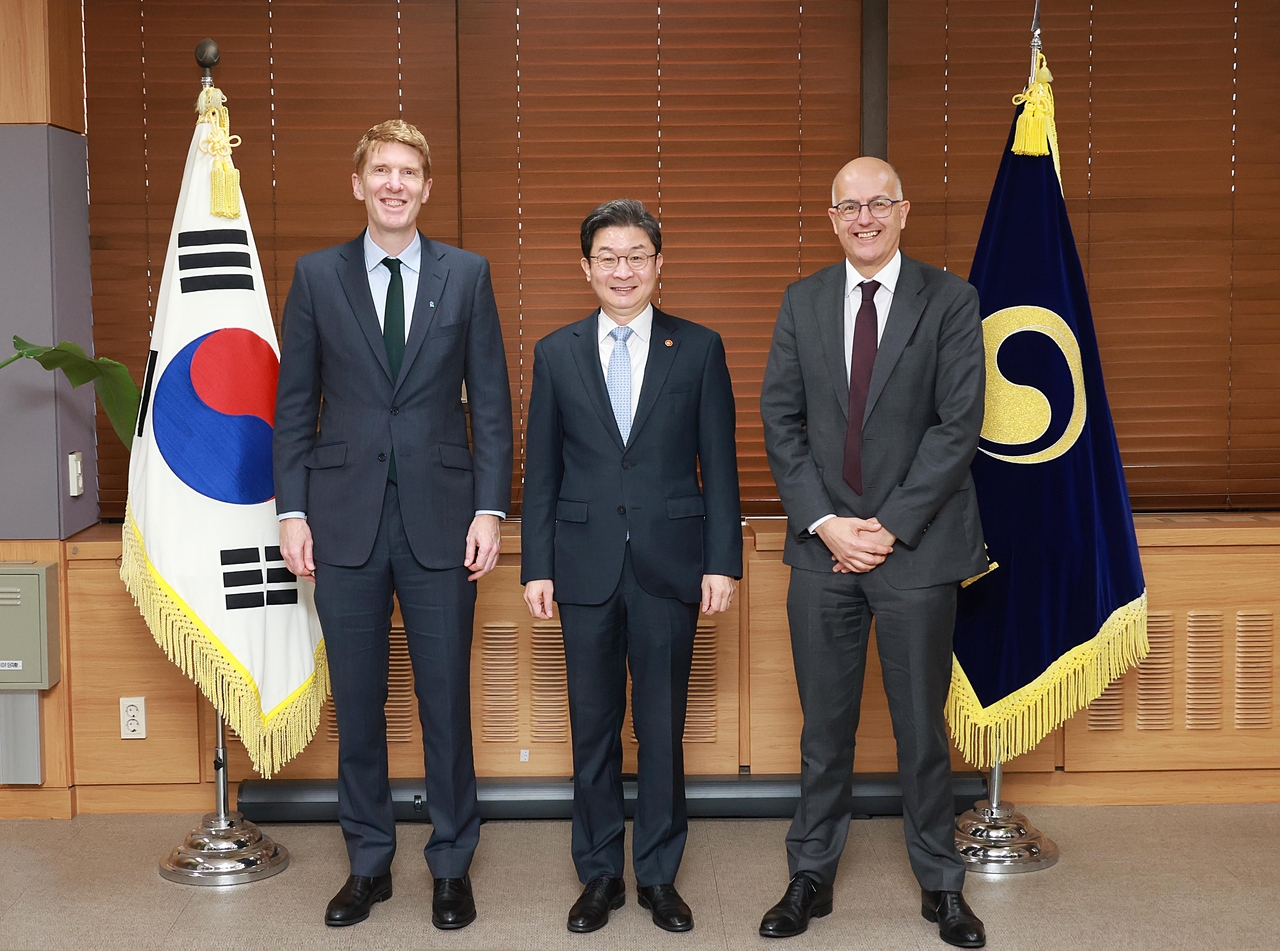
On the opening day, Ministry of Climate, Environment and Energy Minister Kim Sung-hwan, IRENA Director-General Francesco La Camera and Global Green Growth Institute Secretary-General Kim Sang-hyup visited the Korea Zinc booth.
Korea Zinc President Baek Soon-heum briefed the visitors on the company's critical mineral production at the Onsan smelter, its renewable energy and green hydrogen projects in Australia, and its resource-recycling operations in the United States. He also outlined the company's so-called "green metal" strategy — a vision to reduce carbon emissions by expanding the use of renewable energy and resource recycling throughout the metal production process.
Korea Zinc installed large LED screens above and at the center of its booth to present video content on its renewable energy, resource-recycling and critical mineral businesses. Kiosks were placed throughout each exhibition zone to provide detailed information on individual projects and technologies.
"Through this year's WCE, we were able to effectively communicate Korea Zinc's business value chain — connecting Korea, Australia and the United States — and our green metal vision to key figures and visitors from home and abroad," a company official said. "We will continue to strengthen synergies among our renewable energy and green hydrogen, resource-recycling and smelting businesses, and take a leading role in safeguarding resource supply chains for critical minerals and beyond."
kwater@heraldcorp.com