
Korea Federation of Industries analysis of zombie-company trends among listed firms in major countries
Share up 15.8 percentage points since 2017, outpacing US, France, UK, Germany and Japan
Kosdaq zombie-company rate hits 32.6%, nearly double the Kospi figure

The share of financially distressed "zombie" companies among South Korea's listed firms has grown faster than in any other major advanced economy, a new analysis shows. On the Kosdaq market, the proportion has surpassed 30 percent — roughly double the rate on the Kospi.
The Korea Federation of Industries released an analysis Tuesday of zombie-company trends among listed firms in major economies. It found that 27.6 percent of South Korean listed companies qualified as zombie firms in 2025, the second-highest rate after the United States at 30.7 percent. The share has risen 15.8 percentage points from 11.8 percent in 2017, a steeper increase than in the US (9.5 percentage points), France (5.5 percentage points), the UK (2.8 percentage points), Germany (2.3 percentage points) and Japan (1.9 percentage points).
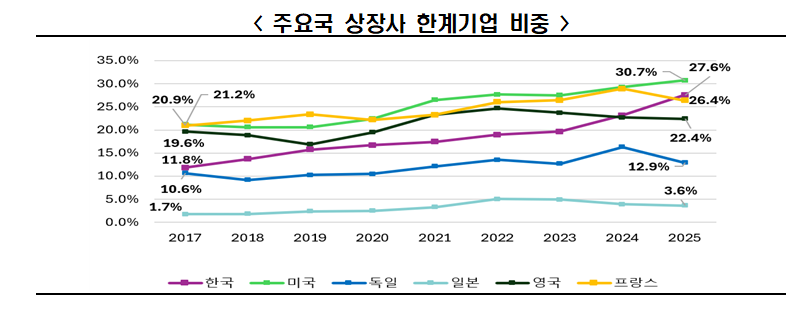
A zombie company is defined as a firm that has been unable to cover its interest expenses with earnings — including non-operating income and losses — for three consecutive years. The Bank of Korea has previously published research showing that a higher proportion of zombie companies suppresses investment and hiring at financially healthy firms.
Within the zombie-company category, the share classified as "temporarily distressed" — firms whose profitability has deteriorated only on a short-term basis — has also consistently expanded, rising for three consecutive years: 41.8 percent in 2023, 43.7 percent in 2024 and 43.9 percent in 2025.
South Korea's temporarily distressed zombie-company rate of 43.9 percent this year was the second highest among the countries surveyed, just behind the US at 44.0 percent. France (40.1 percent), the UK (36.7 percent), Germany (27.0 percent) and Japan (9.8 percent) followed.
The Kosdaq figure was particularly striking: 32.6 percent of Kosdaq-listed companies were zombie firms last year, nearly double the 16.7 percent rate on the Kospi. The increase since 2017 was also far sharper on the Kosdaq, at 19.5 percentage points — about 2.7 times the Kospi's 7.1-percentage-point rise. Analysts attributed the wider impact on the Kosdaq to its higher concentration of growth-oriented and technology companies, which have been more exposed to the economic slowdown and tighter financing conditions.
By sector, arts, sports and leisure-related services had the highest zombie-company rate at 60.0 percent, followed by professional, scientific and technical services (36.8 percent), wholesale and retail trade (36.4 percent), information and communications (32.5 percent), manufacturing (25.6 percent) and construction (23.6 percent).
Among sectors that saw the sharpest increases since 2017, professional, scientific and technical services led with a 30.0-percentage-point rise, followed by information and communications (19.6 percentage points), wholesale and retail trade (18.6 percentage points) and manufacturing (14.4 percentage points). The figures suggest that management burdens are mounting rapidly even in knowledge-intensive fields such as research and development, engineering and consulting.
"The rapid increase in the zombie-company share among South Korean listed firms signals that operating conditions are deteriorating across key industries outside the semiconductor sector, as worsening trade conditions combine with rising exchange rates, raw material costs and labor costs alongside sluggish domestic demand," said Lee Sang-ho, head of the KFI's economics division. "Institutional support must be strengthened to restore corporate vitality and competitiveness."
go@heraldcorp.com





