
National Investigation HQ chief retires this month
Both police commissioner, investigation chief posts now vacant
Fears grow over stalled probes, policy drift
By Kim A-rin, The Herald Business
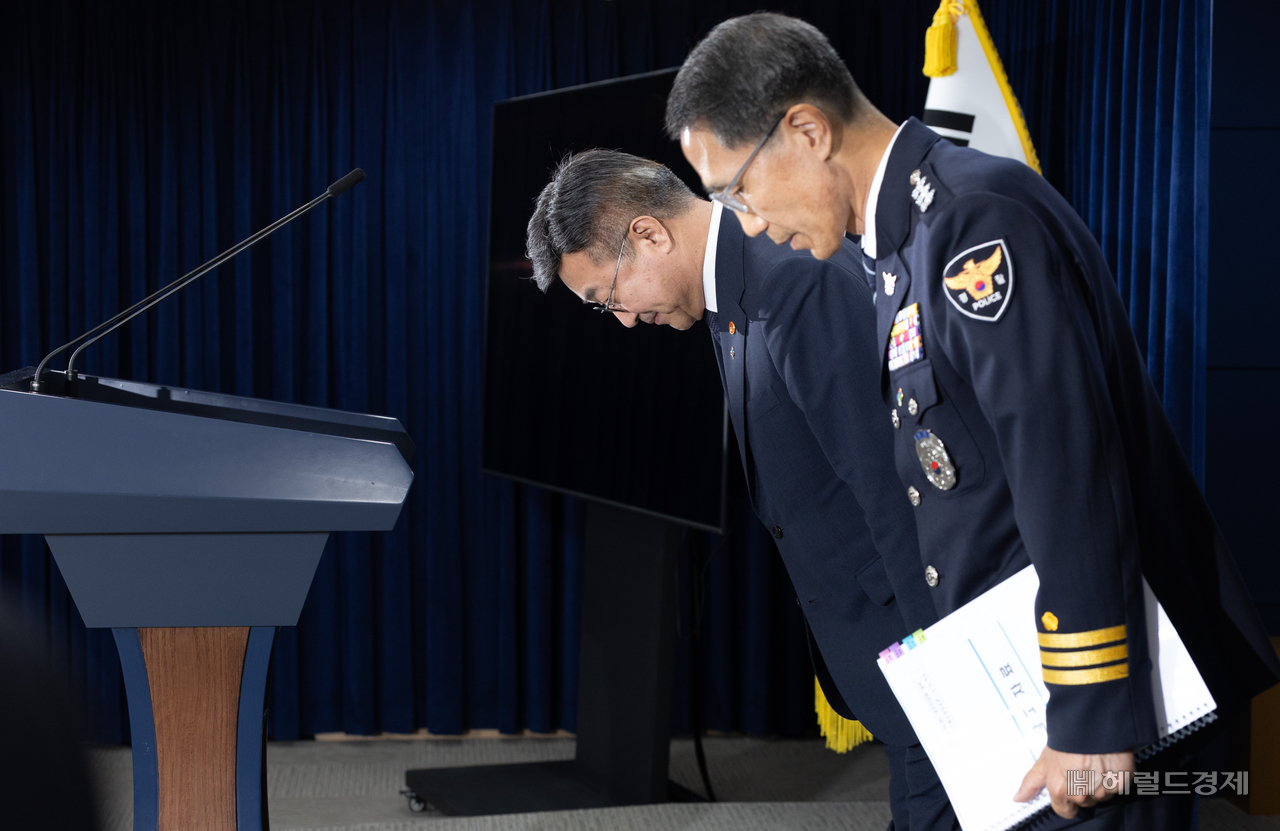
South Korea's National Police Agency has entered an unprecedented leadership vacuum after Park Sung-joo, chief of the National Investigation Headquarters, retired Tuesday — even as the police commissioner post has remained vacant since last June. With no successor named, the NIH's investigation planning and coordination director will serve as acting chief for now, leaving both of the agency's top positions simultaneously without permanent leadership for the first time in its history.
Park's departure adds pressure to several high-profile investigations still under way. Most prominent is a 10-month-old probe into alleged misconduct by Rep. Kim Byung-kee, a former floor leader of the Democratic Party of Korea and a close ally of President Lee Jae Myung who served as the ruling party's inaugural floor leader under the current administration. The investigation is considered politically sensitive. With it nearing its final stages, the vacancy at the top of the NIH has raised fears — inside and outside the police — that momentum could falter at a critical moment.
Some observers have suggested the prolonged vacancies amount to an attempt to bring the police to heel after the agency spent the early months of the administration investigating figures close to the ruling camp. "Police are handling all sorts of politically charged cases, but it's hard to make decisive calls when there's no one at the top," one investigative officer said. "With no appointments being made, the whole organization has no choice but to watch which way the wind blows."
A police expert who asked not to be named said the situation raised unavoidable questions about intent. "One cannot help but wonder whether this government is trying to tame a police organization it handed sweeping investigative powers to — for political purposes," the expert said.
The prolonged leadership void has fueled deep frustration within the ranks. "It is pathetic that, as a member of this organization, we are in a situation where the head of the agency has not been appointed," one senior police official said, adding: "We held a superintendents' conference and opposed the police bureau — how is the current government any different?" Another officer said the disorder at the Jamsil rally and various misconduct incidents were the direct result of having no commissioner willing to take responsibility. "The current government's handling of police appointments is, in a word, a disaster," the officer said.
The leadership vacuum has also left a growing backlog of policy priorities adrift. When the Prosecution Service is abolished in October and its investigative and prosecutorial functions are separated, the police will shoulder far greater investigative responsibilities. Strengthening the organization's investigative expertise has never been more urgent — yet the agency has spent this entire period under an acting structure. "For a full year that should have been devoted to preparing for the transformation of the criminal justice system, the police have been kept in acting mode," said Hwang Moon-gyu, a former special committee member on the autonomous policing system. "The conditions for doing proactive work have not even been put in place."
The paralysis has spread to the field as well. "If you visit regional police agencies across the country, it's chaos," said Min Gwan-gi, chairman of the National Police Workplace Council. "Mid-level commanders are avoiding anything that might land them with responsibility, and police projects large and small are being shelved or stalled. The 140,000-strong police force is the second-largest organization in the country after the military — the idea that it has no one in charge is simply incomprehensible."
Some officials point to another factor behind the delay: a large number of police officers are among those being investigated by a government task force — overseen by the Office for Government Policy Coordination — examining involvement in the Dec. 3 emergency martial law declaration. "My understanding is that there was a judgment that personnel reform needed to come first, given that the police were also an organization entangled in the emergency martial law," a ruling party official said.
Lim Jun-tae, dean of Dongguk University's College of Police and Criminal Justice, said the situation was simply abnormal. "This is not a state of emergency, and a president has already been elected — the country is operating normally. A prolonged vacancy in the police leadership under these circumstances is not acceptable," he said.
Oh Yun-sung, a professor of police administration at Soonchunhyang University, said the government owed the public an explanation. "The government must provide a justification that citizens can accept for why it has not appointed a head to an agency responsible for maintaining national public safety," he said. "There is no precedent for leaving senior police posts vacant for this long." He added: "If the police are not stable, the damage will fall squarely on the public."
arin@heraldcorp.com





