Creditors, unions urge deadline extension; pan-ruling bloc calls for government mediation
Homeplus has submitted a revised rehabilitation plan to the Seoul Rehabilitation Court, but the plan does not include a solution for the 200 billion won ($130 million) in external financing the court has demanded.
According to industry sources Wednesday, Homeplus filed the amended plan with the Seoul Rehabilitation Court on Tuesday. The revision reflects the sale of Homeplus Express, the closure of 37 stores, and workforce reductions through natural attrition and voluntary redundancies.
The court will assess the plan's feasibility before deciding whether to continue the rehabilitation proceedings. Homeplus's creditor council, unions and shareholders are understood to have submitted opinions requesting an extension of the July 3 deadline for approving the rehabilitation plan.
The revised plan does not address the court's financing requirement. The court has been pressing Homeplus to secure at least 200 billion won — the minimum needed to carry out the rehabilitation plan. Homeplus requested debtor-in-possession financing from its largest creditor, Meritz Financial Group, but Meritz approved only half that amount, 100 billion won. Even that approval came with a condition: a personal guarantee from Kim Byung-ju, chairman of Homeplus's majority shareholder MBK Partners, as a prerequisite for withdrawing funds from an escrow account.
MBK and Meritz are understood to have told the court in their respective submissions that they had made their best efforts. The two sides had previously traded blame over who would bear responsibility if Homeplus were to go bankrupt.
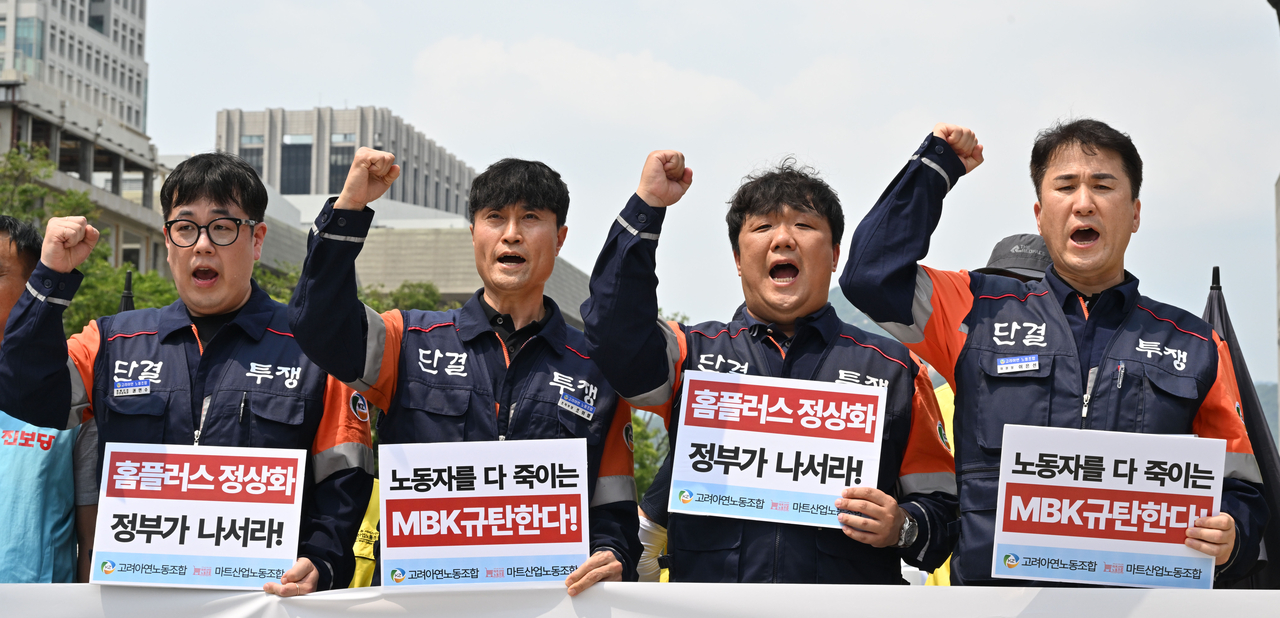
Homeplus's two main unions appealed for a deadline extension, citing the livelihoods of employees. The Homeplus General Labor Union said in its submission that the court should "defer any decision to terminate rehabilitation proceedings so that the livelihoods of countless workers and small-business owners are not destroyed," and urged the court to press "MBK and Meritz Financial to stop trading blame and act as responsible parties in the Homeplus crisis." The Mart Workers' Union also filed an opinion stating that a bankruptcy "could cause significant social harm to spread widely," and that more time was needed given that stakeholders — including the National Assembly, which is working to establish a social dialogue body — were making efforts on multiple fronts.
In the political arena, the Democratic Party of Korea and other pan-ruling-bloc parties held a preparatory meeting to propose National Assembly mediation and a social dialogue body aimed at rehabilitating Homeplus and preventing mass unemployment. They urged the government to step in as a mediator.
The parties said "the reality facing Homeplus is a crisis of employment and people's livelihoods — a public matter that requires active state intervention and mediation," and strongly urged "administrative support and mediation efforts from the government." They plan to ask the court to extend the deadline for approving the rehabilitation plan to allow time to arrange debtor-in-possession financing.
The Seoul Rehabilitation Court had already extended the original March 4 approval deadline to May 4, and then further to Aug. 3. Under rehabilitation law, the deadline for approving a plan is one year from the date proceedings begin, but it can be extended by up to six months when unavoidable circumstances exist.
Legal circles have raised the possibility of a further two-month extension through September. However, even if an extension is granted, observers say court approval of the rehabilitation plan will be difficult unless a viable financing solution is found.
![A Homeplus store in Seoul [Yonhap]](https://wimg.heraldcorp.com/news/cms/2026/07/01/rcv.YNA.20260630.PYH2026063012000001300_P1.jpg)
soho0902@heraldcorp.com