![[Generated with ChatGPT]](https://wimg.heraldcorp.com/news/cms/2026/07/01/news-p.v1.20260701.841ae8010f484827acca99ce98d9782a_P1.png)
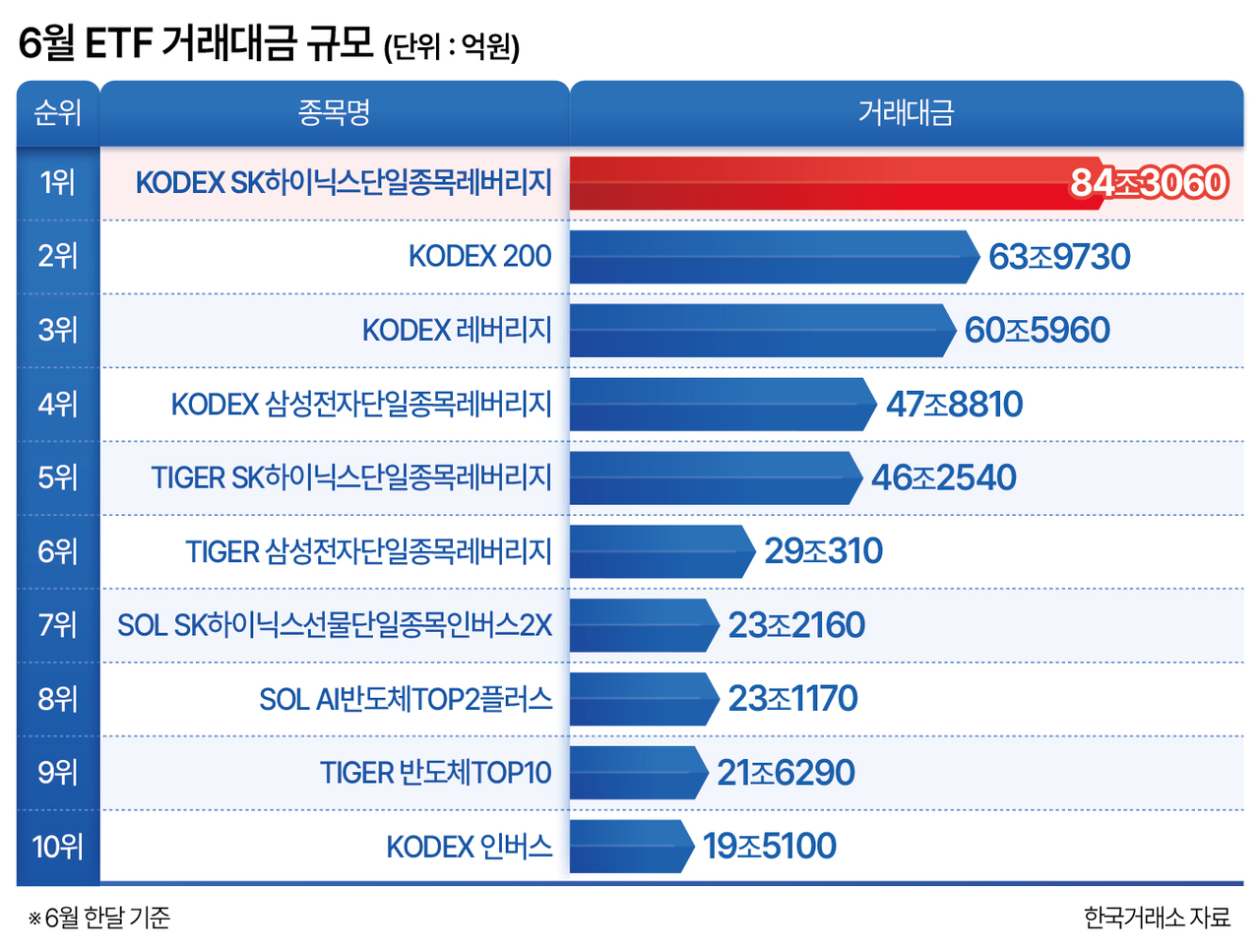
A single-stock leveraged exchange-traded fund tied to SK hynix ranked first in ETF trading volume in June, with nearly 4 trillion won ($2.58 billion) changing hands on average each day and monthly turnover surpassing 84 trillion won. The surge reflects a concentration of short-term retail trading fueled by the AI semiconductor boom and a steep climb in SK hynix's share price. Market observers warn that the heavy tilt toward single-stock and leveraged products could amplify volatility.
Korea Exchange data released Tuesday showed the KODEX SK hynix Single-Stock Leverage ETF was the most actively traded ETF in June, with total volume reaching approximately 84.3 trillion won and daily average turnover of about 4 trillion won.
That figure far exceeded the roughly 64 trillion won in trading volume recorded by KODEX200, the benchmark index ETF with the largest assets under management in South Korea. While KODEX200 remains dominant in terms of AUM, actual trading activity was far more concentrated in the single-stock leveraged product.
Single-stock leverage ETFs dominated the rest of the top rankings as well. The KODEX Samsung Electronics Single-Stock Leverage ETF ranked fourth with 47.9 trillion won in volume, followed by the TIGER SK hynix Single-Stock Leverage ETF in fifth at 46.3 trillion won and the TIGER Samsung Electronics Single-Stock Leverage ETF in sixth at 29 trillion won. The SOL SK hynix Futures Single-Stock Inverse 2X ETF, which bets on a decline in the share price, also saw 23.2 trillion won in trading to rank seventh.
Single-stock leverage ETFs have in effect come to dominate ETF market trading volume. Behind the surge is the fervor for AI semiconductor investment. SK hynix has emerged as the biggest beneficiary of the high-bandwidth memory (HBM) market boom, sending its share price sharply higher, while expectations of a rebound at Samsung Electronics have also grown — drawing retail investors in droves to leveraged ETFs that aim to deliver twice the daily return of the underlying stock.
A Korea Capital Market Institute report titled "Stock Market Trends and Implications Before and After the Launch of Single-Stock Leverage and Inverse ETFs" found that retail investor money flowed in rapidly after Samsung Electronics and SK hynix single-stock leverage and inverse ETFs listed on May 27. From the launch date through June 19, retail investors' cumulative net purchases reached approximately 8.2 trillion won for the leverage ETFs and about 300 billion won for the inverse ETFs.
Capital flows also shifted away from existing semiconductor ETFs. The Korea Capital Market Institute found that domestic semiconductor ETFs turned to net selling after the single-stock ETFs launched, and that leveraged products in particular saw capital outflows from Kospi index ETFs. The institute interpreted this as a sign that some money previously invested in conventional semiconductor ETFs had migrated into single-stock leverage ETFs.
The product structure itself also helps explain the explosion in trading volume. Because leverage ETFs aim to deliver twice the daily return of the underlying asset, they lend themselves to frequent short-term trading. Their turnover rate is higher than that of ordinary ETFs, which means reported trading volume tends to be far larger than the actual amount of new money flowing in.
Market participants also see a shift in retail investor behavior. Demand for short-term directional bets on individual stocks has grown significantly relative to long-term index ETF investing. The trend is especially pronounced for highly volatile stocks such as SK hynix and Samsung Electronics, where leverage ETF trading tends to expand alongside share price swings.
The concern is that this dynamic could amplify market volatility. Single-stock leverage ETFs must execute daily rebalancing trades to hit their target returns, which can push share price volatility even higher. As a stock rises, the ETF's net asset value (NAV) increases along with it, growing AUM and in turn enlarging the scale of rebalancing trades — a feedback loop in which volatility begets more volatility.
The Korea Capital Market Institute found that the AUM of the SK hynix leverage ETF nearly doubled in just nine trading days, rising from 4.84 trillion won on June 10 to 9.15 trillion won on June 19.
Much of that increase is estimated to reflect NAV appreciation from the share price rally rather than fresh inflows. As AUM grows, the same magnitude of share price movement triggers larger rebalancing trades, potentially amplifying the ETF's impact on the broader market.
"Single-stock ETFs can, by their structural nature, amplify volatility further through rebalancing trades," said Jang Geun-hyeok, a senior research fellow at the Korea Capital Market Institute. "Given that the AUM of leverage ETFs is growing due to the NAV appreciation effect from recent share price gains, that impact could become increasingly significant."
Jang added that continuous monitoring of AUM growth trends and the impact of rebalancing trades during periods of volatility would be necessary, and that investors also needed to pay close attention to risk management, taking into account that risks can grow even larger after a share price rally and that concentration in specific stocks carries its own dangers.

th5@heraldcorp.com