
Guri already absorbing Seoul displacement demand — regulations set to worsen the squeeze
Dongtan, Giheung also see sharp drops as housing instability spreads across Greater Seoul
![A view of the transit-oriented area around Guri Station in Gyeonggi Province. [Herald DB]](https://wimg.heraldcorp.com/news/cms/2026/07/02/news-p.v1.20260630.5b4c46b4f993462c94842a760d4a4187_P1.jpg)
A, a man in his 50s who had been renting a jeonse unit at Eunma Apartments in Daechi-dong, Gangnam-gu — one of Seoul's top school districts — for his children's education, is losing sleep over his next move as his lease approaches expiration at the end of this year. Listings in Jamsil, which he had been considering, are nearly impossible to find, and his existing jeonse deposit falls far short of what nearby complexes are asking. "I had been looking at Guri as a fallback, but with it now designated a regulated zone, even that seems unlikely," he said with a sigh. "Now I'm going to have to look at Namyangju."
Concerns are growing that the jeonse and monthly rent shortage concentrated in Seoul and key parts of Gyeonggi Province will spread to neighboring areas, as Dongtan, Guri and Giheung are set to be designated land transaction permit zones starting Sunday. Guri, in particular, had already been running low on jeonse listings as a popular alternative destination absorbing displacement demand from the Gangnam area — and analysts say the new owner-occupancy requirement that comes with the designation will hit the area even harder.
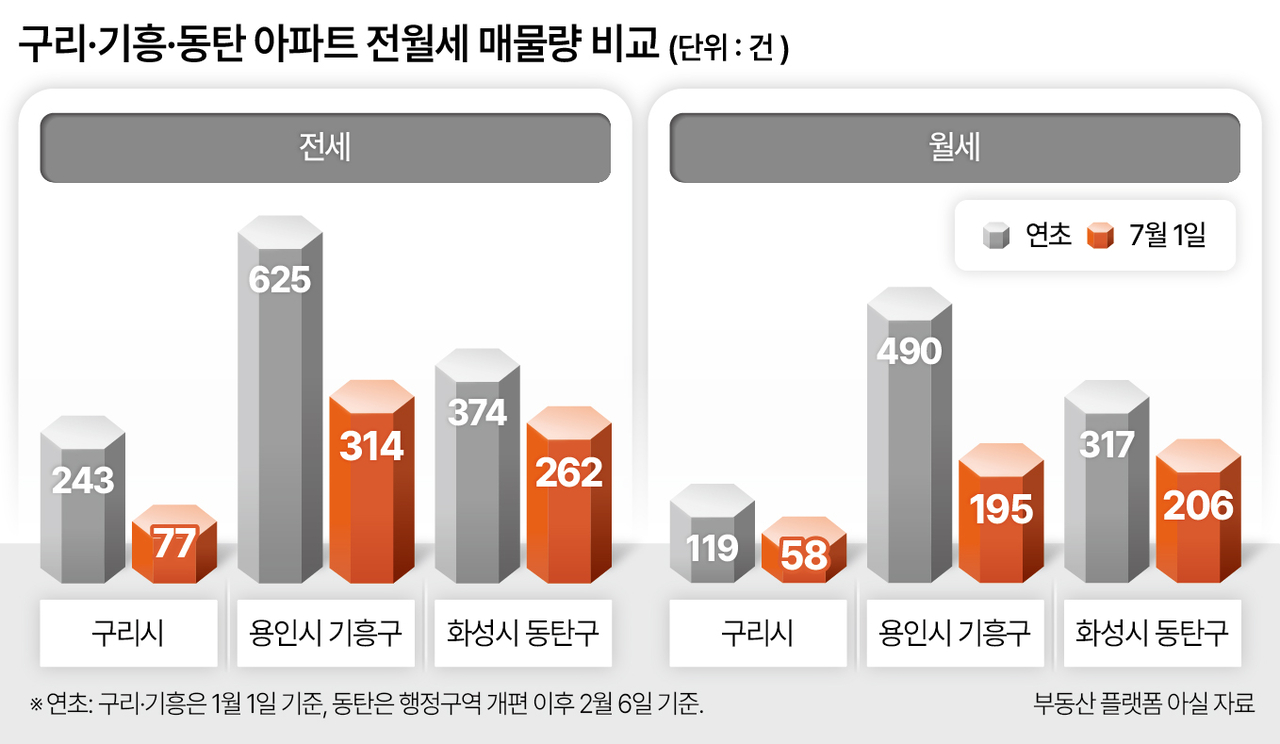
According to real estate platform Asil, jeonse listings for apartments in Guri, Gyeonggi Province stood at just 77 as of Tuesday — a near-total supply drought given that the city has roughly 150 apartment complexes comprising about 46,000 units, according to Real Estate R114. The number had been 243 on Jan. 1, dipped below 200 in mid-May, and has since fallen steadily into double digits — a plunge of 67.8 percent from the start of the year.
At the complex level, many developments show zero listings. The Inchang Jugong complexes 1, 5 and 6 in Inchang-dong have no registered jeonse listings at all, while Guri-yeok Lotte Castle Signature — a large complex of 1,180 units prized for its location in the transit-oriented area around Guri Station — has just four.
Monthly rent listings tell the same story. Guri apartment monthly rent listings stood at 58 as of Tuesday, roughly half the 119 recorded on Jan. 1. Most complexes have just one or two monthly rent units available.
The disappearance of jeonse and monthly rent listings across Guri reflects a severe supply-demand imbalance in the broader Greater Seoul housing market. New apartment move-ins in Seoul from January through May totaled 10,690 units, down 48.4 percent from 20,702 units in the same period last year. Renters priced out of Seoul have been flowing into outlying alternatives, but supply in those areas is drying up as well, deepening instability across the lease market.
Against that backdrop, analysts expect the jeonse and monthly rent crunch to accelerate now that Guri was designated a regulated zone — covering both speculative overheating districts and adjustment target areas — on Tuesday, with land transaction permit zone status taking effect Sunday. Under the regulated zone designation, jeonse loans contingent on ownership transfer are banned outright, and the jeonse loan guarantee ratio tightens to 80 percent. The jeonse loan ceiling for single-homeowners also shrinks to 200 million won ($129,000), raising the bar for securing jeonse financing and making it harder to find a qualifying unit — while the land transaction permit zone designation imposes an owner-occupancy requirement on buyers, further reducing the rental listings that come to market.
The head of a real estate agency near Guri-yeok Lotte Castle Signature said there are simply no jeonse listings. "Almost none of the residents in these new complexes around here are locals from Guri — most come from Seoul," the agent said. "Once the land transaction permit zone kicks in, whatever listings were trickling out will dry up completely."
Dongtan and Giheung are seeing the same trend. Dongtan apartment jeonse listings stood at 262 on Tuesday, down 42.7 percent from 374 on Feb. 6, when tracking began following an administrative redistricting in February. Monthly rent listings in Dongtan fell 53.9 percent over the same period, from 317 to 206. In Giheung, jeonse listings dropped roughly 50 percent from 625 at the start of the year to 314, while monthly rent listings fell 151.3 percent from 490 to 195.
Market watchers say the regulated zone and land transaction permit zone designations covering all three areas will push the jeonse and monthly rent shortage into adjacent unregulated areas connected by transit links — with Namyangju's Dasan new town and Suwon's Gwonseon-gu cited as prime candidates — deepening housing instability across Greater Seoul.
Kwon Dae-jung, an endowed professor of economics and real estate at Hansung University, said the areas being brought under land transaction permit zones or regulated zone status are places where demand has held steady while supply has fallen short, pushing up prices for both sales and rentals. "This year, Seoul's new move-in supply has been cut roughly in half, and there has been a tendency for people to be pushed out into areas with good Seoul access, like Guri," he said. "That phenomenon will spread further, and we will see residential gentrification take hold."
hwshin@heraldcorp.com





