Dedicated call center and National Health Insurance Service big data used to proactively identify residents in need
One-stop service from consultation to care linkage drives roughly 2.7-fold increase in applications
Songpa-gu also runs specialized programs to close gaps in long-term care coverage
Seoul's Songpa-gu is stepping up efforts to identify residents who need care and connect them with tailored support, as the district works to establish its integrated medical and care service program.
The initiative aims to reduce welfare blind spots — cases where elderly or severely disabled residents who need help are not receiving it due to a lack of information — so that people can continue living healthy, stable lives in their own homes and communities.
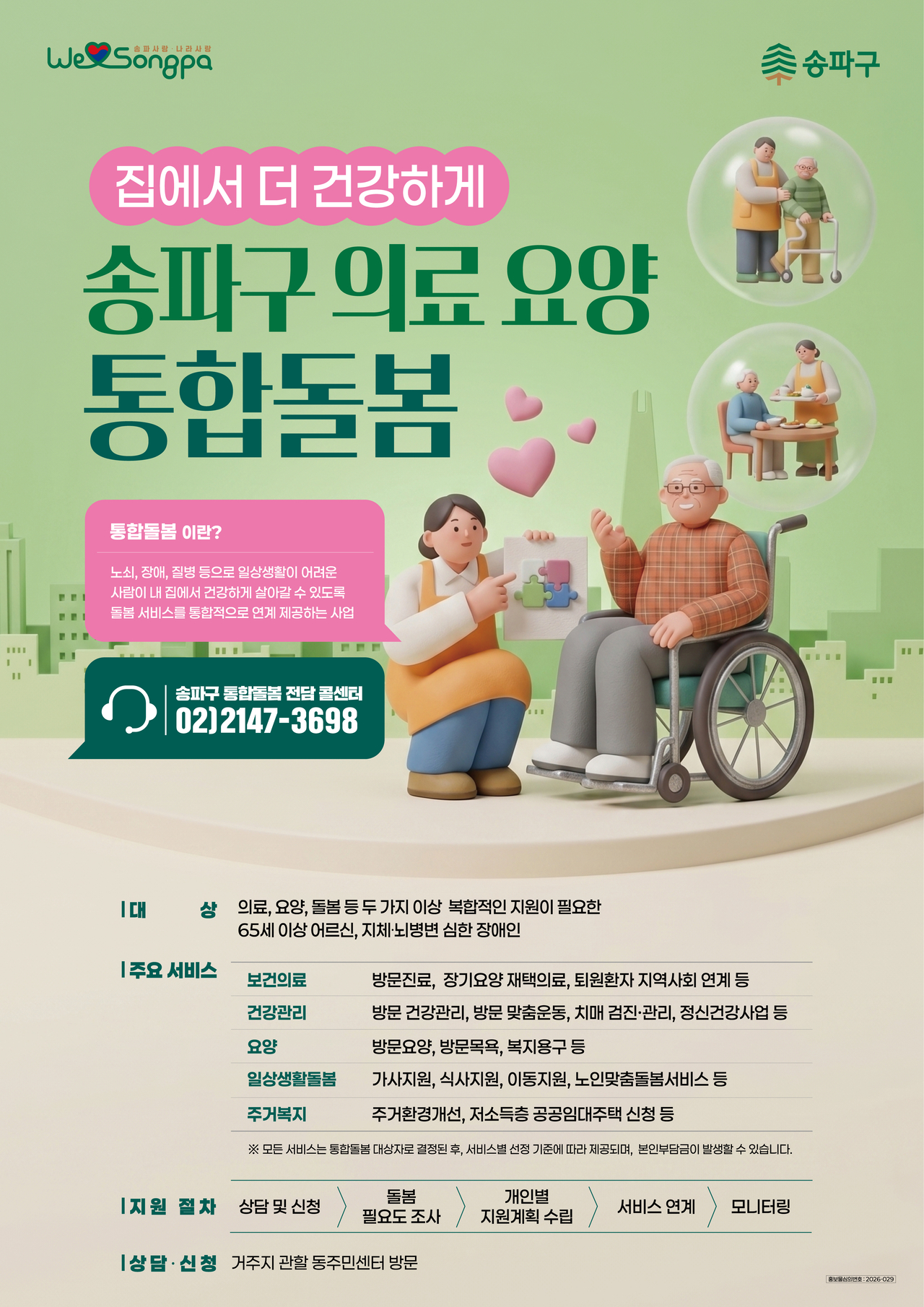
To that end, the district launched a dedicated integrated-care call center on May 18. Two counselors handle care consultations, preliminary assessments and application guidance, while the district also works with the National Health Insurance Service to proactively identify eligible residents using big data.
The program targets residents aged 65 and older, as well as people with severe physical or brain lesion-related disabilities, who require support in two or more areas spanning medical care, long-term care and general welfare services.
Once enrolled, each resident undergoes a comprehensive assessment covering health status, daily functioning and living environment, and a personalized care plan is drawn up. Services are coordinated across five areas — healthcare, health management, long-term care, daily living support and residential welfare — and include home medical visits, health management visits, housekeeping and meal support, and accompaniment services.
One example involves an elderly resident living alone who had difficulty going outside due to left-side hemiplegia and muscle weakness. The resident was identified through a big data-based survey and enrolled in the program, which connected them with customized home exercise sessions, meal delivery through the Care SOS service and home health management visits. Their muscle strength and balance improved, and they regained confidence in managing daily life.
The district also runs programs unique to Songpa-gu to address care gaps that existing systems fail to cover. These include daily living care for residents who did not qualify for long-term care ratings, as well as support for welfare equipment and home medical visit costs — filling gaps left by standard programs.
In addition, Songpa-gu plans to continue identifying underserved residents through local community networks, including neighborhood care teams and building managers, and to strengthen community-centered care by working with senior care providers, long-term care facilities and welfare centers.
District Mayor Seo Gang-seok said the dedicated call center has laid the groundwork for residents to access care services more easily and quickly. "We will actively seek out residents who need help and connect them with Songpa-gu's specialized programs to build a tight-knit care safety net where no one is left behind," he said.
seouldream01@heraldcorp.com