OECD says South Korea's economy is recovering despite martial law crisis and Middle East war; calls for fiscal consolidation and pension reform
VAT base expansion, corrective taxes proposed to boost revenue; shift from transaction to property taxes recommended
Structural reform blueprint covers education overhaul and balanced regional development
![Finance Minister and Deputy Prime Minister Koo Yun-cheol meets with an OECD delegation visiting South Korea at the Seoul Government Complex in Jongno-gu, Seoul, on Tuesday. [Ministry of Economy and Finance]](https://wimg.heraldcorp.com/news/cms/2026/07/02/rcv.YNA.20260702.PYH2026070202280001300_P1.jpg)
The OECD projected South Korea's economy will grow 2.6% this year, saying the country has maintained its recovery momentum despite domestic and external shocks including last year's martial law crisis and the ongoing Middle East conflict. The organization also urged Seoul to pursue structural reforms — including fiscal consolidation, pension overhaul and tax restructuring — to address long-term challenges such as a low birth rate, an aging population and regional inequality.
South Korea's Ministry of Economy and Finance said Wednesday that the OECD released the findings in its "OECD Economic Surveys: Korea 2026." The report assessed the Korean economy across four areas: forward-looking macroeconomic policy, tax reform for growth and revenue, education and lifelong learning, and balanced regional development.
The OECD said South Korea has seen significant gains in income and quality of life since joining the organization in 1996, and that the economy has stayed on a recovery track thanks to the government's swift response to last year's martial law episode and strong semiconductor exports, even as the Middle East conflict weighs on the global outlook. The report also credited the government's consumer voucher program with a substantial boost to private consumption and the recovery of small businesses.
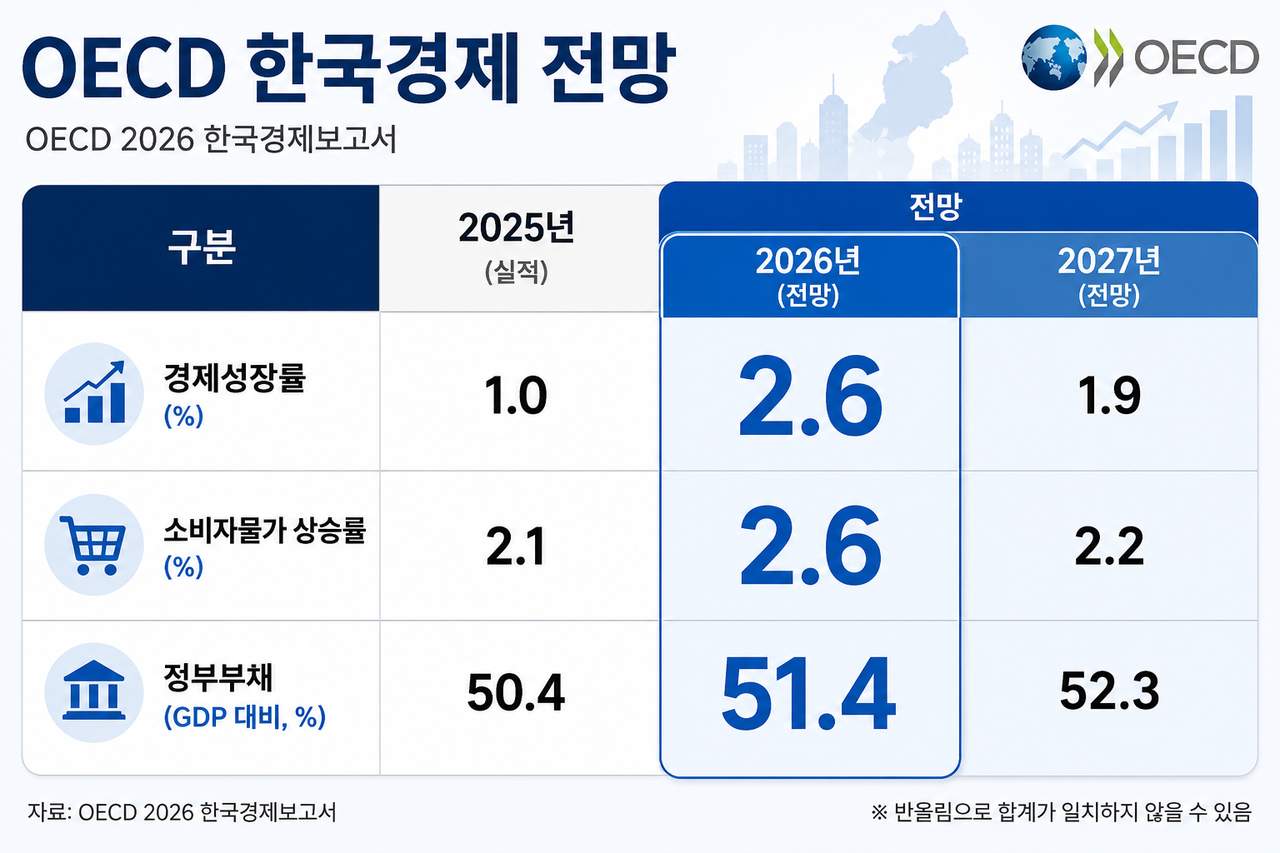
The OECD forecast GDP growth of 2.6% and consumer price inflation of 2.6% for this year, and projected growth of 1.9% and inflation of 2.2% for next year.
The organization warned that fiscal pressures from an aging population will mount rapidly, calling for medium-term consolidation efforts. It recommended that South Korea set a medium-term fiscal target with long-term sustainability in mind and pursue expenditure restructuring, while also pushing ahead with further pension reform. In particular, it proposed raising the pension eligibility age in line with the contribution age by 2035, with subsequent adjustments tied to life expectancy.
On tax reform, the OECD recommended expanding the revenue base by making greater use of indirect taxes and corrective taxes, which distort economic activity less than direct taxes.
For corporate tax, it proposed simplifying the current four-bracket progressive rate structure to reduce tax expenditures and gradually moving to a single flat rate. It also suggested narrowing the scope of tax exemptions on earned income and broadening the capital gains tax base.
On value-added tax, the OECD noted that South Korea's 10 percent rate is roughly half the OECD average of 19.3 percent, and recommended widening the tax base by reducing the scope of the simplified taxation regime and narrowing the duty-free threshold for imports under $150. It also proposed raising tobacco taxes and restructuring alcohol taxes to be levied based on alcohol content.
The report reaffirmed the OECD's position that South Korea's real estate tax system should shift from transaction-based taxes toward property holding taxes. Over the longer term, it recommended building a tax framework that reflects market prices and applying higher rates to underutilized assets such as vacant properties and second homes. On emissions trading, it called for expanding the share of paid allowances to strengthen the carbon pricing mechanism.
In education, the OECD said South Korea needs to reallocate resources from primary and secondary schooling and ease university tuition regulations to secure more funding for higher education. It also identified expanding school-based childcare services, strengthening critical-thinking education and promoting lifelong learning as key priorities. On the labor market, it recommended easing protections for regular workers, expanding social insurance coverage and restructuring wages around job function and performance to address the country's dual labor market structure.
To ease the concentration of population and economic activity in the greater Seoul area, the OECD also recommended a set of balanced regional development measures — focused investment in key regional hubs, strengthening the competitiveness of regional universities, expanding fiscal autonomy for local governments and streamlining land-use planning systems.
The government said it "plans to carefully review the policy recommendations put forward by the OECD and refer to them in the course of future policy implementation."
fact0514@heraldcorp.com