Ulsan to host AI vehicle hub; Daegu, Changwon to expand EV parts lines
Ulsan EV factory to become AI future mobility base
Electrification parts lines added in Daegu and Changwon
Expansion to cover air mobility, lunar rover and small modular reactors
Vice Chairman Jang Jae-hoon: 'Yeongnam to become core hub of future advanced industries'
![Hyundai Motor Group Vice Chairman Jang Jae-hoon announces the group's investment plan at the Yeongnam Advanced Industry Development Vision National Report, held in Jinju, South Gyeongsang Province, on Thursday under the chairmanship of President Lee Jae Myung. [Cheong Wa Dae press pool]](https://wimg.heraldcorp.com/news/cms/2026/07/03/rcv.YNA.20260703.PYH2026070310050001300_P1.jpg)
Hyundai Motor Group plans to transform the Yeongnam region — the birthplace of the conglomerate — into an advanced industry hub spanning future vehicles, AI, aerospace and energy. Starting this year, the group intends to invest 42 trillion won ($27 billion) over the next 10 years, converting its existing automotive production base into a future industry hub.
The group unveiled the investment plan Thursday at the Yeongnam Advanced Industry Development Vision National Report, held in Jinju, South Gyeongsang Province, and presided over by President Lee Jae Myung.
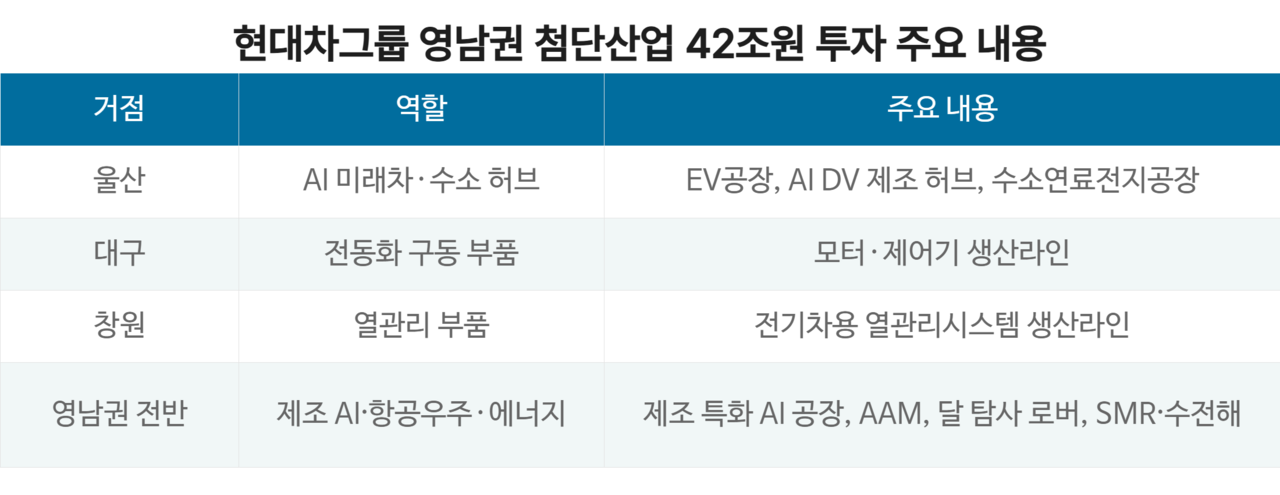
The plan centers on five initiatives for the Yeongnam region: building a manufacturing hub for AI-based advanced autonomous vehicles, establishing a future core parts cluster, driving production innovation through manufacturing-specialized AI, developing future aviation and space technology, and building a sustainable energy infrastructure.
The investment focuses on repositioning Yeongnam — the group's founding base and South Korea's largest automotive production center — as the engine of future growth. Hyundai Motor Group said it aims to foster an advanced industry ecosystem in the region alongside the Saemangeum project currently under way in the Honam region, contributing to balanced regional development and job creation.
"By making additional investments in new business areas in the Yeongnam region, where Hyundai Motor Group has its roots, we will develop it into a core hub for future advanced industries and contribute to strengthening South Korea's industrial competitiveness," Vice Chairman Jang Jae-hoon said.
Ulsan EV factory to become AI future mobility hub
Hyundai Motor Group will convert the Hyundai Motor Ulsan plant — the world's largest single-site automobile factory — into a future mobility production base. The plan calls for building an AI-based advanced autonomous vehicle manufacturing hub centered on the Ulsan EV factory, which is scheduled to begin operation in the fourth quarter of this year, equipped with cutting-edge automation and an integrated production system.
The AI-based advanced autonomous vehicle concept refers to a next-generation vehicle in which AI independently learns and makes decisions based on vehicle data. Hyundai Motor Group has set a goal of advancing the technology to Level 4 autonomous driving — the standard associated with robotaxis — and beyond, to secure leadership in the global mobility market.
A hydrogen fuel cell factory will also be built in Ulsan, serving as a strategic production base to support the expansion of hydrogen mobility and clean energy industries. Hyundai Motor broke ground on a new hydrogen fuel cell factory at the Ulsan plant in October last year, marking the start of work on the production hub.
![Rendering of Hyundai Motor's dedicated EV factory in Ulsan [provided by Hyundai Motor]](https://wimg.heraldcorp.com/news/cms/2026/07/03/news-p.v1.20260602.49effdfbca1e49b38af6f2b9d721a24b_P1.jpg)
The facility is set to become South Korea's first site to produce next-generation hydrogen fuel cells and proton exchange membrane (PEM) electrolyzers together. Hyundai Motor Group plans to improve the output and durability of next-generation hydrogen fuel cells produced at the new factory beyond current levels while also securing cost competitiveness, with the aim of strengthening its leadership in the global fuel cell market.
A PEM electrolyzer is a device that produces high-purity clean hydrogen by electrolyzing water. Hyundai Motor developed it independently, drawing on roughly three decades of accumulated hydrogen fuel cell development experience. Through the commonalization of fuel cell and electrolysis technologies and components, the company has also achieved a domestic content rate of more than 90 percent.
Electrification parts lines to expand across Ulsan, Daegu and Changwon
The group will also expand its electrification parts production base across the Yeongnam region. Hyundai Motor Group plans to scale up Hyundai Mobis's battery system assembly lines in Ulsan and reinforce Hyundai Mobis's motor and controller production lines in Daegu by 2030. Both cities already have electrification parts production infrastructure in place, and the investment represents a phased expansion of existing lines in step with growing electric vehicle demand and order volumes.
In Changwon, South Gyeongsang Province, Hyundai Wia will expand its thermal management system production lines for electric vehicles. Hyundai Wia has already established a mass production system for integrated EV thermal management systems at its Changwon Plant 1 and has been expanding the business. The company has been producing integrated thermal management systems for electric vehicles since July last year, supplying them to Kia's purpose-built vehicle PV5, and plans to also supply the larger PBV model PV7, scheduled for mass production in 2027.
![The integrated thermal management module unveiled by Hyundai Wia at CES 2026 in Las Vegas in January. [provided by Hyundai Wia]](https://wimg.heraldcorp.com/news/cms/2026/07/03/news-p.v1.20260107.bd69971bb6b9472ea0487b1a607f4ef0_P1.jpeg)
Unlike internal combustion engine vehicles, electric vehicles cannot easily draw on heat generated by an engine, making thermal management technology — which efficiently controls battery and cabin temperatures — critically important. Hyundai Wia develops in-house key air conditioning components including HVAC units, cooling modules, electric compressors and interior condensers, and mass-produces thermal management systems tailored for electric vehicles. The Changwon expansion is a phased increase in production lines driven by growing order volumes, aimed at strengthening competitiveness in electrification parts and building production capacity to meet future global demand.
Through these efforts, the group aims to strengthen the electrification value chain spanning not only finished vehicle production but also battery systems, drive components and thermal management parts.
Yeongnam to become testbed for manufacturing-data-driven physical AI
AI-driven innovation will also be applied in earnest on the factory floor. The manufacturing-specialized AI-based intelligent factory envisioned by Hyundai Motor Group is one in which AI autonomously analyzes and optimizes all aspects of factory operations — from production equipment and logistics to quality control. Rather than simply automating equipment, the system is designed to have AI learn from data accumulated during the production process, simultaneously improving efficiency and quality.
The Yeongnam region, home to a dense concentration of Hyundai Motor Group's large-scale manufacturing sites, is considered well suited for demonstrating and scaling manufacturing AI. The group plans to develop manufacturing-specialized AI models based on production data accumulated at its global manufacturing sites, creating a virtuous cycle in which physical AI drives innovation across industrial settings.
![The Ioniq 5 production line at Hyundai Motor's Ulsan plant [provided by Hyundai Motor]](https://wimg.heraldcorp.com/news/cms/2026/07/03/news-p.v1.20260527.4b02c322b71341549f64e78d963831ad_P1.jpg)
Expansion to cover air mobility, space and small modular reactors
Future aviation and space are also part of the investment blueprint. Supernal, Hyundai Motor Group's US-based advanced air mobility subsidiary, will conduct parallel development of next-generation aircraft based on electrified powertrains in the Yeongnam region, with the aim of establishing a domestic base to address the next-generation air mobility market, including urban air transportation.
Hyundai Motor Group will also pursue the development of space launch vehicle engines and a lunar exploration rover. The strategy applies autonomous driving, AI and drive control technologies accumulated through automotive and robotics development to the space industry, advancing the localization of core technologies.
Energy infrastructure investment will proceed alongside these efforts. Hyundai Motor Group is reviewing plans to build a stable and sustainable energy supply base — encompassing small modular reactors, offshore wind power and PEM electrolyzer plants — and to develop these into a next-generation export industry over the long term.
"By extending Hyundai Motor Group's manufacturing capabilities, built up over decades, into future advanced industry sectors, we will strengthen the group's growth engines, secure unrivaled competitiveness, and continue to contribute to enhancing South Korea's industrial competitiveness," a Hyundai Motor Group official said.
kwater@heraldcorp.com