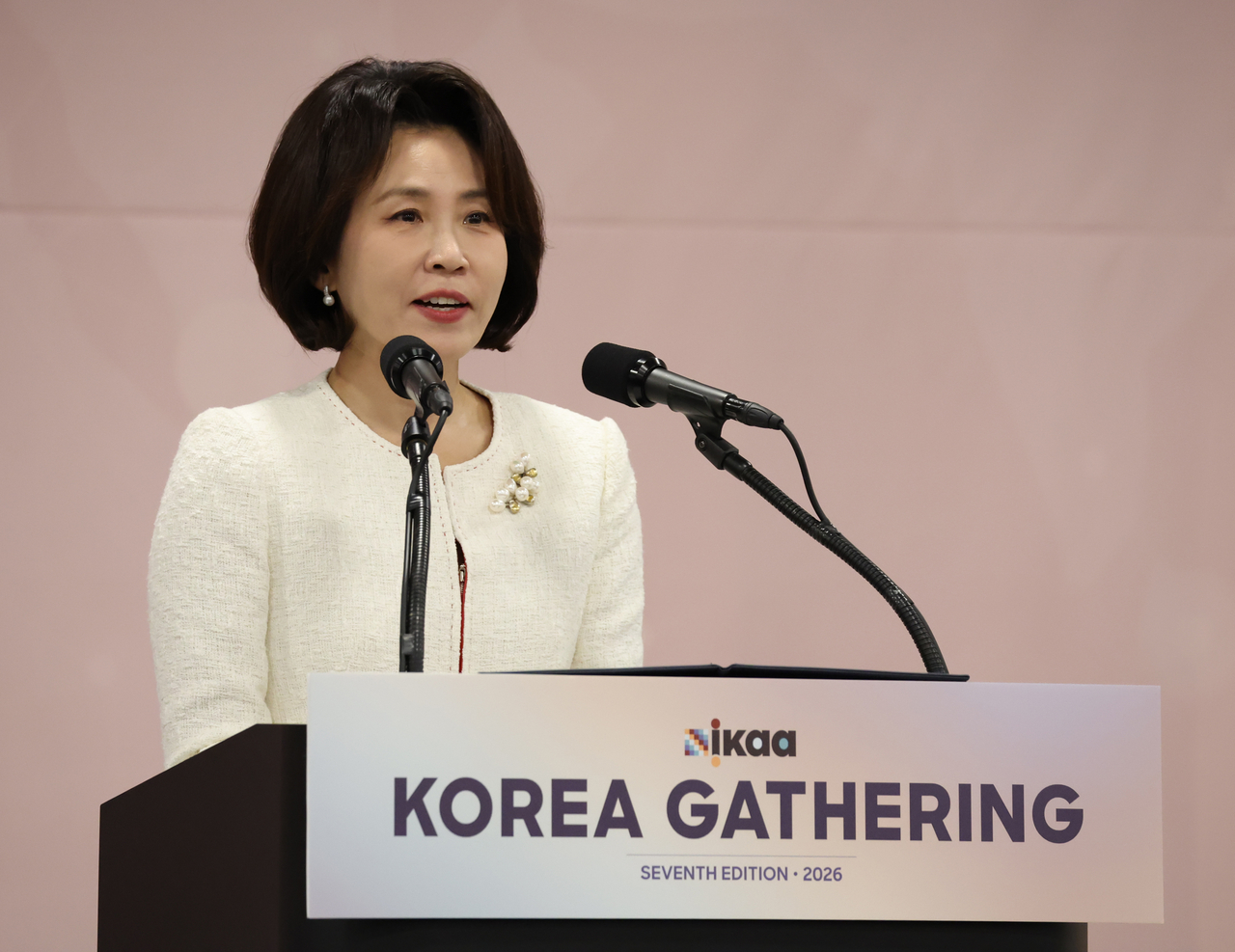
![SK Telecom CEO Jeong Jae-heon announces the company's AI data center investment plan at a national briefing on advanced industry development strategies for the Yeongnam region, held at Gyeongsang National University in Jinju, South Gyeongsang Province, on Friday. [SK Telecom]](https://wimg.heraldcorp.com/news/cms/2026/07/04/news-p.v1.20260704.9acb6a08377d4373b2025c95325a78b4_P1.jpg)
SK Telecom is embarking on what it calls a landmark undertaking: building an AI data center network with a total capacity of 15 gigawatts.
The project is expected to require about 1,000 trillion won ($643 billion) in total investment — making it the largest infrastructure project in South Korean history, surpassing even the Gyeongbu Expressway and the nationwide broadband rollout. Through the initiative, SK Telecom aims to establish itself as Asia's central AI infrastructure hub.
SK Telecom announced Friday it is pursuing AI data centers with a combined capacity of up to 15GW, citing surging demand for AI model training and inference and the growing role of high-performance computing in determining national competitiveness. The company said it intends to build out domestic AI computing capacity ahead of the curve.
![SK Telecom CEO Jeong Jae-heon announces the company's AI data center investment plan at a national briefing on advanced industry development strategies for the Yeongnam region, held at Gyeongsang National University in Jinju, South Gyeongsang Province, on Friday. [SK Telecom]](https://wimg.heraldcorp.com/news/cms/2026/07/04/news-p.v1.20260704.8b2152ea2b9542808422fe452cb45a08_P1.jpg)
SK Telecom's decision to pursue what it describes as the third-largest infrastructure project in Korean history stems from a rapid rise in global AI data center demand. The company aims to get ahead of that trend, using it as a new growth engine for a South Korean economy stuck in a low-growth phase, while developing AI data centers into a long-term national strategic asset.
According to McKinsey & Company, global data center demand is growing 19 to 22 percent annually, yet supply is struggling to keep pace. A shortfall of roughly 15GW is projected in the United States alone by 2030. Industry analysts say Amazon's announcement this year of a capital expenditure plan of around $200 billion reflects the same dynamic.
South Korea's emergence as a prime destination for AI data center investment adds to the favorable conditions. The country holds a competitive edge in key AI components such as high-bandwidth memory chips. It also offers stable power supply — drawing on nuclear and liquefied natural gas sources — and has demonstrated the capacity to operate gigawatt-scale infrastructure through its semiconductor fabrication facilities.
The project cost, which could reach up to 1,000 trillion won, will be funded through a combination of SK Telecom's own investment, contributions from strategic partners, long-term contracts with anchor customers who commit to large shares of data center capacity, and project financing. Building a single 1GW AI data center can cost up to 70 trillion won, so SK Telecom plans to develop the facilities in stages to minimize upfront capital burden and project risk.
The rollout begins with the company's first AI data center, under construction in Ulsan, which will anchor a cluster of more than 2GW across the broader Yeongnam region. An additional 1GW facility is planned for the southwestern part of the country, bringing total domestic capacity to 5GW, with phased openings starting in 2029. SK Telecom plans to continue expanding incrementally, reaching a total of 15GW by 2035.
![SK Telecom President Jeong Jae-heon presents the company's investment plan at a national briefing on the development blueprint for advanced industries in the Yeongnam region, held in South Gyeongsang Province on Friday. [Cheong Wa Dae press pool]](https://wimg.heraldcorp.com/news/cms/2026/07/04/news-p.v1.20260704.91131a2505744c0eb7b87ee39792f039_P1.jpg)
The data center buildout will draw on SK Group's full-stack AI capabilities — spanning semiconductors, energy solutions, and data center construction and operations. SK Telecom will serve as lead architect, overseeing the design, construction and management of the AI infrastructure.
SK Telecom has already been working with Nvidia and Amazon Web Services on its AI data center business. In Ulsan, it is currently building a hyperscale AI data center with AWS, targeting operation in the second half of next year. The facility will incorporate cooling and power systems specifically designed for AI data centers.
At the "SK AI Summit 2025" in November last year, SK Telecom CEO Jeong Jae-heon unveiled a roadmap for AI infrastructure development. He also outlined a longer-term vision to expand the Ulsan AI data center to more than 1GW through deeper partnerships with global technology companies.
More recently, SK Telecom announced plans with Nvidia to operate what the industry calls an "AI factory" — a next-generation AI data center concept. SK Telecom plans to begin running the AI factory next year and scale it to gigawatt-level capacity over time.
"This AI data center project is about proactively preparing the computing infrastructure that the global AI ecosystem will need," Jeong said. "We will work closely with the government, industry and local communities to help South Korea grow into Asia's core AI infrastructure hub."
ko@heraldcorp.com