![Unpaid overtime [Created using ChatGPT]](https://wimg.heraldcorp.com/news/cms/2026/07/05/news-p.v1.20260225.1be8c990d16d4230bdbac5849c61912b_P1.png)
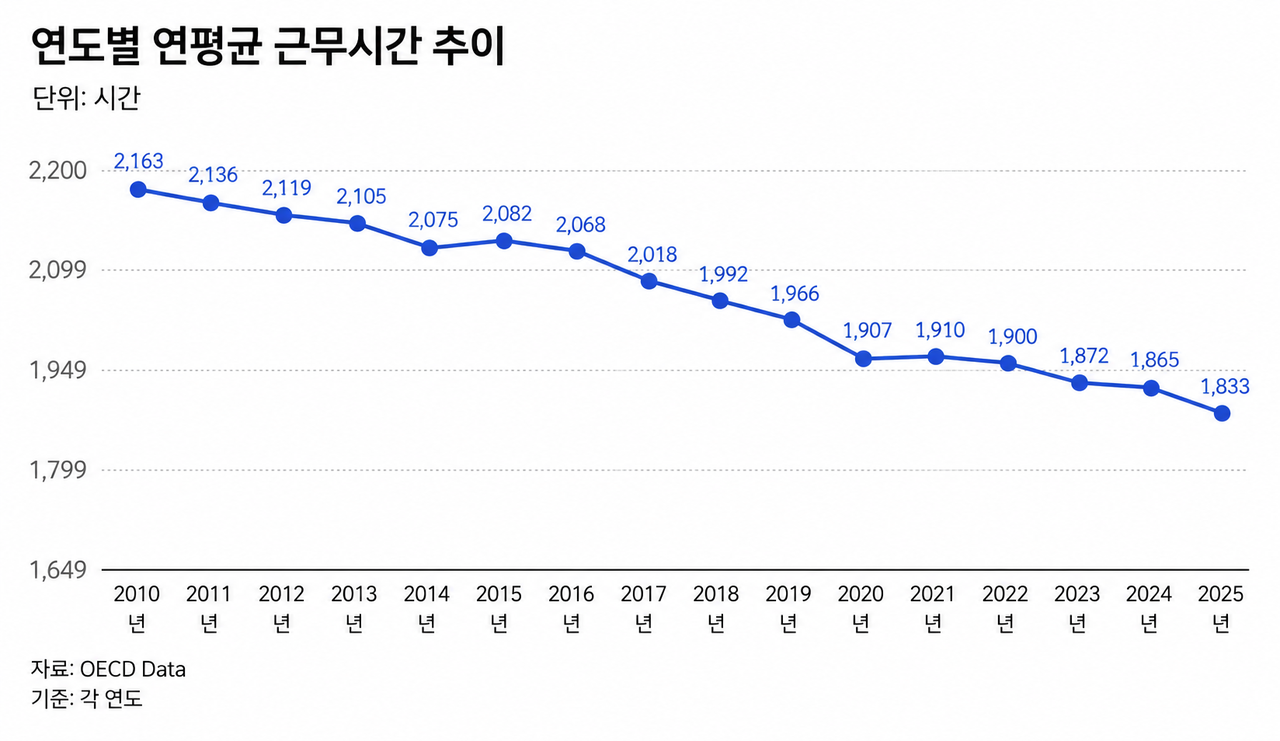
South Korean workers averaged 1,833 hours on the job last year, down 32 hours from the year before, according to OECD data. Working hours have been consistently declining, yet South Korea still ranks sixth longest among OECD member states — prompting calls for further policy reform if the government is to meet its goal of bringing actual working hours into the 1,700s by 2030.
According to OECD data, South Korea's 2025 annual average was 1,833 hours, down from 1,865 hours in 2024. The long-term trend has been downward: hours stood at 2,163 in 2010 and fell to 2,082 by 2015. When the 52-hour workweek cap took effect in 2018, annual hours dipped below 2,000 for the first time, reaching 1,992. The decline continued through 1,900 hours in 2022, 1,872 in 2023 and 1,865 in 2024, before falling to 1,833 last year.
Analysts attribute the decline to the entrenchment of the five-day workweek, enforcement of the 52-hour cap, the conversion of public holidays into paid leave and the expansion of substitute holidays.
South Korea nonetheless remains a long-hours country by international standards. The OECD average across 36 member states last year was 1,736 hours, meaning South Korean workers put in 97 more hours than the average. Only five countries logged longer hours: Mexico (2,205), Costa Rica (2,183), Chile (1,912), Greece (1,874) and Israel (1,870).
By contrast, South Koreans worked 33 more hours than Americans (1,800), 200 more than Australians (1,633), 235 more than Japanese (1,598), 300 more than British workers (1,533) and 335 more than the French (1,498). Compared with Germany, which recorded the shortest hours in the OECD at 1,332, South Koreans worked 501 additional hours a year — the equivalent of roughly 63 extra eight-hour workdays.
The government is pursuing a roadmap to cut actual working hours to the 1,700s — in line with the OECD average — by 2030. Measures include introducing a four-and-a-half-day workweek, issuing guidelines to curb the misuse of lump-sum wage arrangements, amending the Labor Standards Act and establishing a legal basis for supporting companies that reduce working hours.
Experts say achieving further reductions will require structural reform that diversifies how working hours are organized, not just incremental rule changes.
A final report from a working-hours reform forum — commissioned by the Ministry of Employment and Labor and conducted by the Korean Academy of Human Resources Management — identified the country's "uniform, full-time-centered working-hours structure" as a root cause of long working hours.
The report found that 53.1 percent of South Korean workers are on a 40-hour week, compared with 30.9 percent in Germany, 12.5 percent in France and 15.9 percent in the United Kingdom. The academy recommended that the government "consider expanding workers' choice over working-hour arrangements and diversifying the units by which working hours are calculated" as steps toward further reductions.
fact0514@heraldcorp.com