
Gap between regular and non-regular workers narrows 76.1% when insurance, wages and health are factored in; one in five eligible non-regular workers spent five or more years without coverage

Non-regular workers enrolled in employment insurance report higher life satisfaction than those without coverage, according to new research. When employment insurance enrollment, wages and health status were factored into the analysis, the life satisfaction gap between regular and non-regular workers shrank by 76.1%. Some analysts say improving social insurance protection and economic conditions alongside employment type is a key challenge in raising workers' quality of life.
Jo Gwang-rae, a researcher at the Seoul Welfare Foundation, analyzed 134,971 observations from 19,445 wage workers using Korea Labor and Income Panel Study data spanning 1999 to 2025. The results were presented at the 2026 Korea Labor and Income Panel Study academic conference on Sept. 18.
The study classified permanent workers as regular employees and temporary or daily workers as non-regular employees, then divided them into four groups based on employment insurance enrollment status and compared their life satisfaction scores.
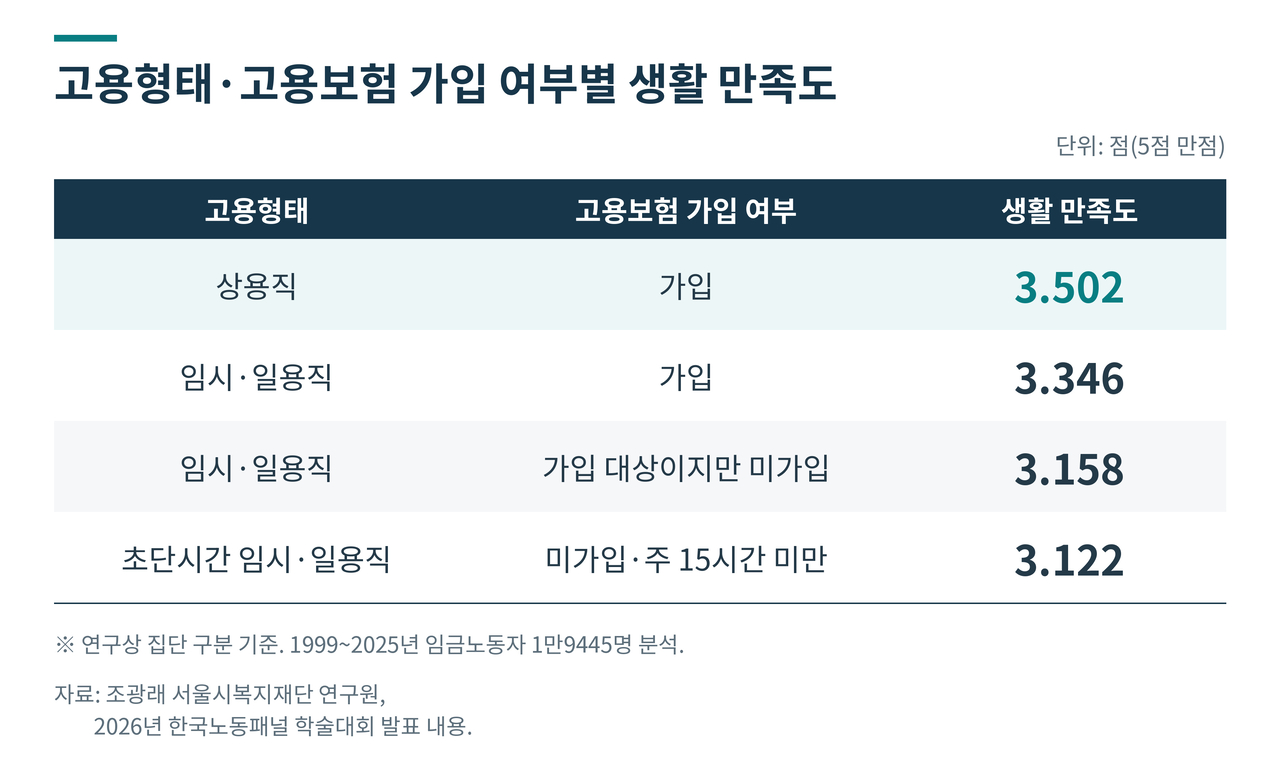
On a five-point scale, permanent workers enrolled in employment insurance scored the highest average life satisfaction at 3.502. Differences were also clear within the temporary and daily worker category. Those enrolled in employment insurance scored 3.346, while workers who were legally required to enroll but had not done so scored only 3.158. Workers classified in the study as working fewer than 15 scheduled hours per week — and therefore not enrolled — scored the lowest at 3.122.
Regression analysis confirmed the explanatory power of employment insurance enrollment, wages and health status. In the baseline model comparing regular and non-regular workers, non-regular workers scored 0.273 points lower in life satisfaction. Adding employment insurance enrollment to the model reduced the gap by about 39 percent, to 0.166 points.
When wages and health status were also taken into account, the gap narrowed further to 0.065 points — a 76.1 percent reduction from the original difference. The three factors together account for a substantial share of the life satisfaction gap between regular and non-regular workers.
Jo said that understanding the lower quality of life among non-regular workers requires examining not just the type of contract but also the institutional and economic conditions attached to it. He argued that policy should be designed to ensure non-regular workers can access social insurance protection even without converting to regular employment status.
The study also revealed persistent gaps in employment insurance coverage. During the analysis period, 7,926 workers had at least one spell as a temporary or daily worker who was legally required to enroll in employment insurance but did not. Their average longest consecutive period without coverage was 3.2 years.
Of those, 1,693 — or 21.4 percent — went without coverage for five or more consecutive years, meaning roughly one in five workers who should have been enrolled spent more than five years outside the system's protection.
Jo identified very-short-hour workers and temporary or daily workers in small workplaces or with contract arrangements that make premium payments difficult as the primary groups falling through the cracks. He recommended prioritizing an expansion of social protection for non-regular workers, saying such measures could deliver more direct and immediate improvements to quality of life, and called for a system redesign that brings these groups within the coverage framework.
The government is also pursuing a reform to shift employment insurance enrollment criteria from working hours to income. Amendments to the Employment Insurance Act and related laws this year established the legal foundation, and follow-up steps including revisions to subordinate regulations are under way.
fact0514@heraldcorp.com





