As high prices and sluggish consumer spending drag on, support for small-business owners is shifting rapidly from reactive assistance to proactive prevention. Rather than waiting for struggling owners to apply for help, a new policy model is taking hold — one that uses data analysis to detect early warning signs and deliver tailored support before a crisis deepens.
The Seoul Credit Guarantee Foundation said it is advancing a data-driven support system that combines information held by borough governments and private institutions to revitalize small businesses and neighborhood commercial districts.
The foundation links its roughly 20,000 monthly small-business counseling records with public MyData, borough-level datasets, and private data from financial and telecommunications companies to identify at-risk owners early. It is also expanding its role as a data-based policy platform by analyzing commercial-district shifts across Seoul and helping borough governments verify the effectiveness of their policies.
Proactive outreach lifts sales by up to 11.4 percentage points
The Seoul Credit Guarantee Foundation is moving beyond blanket financial assistance and strengthening big-data-driven, personalized support.
A flagship example is its early-detection and proactive-support project for at-risk small businesses, in operation since 2023. Using a proprietary "business-crisis alarm model," the foundation identifies owners showing simultaneous declines in sales and deteriorating financial health, then connects them with management diagnostics and loan restructuring.
More than 5,400 businesses have received support through the project over the past three years.
An analysis of businesses assisted last year found their closure rate was 2.1 percentage points lower than that of comparable businesses. Sales one year after receiving support rose by up to 11.4 percentage points depending on how long the business had been operating — evidence that data-driven early intervention translates into real operational recovery.
Data analysis narrows policy blind spots
Data analysis findings have also been applied directly to the Seoul Metropolitan Government's "Ansim Tongjang," the foundation's flagship guarantee product.
An analysis of debt growth rates by age group and business tenure found that entrepreneurs in their 30s had the highest rate of multiple-debt accumulation at 17.5 percent. The foundation then eased its guarantee screening criteria for business owners under 40.
The foundation uses diverse datasets to identify those most in need of support and reduce blind spots in its policy coverage.
Financial and telecom data sharpen commercial-district analysis
To improve analytical accuracy, the foundation is also expanding data partnerships with private institutions.
Financial, consumer and foot-traffic data held by NongHyup Bank, KB Kookmin Bank, KB Kookmin Card and SK Telecom are combined with the foundation's own counseling records and public MyData to produce more precise analysis of commercial-district trends.
Card data track the scale of consumer spending and sales changes by sector; telecom data map foot-traffic flows; and banking data shed light on business owners' cash positions and debt burdens.
The foundation plans to use these combined datasets to flag areas where falling consumer spending, shrinking foot traffic and rising financial pressure converge — identifying distressed commercial districts early and rolling out tailored financial products and specialized support policies in response.
Borough partnerships verify impact of locally tailored policies
The Seoul Credit Guarantee Foundation has signed MOUs with 14 of Seoul's borough governments and is jointly conducting big-data-based commercial-district analysis and policy research with them.
Under the arrangement, a borough identifies a local issue, the foundation analyzes relevant commercial-district data, and the borough uses the findings to shape policy and verify its effectiveness.
Dongjak-gu partnered with the foundation to assess the impact of a new public parking lot near Sadang Station. The analysis found that after the lot opened, the number of nearby businesses rose 5 percent, closures fell 31.3 percent, and both foot traffic and sales increased.
With Yeongdeungpo-gu, the foundation analyzed how a youth housing supply project in Dangsan-dong affected the surrounding commercial district. Sales in the area rose 10.1 percent and the number of businesses grew 2.2 percent after the housing opened, confirming that an influx of young residents had a positive effect on the local economy.
A separate analysis of the effects of designating the Saetgang-duri area as a neighborhood shopping street found that the district's commercial scale and sales grew even amid an economic slowdown, and that consumer inflows from people in their 40s and 50s expanded — providing data-backed evidence for the neighborhood shopping-street policy pursued by the Seoul Metropolitan Government and borough governments.
AI-powered commercial-district analysis services to be upgraded
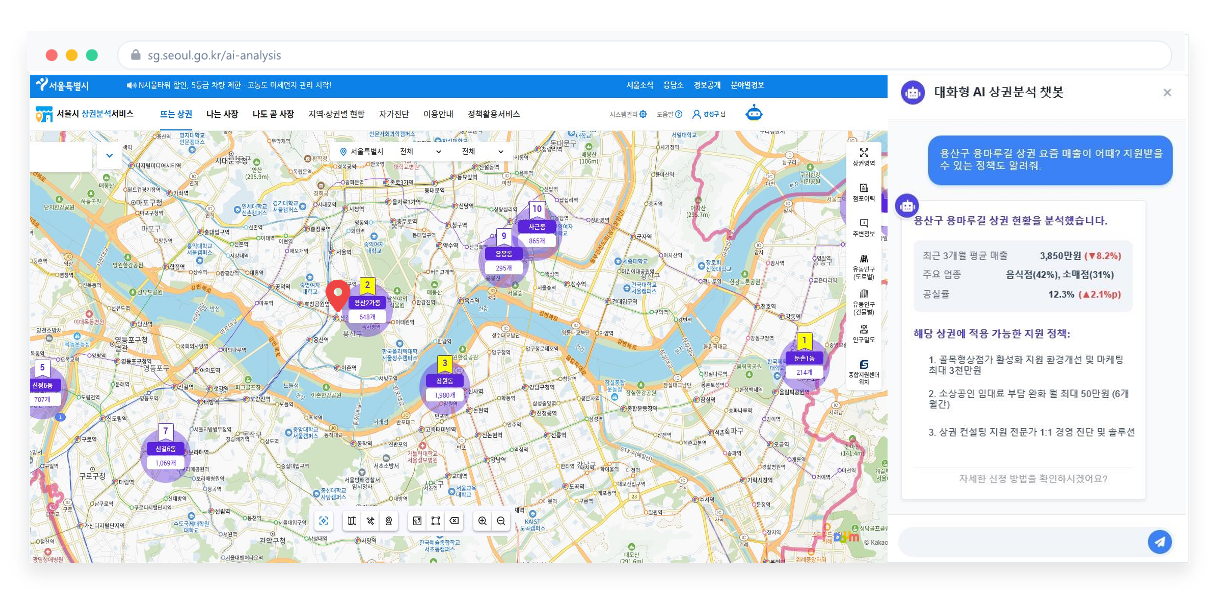
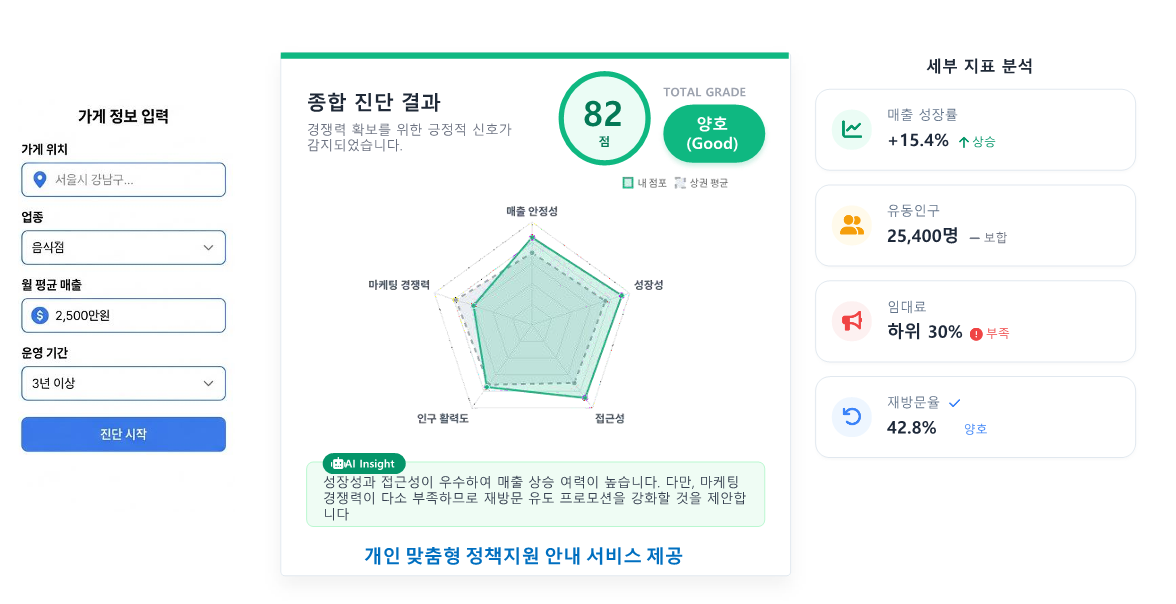
The foundation plans to expand AI-based commercial-district analysis services so that residents and small-business owners can make better use of data.
Prospective entrepreneurs will be able to check AI-projected sales and foot-traffic trends to assess a district's growth potential and closure risk before opening. Existing small-business owners will be able to analyze their own operational health through an AI self-diagnostic tool and receive recommendations for tailored support programs.
The foundation also plans to upgrade a conversational AI chatbot to give users faster, easier access to commercial-district information and available support programs.
"Data has become more than a simple analytical tool — it is now the starting point for policies that detect a small business's crisis early and respond at the right moment," a foundation official said. "We will continue to expand field-centered support that uses data and AI to breathe life back into neighborhood commercial districts."
seouldream01@heraldcorp.com