![Deputy Prime Minister and Minister of Finance and Economy Koo Yun-cheol visits the foreign exchange dealing room at Hana Bank's headquarters in Jung-gu, Seoul, on Monday to mark the launch of the 24-hour forex market, and poses for a photo with attendees. From left: Moon Ji-seong, international economic affairs assistant minister at the Ministry of Finance and Economy; Kwon Min-su, deputy governor of the Bank of Korea; Koo Yun-cheol, deputy prime minister; Ham Young-joo, chairman of Hana Financial Group; and Lee Ho-seong, president of Hana Bank. [Ministry of Finance and Economy]](https://wimg.heraldcorp.com/news/cms/2026/07/06/news-p.v1.20260706.3b2412274fae406b8815e1b9045f22dc_P1.jpg)
South Korea has expanded its foreign exchange market to a full 24-hour, five-day-a-week operation, accelerating efforts to internationalize the won. The government aims to boost the competitiveness of its capital markets and improve market accessibility by making trading more convenient for foreign investors.
Deputy Prime Minister and Minister of Finance and Economy Koo Yun-cheol visited the foreign exchange dealing room at Hana Bank's headquarters in Jung-gu, Seoul, on Monday morning — the first day of the 24-hour market — to inspect operations and meet with market participants. Also present were Moon Ji-seong, international economic affairs assistant minister at the Ministry of Finance and Economy; Kwon Min-su, deputy governor of the Bank of Korea; Ham Young-joo, chairman of Hana Financial Group; and Lee Ho-seong, president of Hana Bank.
"The launch of a 24-hour forex market is not simply an extension of trading hours — it is core infrastructure for achieving the level of accessibility and convenience found in advanced markets," Koo said. "It will serve as the starting point for the won's leap onto the global stage." He added that allowing domestic and foreign investors and import-export companies to trade foreign exchange without time constraints would enhance the appeal of both South Korea's capital markets and the won.
Trading hours in the foreign exchange market have been expanded in stages over the years.
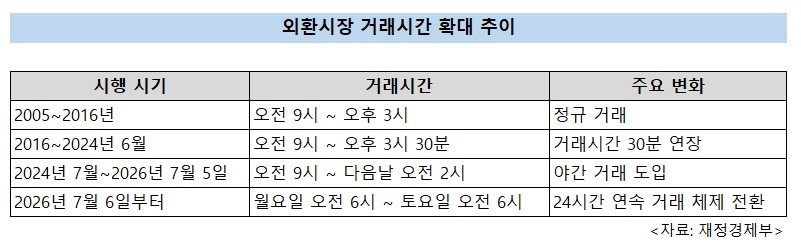
From 2005 to 2016, the market operated from 9 a.m. to 3 p.m., before being extended by 30 minutes to 3:30 p.m. in 2016. From July 2024, overnight trading became available until 2 a.m. the following day. As of Monday, the market shifted to continuous 24-hour operation running from 6 a.m. Monday through 6 a.m. Saturday. During the US winter time period, the market will open and close at 7 a.m. instead.
The government described the move as a reform to raise the international competitiveness of South Korea's foreign exchange market, building on solid external soundness, a record-high current account surplus and the country's inclusion in the World Government Bond Index. It also expects import-export companies to respond to exchange rate fluctuations in real time, while domestic financial firms and brokers expand their global operations.
"We expect the 24-hour opening to broaden and deepen our foreign exchange market," said Kwon Min-su, deputy governor of the Bank of Korea. "We will closely monitor market conditions and trading trends, and continue working with the government on necessary policy efforts." Representatives from banks and export companies at the event also said they would adapt quickly to the new trading environment and make active use of the upgraded forex infrastructure.
The government also expects the reform to help lay the groundwork for South Korea's stock market to be included in the MSCI developed-market index.
Earlier, MSCI did not place South Korea back on its watchlist for developed-market reclassification in its annual market classification review in June. At the time, MSCI noted that the won "cannot be physically delivered offshore" — meaning the currency cannot be exchanged and settled in international foreign exchange markets outside South Korea.
In response, the government plans to operate a round-the-clock monitoring system to ensure the new forex regime takes hold smoothly, while launching an offshore won settlement system in January 2027 to build infrastructure enabling 24-hour settlement as well. Through these measures, it aims to improve foreign investor access to the market and expand the international use of the won.
fact0514@heraldcorp.com