![The domestically built submarine ROKS Dosan Ahn Chang-ho (SS-III, 3,000-ton class) enters CFB Esquimalt in Victoria, Canada, on May 24 (local time) to participate in a South Korea-Canada joint naval cooperation exercise. [Yonhap]](https://wimg.heraldcorp.com/news/cms/2026/07/06/news-p.v1.20260528.25d64a4ca0b6460e8b68b5aff4f58502_P1.jpg)
Canada is set to announce the preferred bidder for its next-generation submarine program — a contract worth up to 60 trillion won ($38.6 billion) — as South Korea's Hanwha Ocean and Germany's ThyssenKrupp Marine Systems (TKMS) make their final push. The Canadian Patrol Submarine Project (CPSP) calls for 12 diesel-electric submarines to replace Canada's aging fleet, with the total figure encompassing both construction costs and long-term maintenance, repair and operations.
Announcement expected Tuesday dawn Korea time — race too close to call
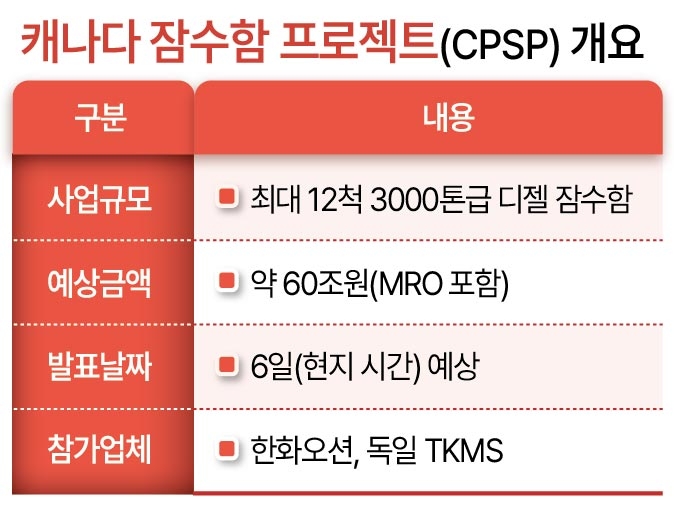
According to foreign media and industry sources, Canada plans to announce the preferred bidder on Monday (local time), just before Prime Minister Mark Carney departs for the NATO summit — which would make it Tuesday dawn in Korean Standard Time. The result had originally been expected by late June, but fierce lobbying from both sides appears to have prolonged Ottawa's deliberations.
Hanwha Ocean has proposed its 3,600-ton Jang Yeong-sil-class (KSS-III Batch II) submarine — an upgraded variant of the Dosan Ahn Chang-ho class (KSS-III Batch I) — while TKMS is offering its 2,800-ton Type 212CD, currently under co-development with Norway. The Korean model has already completed sea trials; the German model has yet to enter operational service.
Given the contract's record scale, Canada has made "industrial and technological benefits" — the local economic impact tied to the award — a central evaluation criterion. Hanwha Ocean has pledged economic opportunities worth about 70 billion Canadian dollars, roughly 500,000 jobs and a contribution of about 100 billion Canadian dollars to Canada's GDP by 2044. Hanwha Group has also secured partnerships with more than 80 Canadian companies and institutions, offering a broad industrial cooperation package. TKMS, for its part, is reported to have countered with promises of 650,000 jobs and 86 billion Canadian dollars in GDP gains.
Early market sentiment had favored Germany, a traditional submarine-building powerhouse and a NATO ally of Canada. But "Team Korea" — led by Hanwha and backed by corporate executives and government officials who have personally hit the pavement in Canada — has mounted an aggressive campaign, deepening local partnerships and making the outcome far harder to predict.
Seoul cautious at '50-50'; a win would set a national defense-export record
The South Korean government is taking a measured stance, putting the odds at even. Presidential Chief of Staff Kang Hoon-sik said July 1 that the situation was "roughly 50-50," adding that "Canada and South Korea have a completely symmetrical structure, so there is a great deal of room for both sides to win." He acknowledged, however, that "Germany is a leading submarine technology nation and, above all, has the advantage of being a core NATO member — Canada will be weighing that."
Berlin, by contrast, is projecting confidence, leaning on its NATO ties. German Deputy Chancellor and Finance Minister Lars Klingbeil visited TKMS facilities on Thursday (local time) and said the entire German federal government was running "an all-out campaign" to secure the defense cooperation deal with Canada, calling the outlook "very favorable to us on several fronts." TKMS CEO Oliver Burkhardt also said he was confident the company would win the contract, citing interoperability among NATO allies' naval forces as a key selling point.
Should South Korea break through the NATO barrier and pull off an upset, the implications would be far-reaching. It would vault the country into the ranks of the world's largest submarine exporters and open the door to supplying a major strategic asset to a Five Eyes intelligence-sharing nation and a G7 member. It would also stand as the single largest defense export in South Korean history.
Several late-breaking variables could still tip the scales. Some observers have pointed to a recent hacking incident at a TKMS subsidiary as a potential liability for the German bidder. On the Korean side, signals that Seoul may join the Canada-led Defence and Security Resilience Bank (DSRB) have been read as a positive sign, since Korean participation would give Ottawa a rationale for awarding the contract to a non-NATO partner — framing it as a contribution to NATO's defense buildup. Isabelle Hudon, CEO of the Business Development Bank of Canada, told Reuters on July 2 that the DSRB had held "productive discussions" with South Korea, putting the odds of Korean membership at 50-50 and leaving open the possibility of a later accession.
keg@heraldcorp.com
yeongdai@heraldcorp.com