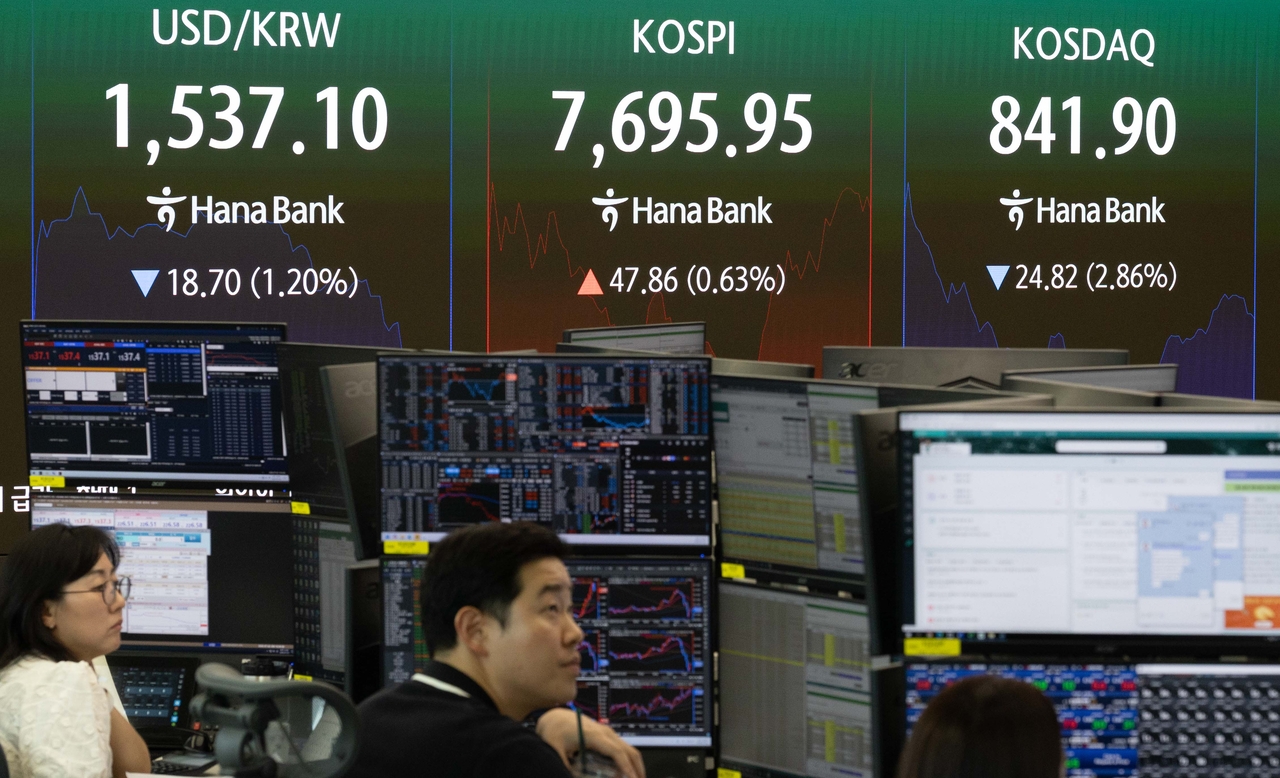
The Democratic Party of Korea is moving to establish a legal basis that would allow the National Pension Service to temporarily suspend asset sales or adjust its domestic equity target weighting, amid growing fears that the fund's resumption of portfolio rebalancing could trigger a sell-off worth tens of trillions of won on the local stock market. The move has raised hopes that codifying clearer rebalancing rules could ease market anxiety.
Democratic Party lawmaker Park Sun-won plans to introduce a partial amendment to the National Pension Act in the near future, according to political sources Sunday.
The core of the bill would allow the target weighting for each asset class under the existing fund management plan to be adjusted — or asset purchases and sales temporarily suspended — when conditions prescribed by presidential decree are met, such as sharp swings in financial or foreign exchange markets. Any such adjustment would require deliberation by the National Pension Fund Management Committee and could only be made within limits that do not undermine the fund's long-term stability and returns.
Under the bill, the health and welfare minister would be required to report to the relevant standing committee of the National Assembly without delay whenever a target weighting adjustment or temporary suspension is implemented.
Market participants have been warning that the fund management plan will need to be revised, as Kospi has surged from around the 4,000 level at the start of the year to above 9,000. The National Pension Service sets a medium-term asset allocation plan on a five-year cycle, which is then reflected in annual fund management plans that determine investment levels across asset classes including domestic and overseas equities and bonds.
This year, even as the domestic equity weighting climbed well above its target, the fund suspended rebalancing and adjusted the target rather than selling — before recently resuming rebalancing.
The domestic equity target weighting under the fund management plan stood at 14.9 percent at the start of this year, but sales did not take place even after that threshold was breached. In May, the medium-term asset allocation plan was revised to raise the domestic equity target sharply to 20.8 percent through 2027. As of the end of April, the fund's domestic equity holdings were estimated at 25.1 percent.
The fund can hold domestic equities at up to 28.8 percent when combining its strategic asset allocation range and tactical asset allocation range. The strategic range allows for deviations caused by market price movements, while the tactical range gives fund managers discretion to adjust weightings. If the fund exceeds both ranges, it must sell mechanically.
Even with those measures in place, the fund's domestic equity weighting is still estimated to exceed its target, keeping market anxiety over rebalancing elevated. The fear is that if the National Pension Service sells a substantial volume of domestic shares in a short period to meet its target, it could trigger a sharp drop in Kospi and broader market turmoil.
The government has moved to dismiss talk of a rebalancing "sell-off bomb." Kim Sung-joo, chairman of the National Pension Service, wrote on his Facebook page Wednesday that "the probability of rebalancing becoming a 'bomb' is zero" and that "rebalancing cannot involve large-scale selling over a short period." Health and Welfare Minister Jeong Eun-kyung said the same day that the government would "closely monitor the operational process to minimize market impact even if rebalancing occurs going forward."
However, some argue it is "not appropriate even from a fund management standpoint" for the National Pension Service to rebalance mechanically according to its fund management plan at a time when domestic equities are highly profitable. Questions have also been raised about past target weighting adjustments and rebalancing suspensions being carried out solely at the fund management committee's own discretion, without any legal basis.
Under the current National Pension Act, the fund management plan must go through deliberation by the fund management committee and the Cabinet before receiving presidential approval, and is reported to the National Assembly once a year by October. Critics note that even when the committee responded to sharp market swings, rebalancing proceeded without any separate oversight mechanism.
Park said the bill aims to "clearly establish in law the necessary grounds for adjustment, premised on fund management committee deliberation and National Assembly reporting," adding that it would "reduce excessive concerns about mechanical rebalancing and protect the long-term returns and retirement security of the national pension."
addressh@heraldcorp.com