![A red traffic light glows near a Homeplus store in central Seoul. [Herald DB]](https://wimg.heraldcorp.com/news/cms/2026/07/06/news-p.v1.20260703.68bba7f4e92f446f912bf0c837bfdbec_P1.jpg)
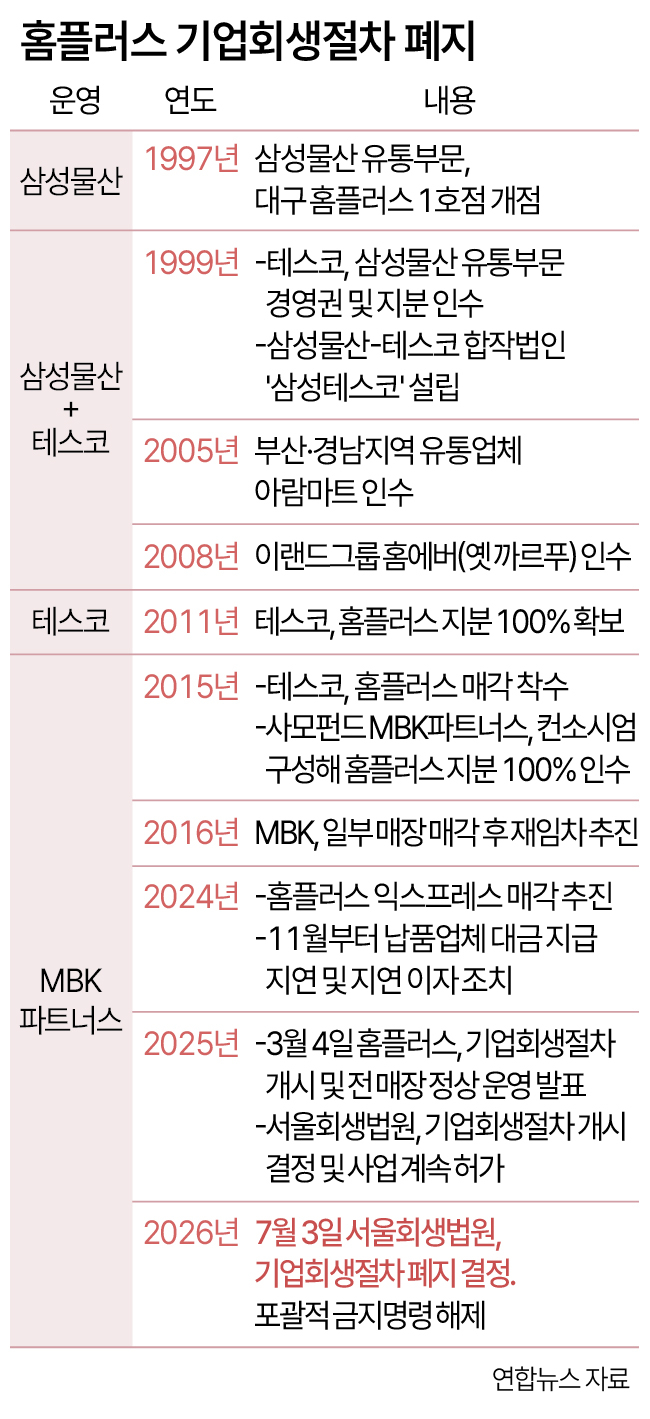
Homeplus has suspended its online customer service center, following an earlier halt to online delivery at all stores nationwide — effectively shutting down the online operations that had been a key revenue driver. With a court having ordered the termination of its rehabilitation proceedings and imposing a 14-day deadline, the prospect of bankruptcy is growing by the day.
According to industry sources Monday, Homeplus shut down its online customer service center on Saturday. The company announced on Friday — the same day Seoul Bankruptcy Court ordered the termination of its rehabilitation proceedings — that "due to internal operational issues, the online customer service center will cease operations as of July 4." The shutdown appears to be a direct consequence of the online delivery suspension, which eliminated the need for the center that had handled related customer complaints.
Homeplus had already halted its "Magic Delivery" online delivery service at all branches nationwide on Wednesday. The suspension is believed to stem from the company's failure to pay logistics providers and a drop in orders caused by dwindling product supply. Online delivery had accounted for more than 20 percent of total sales in the 2024-2025 fiscal year. Homeplus is now operating only a pickup service — where customers collect orders in person — and standard parcel delivery.
Industry insiders believe Homeplus is effectively moving toward bankruptcy. Store operations are expected to become even more difficult over the next two weeks. The company is already struggling to receive adequate supplies of fresh produce such as eggs and milk, along with many other items, making normal operations nearly impossible. Suppliers may grow increasingly reluctant to deliver goods given the uncertainty over whether they will be paid in the event of bankruptcy. Homeplus has been filling shelf space with its own private-label products, but customer foot traffic continues to decline.
Following the court's Friday ruling to terminate the rehabilitation proceedings, Homeplus or its creditors have until July 20 to file an immediate appeal. If no appeal is filed within that period, the termination order becomes final. Filing an immediate appeal would require raising 200 billion won — the operating funds needed to carry out the rehabilitation plan Homeplus submitted. The revised plan, submitted last month, included closing unprofitable stores, transferring business operations and pursuing mergers and acquisitions. The court cited the lack of feasibility in securing the funds needed to execute the plan as the reason for ordering the termination.
How that funding would be raised remains deeply uncertain. Meritz Financial Group has deposited 100 billion won in emergency debtor-in-possession financing into escrow, conditional on joint guarantees from MBK Partners and MBK Chairman Kim Byung-ju, but has maintained that MBK must provide the remaining 100 billion won.
MBK is demanding that Meritz cover the full 200 billion won. The private equity firm says it has agreed to provide a corporate-level joint guarantee for 100 billion won and argues it has already directly and indirectly shouldered hundreds of billions of won through Chairman Kim's personal contributions and credit support. MBK also disclosed that it had accepted Meritz's condition requiring joint guarantees from both the company and Kim. Meritz, however, says it has not received a clear commitment on Kim's personal guarantee.
Even if a funding deal is reached within two weeks, a return to normal operations remains far from certain. Empty shelves have spread across stores as suppliers hold back deliveries amid fears of non-payment, and the online delivery suspension has compounded the damage. Significant investment would be needed just to restore normal operations. Given the damage to Homeplus's brand image, a vicious cycle of declining customers and falling sales appears highly likely to continue. Homeplus's current liabilities — debts due within one year — stood at 4.29 trillion won as of the end of February.
If the company fails to secure funding, Homeplus will ultimately have no choice but to file for bankruptcy. The court would then declare Homeplus bankrupt and initiate liquidation proceedings to distribute its assets to creditors, with a court-appointed bankruptcy trustee overseeing the distribution. Homeplus's 62 self-owned store properties are held as trust collateral by Meritz, which is expected to dispose of those properties and recover its loan principal and interest in the event of bankruptcy.
If stores close, competitors such as E-mart or Lotte Mart could potentially acquire some of the locations. However, that prospect is considered unlikely, as the broader slump in the offline hypermarket sector offers little incentive for rivals to enter a bidding war. Analysts suggest the more probable outcome would be converting the store sites for mixed-use residential and commercial development, logistics centers or office space before selling them off.
A bankruptcy would inflict widespread harm — on employees, tenants, small and medium-sized enterprises owed unpaid supply payments, and investors in Homeplus's short-term commercial paper. As of last month, Homeplus had about 12,000 direct employees, and roughly 1,000 indirectly employed workers would also lose their jobs. The number of suppliers currently delivering goods to Homeplus stands at 4,600. Including tenants and related businesses, analysts estimate that up to 100,000 people could see their livelihoods affected.
Homeplus has already decided to permanently close 37 large-format stores nationwide that have been temporarily shut since May. About 3,500 workers are employed at those stores. The company has also withdrawn a voluntary retirement program it had planned for employees at the managerial level and above at the closing locations.
The average unpaid supply balance owed to each of the 150 small and medium-sized suppliers and small business owners still awaiting payment is 774 million won. General trade receivables rank as subordinate claims, and Homeplus's cash and cash equivalents stood at just 10.4 billion won as of the end of February. Investors in the company's short-term commercial paper face losses of 401.9 billion won that will be difficult to recover.
The hypermarket workers' union urged the government to act, calling the situation "not simply a problem for one company, but a social disaster that would destroy the jobs of hundreds of thousands of people and devastate local economies." The union demanded that the government "prepare a plan to rehabilitate Homeplus within 14 days through all possible emergency measures, including the injection of public funds."
![A Homeplus store in central Seoul before opening on Friday. [Herald DB]](https://wimg.heraldcorp.com/news/cms/2026/07/06/news-p.v1.20260703.f0fd4773835b451d969a1fd4c8a91e0e_P1.jpg)
korean@heraldcorp.com
spa@heraldcorp.com