South Korea's local education finance grant system automatically channels 20.79% of all domestic tax revenue to the country's 17 metropolitan and provincial education offices. With a semiconductor boom expected to lift corporate tax receipts, a significant share of that windfall would flow to education budgets before it could be directed elsewhere — and that is precisely why fiscal authorities are now pushing to overhaul the formula.
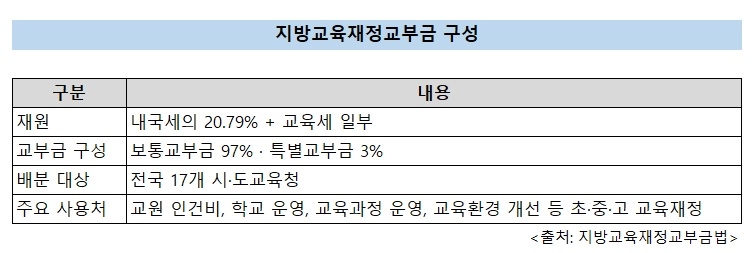
According to fiscal authorities Monday, the local education finance grant draws on 20.79% of domestic tax revenue plus a portion of the education tax, and is split into a general grant (97%) and a special grant (3%) distributed across all 17 education offices nationwide. The general grant covers recurring costs such as teacher salaries and school operating expenses, while the special grant addresses exceptional needs including natural disasters and national policy initiatives.
The government's attention has turned to the recent recovery in the semiconductor sector. Improving conditions driven by demand for HBM chips used in AI servers are expected to push corporate tax revenue higher. NABO, the National Assembly Budget Office, has also projected that corporate tax receipts this year will rise sharply from last year's levels.
Under the current system, however, a large portion of any tax revenue increase is automatically routed to education grants. For every 10 trillion won ($6.49 billion) increase in domestic tax revenue, the education grant rises by roughly 2.08 trillion won. In effect, tax gains generated by the semiconductor industry end up in education budgets ahead of investments in AI data centers or semiconductor mega-clusters.
The government is pursuing large-scale spending programs aimed at securing future growth engines — including AI data center construction, semiconductor mega-cluster development, support for advanced strategic industries, research and development, and measures to address the low birth rate. Fiscal authorities believe the grant distribution formula needs to be made more flexible so that additional tax revenue from the semiconductor boom can be directed first toward these national strategic priorities.
The presidential office shares that concern. Chief of Staff Kang Hoon-sik said at a senior ruling party-government consultative meeting Sunday that additional tax revenue generated by the semiconductor boom and other factors "must not be squandered," and announced plans to establish a new fund for future preparedness. The government envisions using the additional revenue to invest boldly in future growth engines — including three major mega-projects — as well as youth support programs.
A widening gap between a shrinking school-age population and rising education budgets is adding further momentum to the reform push. According to the Ministry of Education's basic education statistics, the number of elementary, middle and high school students fell from about 5.96 million in 2016 to about 4.922 million this year, a decline of about 1.04 million, or 17.4%. Over the same period, the local education finance grant grew from 43.16 trillion won to 76.44 trillion won — an increase of 33.28 trillion won, or 76.7%. Critics argue the current structure, which automatically expands education grants as tax revenue rises regardless of student enrollment, needs revision.
NABO projects that total transfers to local governments — including local shared taxes and local education finance grants — will rise from 139.7 trillion won in 2025 to 172.4 trillion won in 2029, an average annual increase of 5.4% that outpaces projected nominal GDP growth of 3.7%. The share of mandatory spending in total expenditure is also expected to climb from 53.5% to 56.1% over the same period, leaving the government with progressively less discretionary spending room to pursue its policy priorities.
Rather than cutting the total education grant, fiscal authorities are reviewing ways to adjust the calculation formula to reflect the declining school-age population and actual education demand. Options under discussion include incorporating school-age population figures into the distribution criteria, applying a standard education cost benchmark, and partially expanding the permitted uses of grant funds.
The education community is pushing back, arguing that stable funding must be maintained to meet growing new demands — including the expansion of after-school care programs, AI and digital education, special education, and education welfare.
The debate moves into the open this week. The two ministries plan to hold a public forum at the Government Seoul Complex on Wednesday on the theme of "the need to reform the education finance grant," where participants will discuss adjusting the statutory grant rate and expanding the permitted uses of grant funds. The forum is expected to serve as the first public airing of reform directions ahead of a national fiscal strategy conference scheduled for mid-month.
Lee Kang-goo, a senior research fellow in the fiscal and social policy research division at the Korea Development Institute (KDI), said most projects aimed at securing future growth engines — AI investment, R&D and social overhead capital — fall under discretionary spending. He warned that if mandatory spending keeps rising, it will ultimately reduce the resources available for future investment.
He added that the current education grant is designed primarily around primary and secondary education, but that fiscal resource management needs to be revisited to account for higher education, lifelong learning and AI vocational training as human capital investments — in line with the declining school-age population and broader demographic shifts.
fact0514@heraldcorp.com