
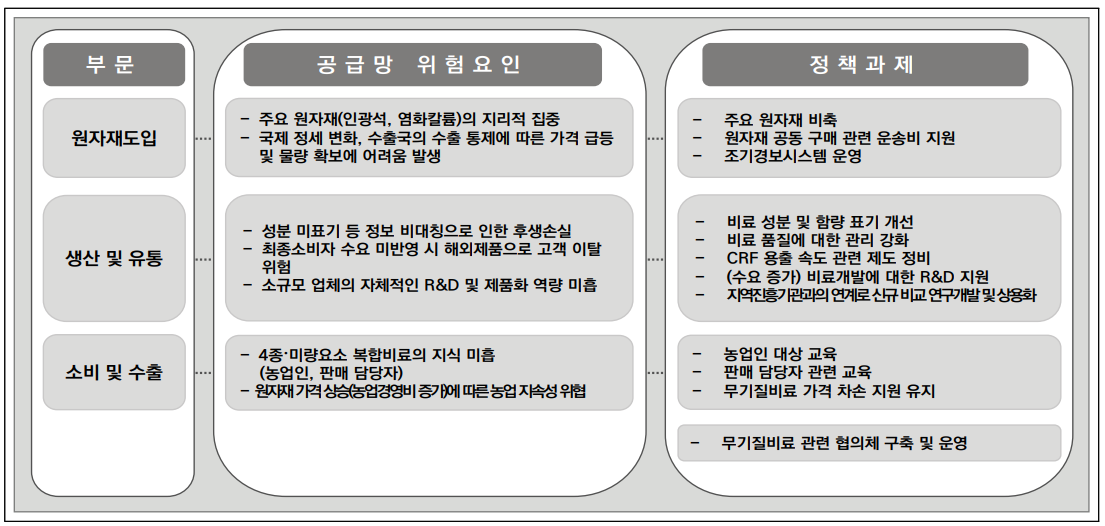
A state-run research institute is calling on South Korea to stockpile diammonium phosphate, diversify its import sources and build an early-warning system to reduce the country's dependence on China for fertilizer raw materials. With global supply chain instability capable of driving up not only fertilizer prices but also agricultural and dining-out costs, the institute said the government must move quickly to establish a national supply chain management framework.
The Korea Rural Economic Institute said Tuesday it had recently published a report titled "Tasks for Securing the Sustainability of the Mineral Fertilizer Industry." The report identified surging international raw material prices, export restrictions by major supplying countries and over-reliance on specific nations as the key threats to the sustainability of South Korea's mineral fertilizer sector.
Mineral fertilizers are essential agricultural inputs that supply crops with nitrogen, phosphorus and potassium. Among them, DAP — which delivers both nitrogen and phosphorus — is a core ingredient in compound fertilizer production, promoting early crop growth and root establishment. Disruptions to DAP supply can affect not only compound fertilizer production but also farmers' access to fertilizer more broadly.
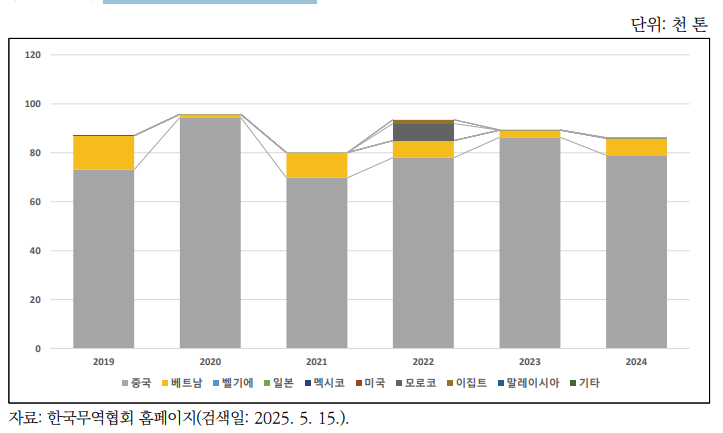
The core concern is that South Korea's dependence on a single supplier remains high. More than 80 percent of the country's DAP imports come from China, which has been restricting DAP exports since 2022 to stabilize its own domestic supply, raising persistent fears of shortages. The institute recommended including DAP in the national stockpile and diversifying import sources to include the Middle East and other regions. It also said South Korea should explore Laos as a new source for potassium chloride and Tunisia for phosphate rock.
Instability in the fertilizer raw material supply chain could also ripple through to agricultural prices, the institute said. An input-output analysis found that rising raw material prices increase production costs for vegetables, fruit and rice, spreading price pressure to processed grains, processed food products and restaurants. A decline in raw material imports was also found to reduce output across related industries.
"We need to build a fertilizer raw material early-warning system that continuously monitors the international situation, raw material prices and export regulations in major supplying countries, and operate it in tandem with stockpiling and import diversification," said Kim Jeong-seung, an associate research fellow at the institute.
The report also called for stronger labeling requirements for fertilizer components and content, improvements to the quality management framework, and expanded research and development support for controlled-release fertilizers and functional fertilizers. Controlled-release fertilizers are produced by coating fertilizer components or applying special processes so that nutrients are released gradually. Compared with conventional fertilizers, they reduce nutrient loss, cut the number of applications needed, lower labor costs and ease the environmental burden.
To ease the financial strain on farmers from sharp fertilizer price increases, the institute also proposed maintaining price-loss support and forming a supply chain consultative body that would bring together the government, producers, the National Agricultural Cooperative Federation and farmers.
adastra@heraldcorp.com





