Samsung Electronics set a new milestone in South Korean corporate history, posting an operating profit of nearly 90 trillion won ($58.5 billion) in the second quarter — the equivalent of close to 1 trillion won earned every day for three months. Strip out provisions set aside for employee bonuses, and the underlying profit figure surpasses 100 trillion won.
Explosive demand for memory chips from global technology giants has driven the company to a new record every quarter. Since the fourth quarter of last year, each earnings announcement has broken the previous high, and analysts expect the streak to continue through the rest of the year.
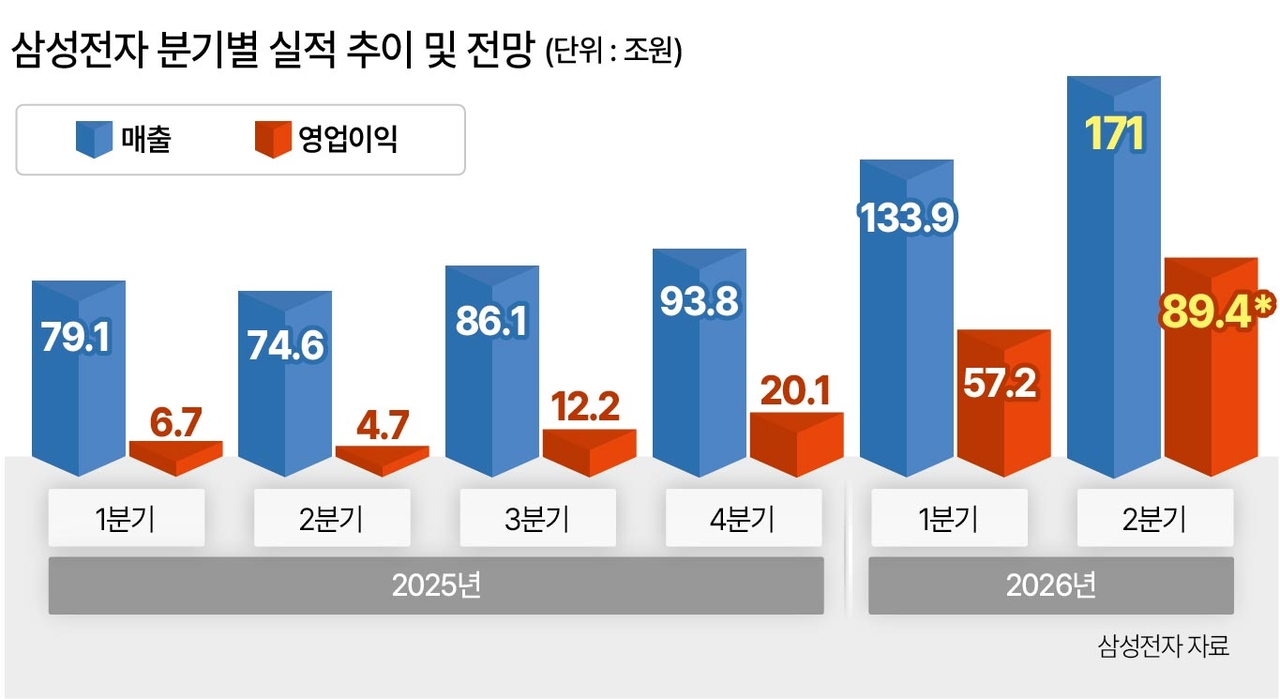
Samsung Electronics disclosed Tuesday that its preliminary second-quarter operating profit came in at 89.4 trillion won — a 56 percent increase from the 57.23 trillion won posted in the first quarter, which had itself been the largest quarterly result in the company's history. Combined first-half operating profit reached 146.63 trillion won.
Sales also hit an all-time high. Second-quarter revenue of 171 trillion won was up 28 percent from 133.87 trillion won in the first quarter, bringing cumulative first-half sales to 304.87 trillion won.
Profitability set a new record as well. The second-quarter operating profit margin reached 52 percent, surpassing the 50 percent threshold for the first time. The previous high had been 43 percent, recorded in the first quarter.
The year-on-year improvement was equally striking. In the second quarter of last year, Samsung posted sales of 74.57 trillion won and operating profit of 4.68 trillion won. Compared with that period, second-quarter sales rose 129 percent and operating profit surged 1,810 percent.
Securities analysts had forecast second-quarter sales of 174.53 trillion won and operating profit of 84.84 trillion won ahead of the announcement. Revenue came in slightly below those estimates, but operating profit exceeded expectations.
As a preliminary release, the filing does not break out results by division, but semiconductors are by far the biggest contributor. Securities analysts had estimated before the announcement that the DS (Device Solutions) semiconductor division's second-quarter operating profit would exceed 100 trillion won.
Depending on the outcome of bonus negotiations, the company is estimated to have set aside provisions in the mid-10 trillion won range, reflecting accruals for both the first and second quarters simultaneously. After accounting for those bonus provisions, the DS division's second-quarter operating profit is expected to come in at around 90 trillion won.
Sustained demand for memory chips — driven primarily by AI data centers — pushed chip prices sharply higher. According to market research firm TrendForce, contract prices for commodity DRAM rose 58 to 63 percent quarter-on-quarter in the second quarter, with the rapid spread of agentic AI fueling the surge.
The non-memory business is estimated to have recorded a loss of around 2 trillion won. The System LSI and foundry units could not avoid losses as they expanded operations, analysts said.
The DX (Device eXperience) division, which covers finished consumer products, is estimated to have seen its profitability squeezed by rising component costs driven by higher memory chip prices — a phenomenon analysts have dubbed "chipflation," referring to cost pressure stemming from elevated semiconductor prices.
Some securities analysts predict the MX (Mobile eXperience) and Networks business — which posted operating profit of 2.8 trillion won in the first quarter — may have swung to a loss of up to 1 trillion won in the second quarter. Even under more optimistic scenarios, operating profit is seen in the range of 500 billion to 1 trillion won, representing a sharp decline from the previous quarter.
The home appliances and TV business is expected to have tracked a similar profitability trajectory to the first quarter, when it posted operating profit of 200 billion won.
However, a four-week Samsung Electronics appreciation festival that ran from June 8 could prove a significant variable for the DX division. The promotional event, which offered customers 20 percent of their purchase amount back in Onuri gift vouchers, proved highly popular and is estimated to have added around 2 trillion won in sales during the period — exceeding initial projections and raising the prospect of a meaningful earnings improvement.
The DX division's strategy centers on boosting productivity through AX (AI Transformation). The division has committed to converting all of its domestic and overseas factories into AI-autonomous facilities by 2030, and since last month has been pursuing a shift to an AI-driven company by combining its in-house AI model "Gauss" with external generative AI tools.
The company's recently announced long-term investment plan also includes measures to build up the DX division. Samsung said it would invest approximately 350 trillion won through 2040 in a humanoid robot mass production line, a global smartphone mother factory, and a digital twin-based home appliance innovation hub.
jeongwan@heraldcorp.com