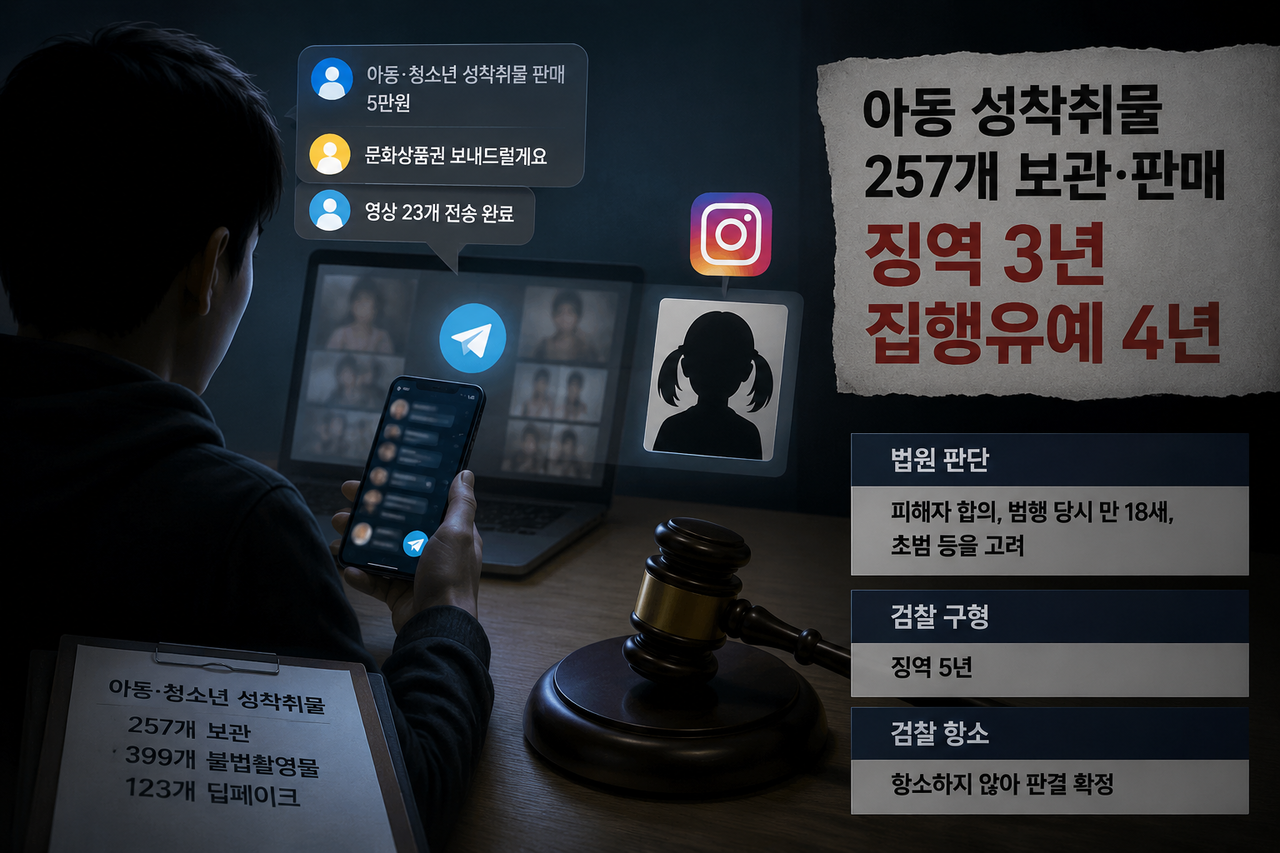
A court handed a suspended prison sentence to a man in his 20s tried on charges of storing hundreds of child and youth sexual exploitation files and selling them for profit. The court acknowledged that "the gravity of the offense is by no means light," but declined to impose an immediate custodial term, citing the defendant's age of 18 at the time of the crimes, his clean criminal record and a settlement reached with the victim. Prosecutors, who had sought a five-year prison term, chose not to appeal, allowing the ruling to stand as final.
Critics say sentences in sexual exploitation cases involving minors — crimes that cause serious social harm and can incentivize further offending — are being reduced far too easily. Experts say particular caution is needed when a settlement with a minor victim or the victim's family is used as grounds for leniency, given that minors may not be capable of making fully independent judgments.
The criminal 12th division of the Ulsan District Court (presiding judge Park Gang-min) sentenced the defendant, identified only as A and born in 2006, on June 12 to three years in prison, suspended for four years. He had been indicted on charges including violations of the Act on the Protection of Children and Youth Against Sex Offenses — specifically the for-profit sale and possession of sexual exploitation material — as well as violations of the Act on Special Cases Concerning the Punishment of Sexual Crimes, including possession of illegally filmed material and possession of deepfake fabricated video.
According to the court, A stored 257 files of child and youth sexual exploitation material on his mobile phone and Telegram storage between October 2024 and last February, having obtained them through Telegram and other channels. He was found to have possessed the material knowing it constituted child and youth sexual exploitation content.
A also faced charges of possessing 399 illegally filmed videos distributed without the victims' consent, and of possessing 123 deepfake fabricated videos in which celebrities' faces had been superimposed on nude images.
His conduct went beyond mere possession.
A created an Instagram account using a photo of B, a 15-year-old victim whose image appeared among the exploitation material he held, then followed B's acquaintances and sent them messages soliciting payment to purchase videos. When B's father posed as a prospective buyer and approached A, the defendant transferred 23 videos via Telegram in exchange for a 50,000-won ($33) gift card — a charge of selling sexual exploitation material for profit.
Of the 257 child and youth sexual exploitation files A had stored, 61 featured B; investigators found material involving numerous other victims as well. A organized the files into folders — three labeled with victims' names and seven with labels such as "XX girl" — for a total of 10 folders.
The court recognized the seriousness of A's offenses.
The court said that "possessing child and youth sexual exploitation material and illegally filmed content provides an incentive for production-related crimes, can trigger other sex crimes, and distorts viewers' sexual values — causing broad harm to society as a whole." It added that A had "engaged in active sales conduct by creating a new social media account using a victim's photo as a profile picture, thereby exposing the exploitation material to the victim's own acquaintances, and the degree of culpability is extremely high." The court also noted that the offenses appeared likely to have "a harmful effect on victims' development of healthy sexual values."
Even so, the court convicted A while imposing a suspended sentence, citing his acknowledgment of the crimes, a settlement with the victim whose family expressed no desire for punishment, and the fact that he was 18 years old with no prior record at the time — someone the court described as socially and mentally immature.
The ruling became final on June 20. Prosecutors had sought five years at the sentencing hearing but did not appeal the first-instance verdict.
![A court ruling. [Herald DB]](https://wimg.heraldcorp.com/news/cms/2026/07/07/news-p.v1.20260703.73b9e05364a34d5ca5804405d03909eb_P1.jpg)
Courts determine actual sentences by starting from the statutory sentencing range, then applying aggravating and mitigating factors within the legally prescribed bounds before weighing various sentencing conditions. According to the ruling in this case, the applicable statutory range for A was two years and six months to 22 years and six months in prison.
Under the sentencing guidelines of the Supreme Court's Sentencing Commission, the standard recommended range for the for-profit sale of child and youth sexual exploitation material is four to eight years in prison. When multiple offenses are recognized together, as in this case, the lower bound of the recommended range rises to at least four years. The guidelines are not strictly binding, but judges who depart from them must state their sentencing rationale in the ruling, meaning they cannot deviate without reasonable justification.
Taking all of these factors into account and weighing the various sentencing conditions, the court settled on a three-year prison term suspended for four years.
Experts point to the reality that settlements with victims and first-offense status are routinely used as grounds for sentence reductions in sexual exploitation cases.
Lee Eun-eui, an attorney with extensive experience representing victims of sexual violence and sex crimes, said in a phone interview that treating a minor victim's wish not to pursue punishment as too strong a basis for leniency "can undermine the very purpose of the state's exercise of judicial authority." She added that "even when a minor appears to have agreed to a settlement voluntarily, it is difficult to regard that as a fully independent decision, and when a parent has reached the settlement, it may not reflect the victim's own wishes." She also criticized prosecutors for not appealing despite a large gap between the sentence they sought and the one imposed.
The Korean Women's Development Institute, in a report published last month titled "Current Status and Challenges of the Legal and Institutional Framework Following Changes in the Legal Status of Child and Youth Victims of Sexual Exploitation," criticized courts' sentencing practice of broadly accepting a victim's wish not to pursue punishment and first-offense status as mitigating factors.
Researchers noted that "personal circumstances — such as the defendant's sincere remorse, absence of prior criminal punishment and the victim's wish not to pursue punishment — are being applied broadly as mitigating factors, perpetuating a trend in which suspended sentences outnumber immediate custodial terms." They also said that "mechanically applying a reduction simply because a defendant has no prior record, even in cases where there is a high likelihood that undetected additional offenses exist or that an unspecified number of victims have been harmed, does not accord with the definition of a sentencing factor and constitutes an inappropriate judgment."
The report analyzed 373 rulings handed down in 2024 involving sex-trade offenses against children and youth. It found that 464 defendants — 93.7 percent of the total — received prison terms, 29 (5.9 percent) received fines and 2 (0.4 percent) received suspended indictments. Of those sentenced to prison, 328 (66.3 percent) had their sentences suspended. The average prison term was about two years, the average suspension period about two years and six months, and the average fine about 7.36 million won. Female victims accounted for 484 cases, or 97.8 percent of the total, and the average victim age was 14.6.
Among the types of sexual violations associated with sex-trade offenses, rape and forced indecent acts accounted for 106 cases (21.6 percent), sexual harassment and other forms of sexual abuse for 70 (14.1 percent), intercourse or indecent acts by deception or coercion for 12 (2.4 percent), production and distribution of sexual exploitation material for 44 (8.9 percent), filming using cameras or similar devices for 19 (3.8 percent), and blackmail or coercion using filmed or edited material for 14 (2.8 percent).
yg@heraldcorp.com