South Korea's current account surplus hit a record $38.61 billion in May, breaking the all-time high for the second time in two months, as strong semiconductor exports and the fading of a seasonal dividend-payment drag combined to lift both the goods balance and primary income balance.
The Bank of Korea released preliminary balance of payments data for May on Wednesday, showing the $38.61 billion surplus surpassed the previous record of $37.93 billion set in March by $680 million.
"The current account posted an all-time high as the surplus expanded from the previous month, led by the goods balance and the primary income balance," the Bank of Korea said.
The surplus extended South Korea's unbroken run to 37 consecutive months, the second-longest streak since the 2000s.
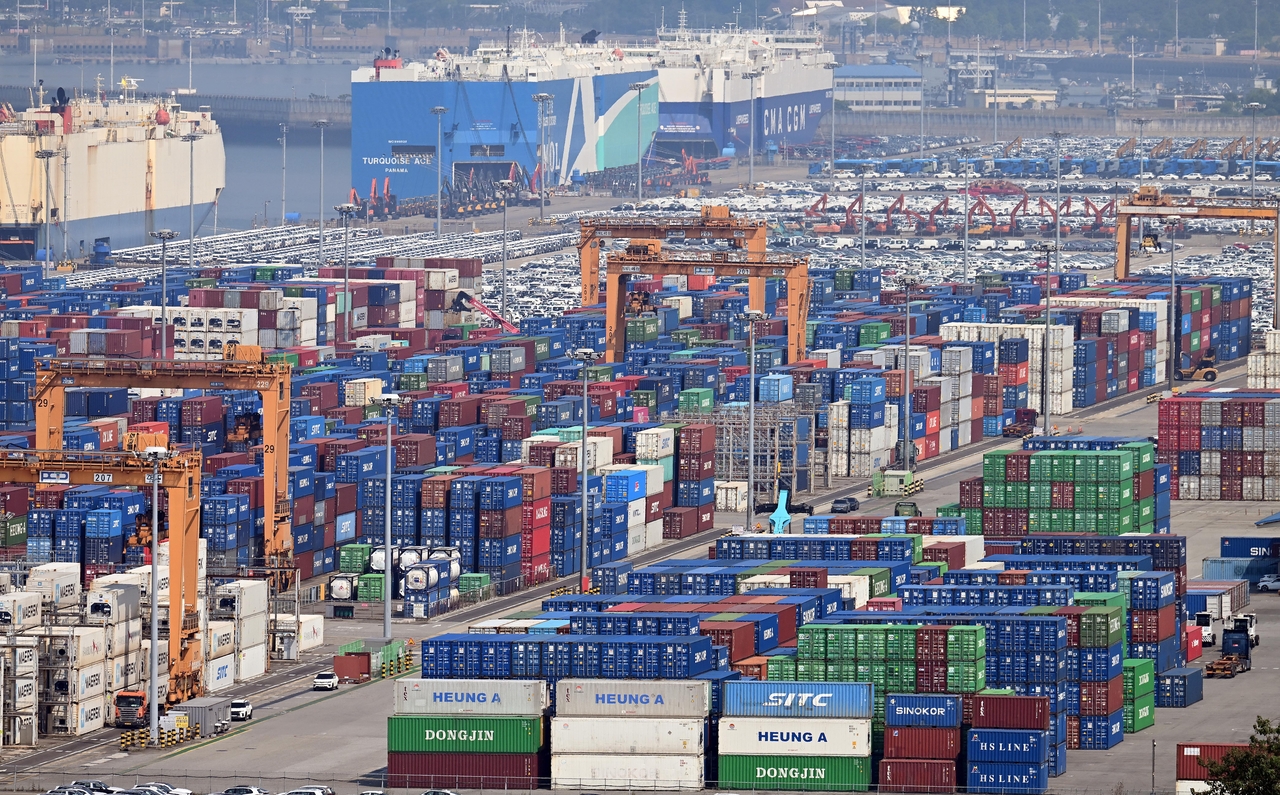
The goods balance reached a record $37.86 billion, topping the previous high of $35.68 billion set in March by $2.18 billion. Exports rose to $94.34 billion, up 62.9 percent from a year earlier — roughly three times the 22.2 percent growth rate for imports over the same period.
Among customs-cleared exports, IT shipments surged 128.9 percent year-on-year in May, driven by computer peripherals (up 249.4 percent) and semiconductors (up 167.7 percent). Non-IT exports also rose 10 percent, led by petroleum products (up 49.1 percent), chemical products (up 11 percent) and steel products (up 6.6 percent). However, machinery and precision instruments fell 4.9 percent, while passenger vehicles declined 7.5 percent.
On the imports side, capital goods rose 28 percent, driven by semiconductors (up 61.1 percent), semiconductor manufacturing equipment (up 54.9 percent) and information and communications equipment (up 7.7 percent). Raw materials climbed 22.1 percent, led by petroleum products (up 70.5 percent) and coal (up 37.2 percent). Consumer goods edged up 1.8 percent.
The services balance posted a deficit of $1.09 billion in May, narrowing by more than half from a deficit of $2.56 billion a year earlier. The travel balance swung to a surplus of $50 million from a deficit of $1.02 billion, as the number of inbound visitors rose 19.4 percent from a year ago. The intellectual property royalties balance also turned to a surplus of $70 million, as royalty payments increased in line with the seasonal pattern typical of the middle month of a quarter.
The primary income balance recorded a surplus of $2.17 billion. Dividend payments declined as seasonal factors dissipated, pushing the dividend income balance to a surplus of $1.15 billion and lifting the overall primary income balance into positive territory. The secondary income balance posted a deficit of $330 million.
On the financial account, net assets rose $31.08 billion in May — the second-largest increase on record after March's $38.05 billion.
Breaking down by type, direct investment saw South Korean residents' overseas investment increase by $4.56 billion, while foreign direct investment in South Korea rose $2.69 billion. In portfolio investment, residents' overseas investment grew $6.24 billion, centered on shares. Foreign portfolio investment in domestic assets fell $24.65 billion, led by equities. Equity holdings in particular dropped $31.05 billion — the largest decline on record, surpassing the $29.33 billion decrease seen in March just two months earlier.
"The decline in equities under securities investment liabilities widened due to profit-taking sales amid rising domestic share prices," the Bank of Korea said, adding that debt securities increased as funds tracking the World Government Bond Index flowed in.
Elsewhere, financial derivatives rose $240 million. Other investment assets grew $14.31 billion, centered on other assets, while liabilities increased $14.5 billion, led by cash and deposits. Reserve assets fell $1.73 billion.
kimstar@heraldcorp.com