![Samsung Electronics' PM1763 [Samsung Electronics]](https://wimg.heraldcorp.com/news/cms/2026/07/08/news-p.v1.20260708.bd122372a63e4da2997ef04990da666d_P1.jpg)
Samsung Electronics announced Wednesday that it has begun mass production of the PM1763, an enterprise solid-state drive (eSSD) built into Nvidia's next-generation AI accelerator, Vera Rubin.
The PM1763 is a PCIe (Peripheral Component Interconnect Express) 6.0-based eSSD — PCIe being the high-performance interface standard that connects CPUs, GPUs and storage devices in servers. It adopts PAM4 (Pulse Amplitude Modulation 4) signaling to deliver twice the data transfer bandwidth of the previous PCIe 5.0 generation. The drive is equipped with Samsung's 9th-generation V-NAND and a new controller built on a 4-nanometer process, significantly boosting both performance and power efficiency.
Samsung expects the PM1763 to become a core solution for next-generation AI platforms. The drive's key strengths are its fast read speeds and efficient data processing enabled by an optimized controller architecture.
The PM1763 drew considerable attention when it was unveiled at Nvidia's AI conference GTC 2026, held in San Jose in March, as the drive serves as the main storage for Nvidia's Vera Rubin superchip.
At Samsung's booth, a physical Vera Rubin unit was on display, fitted with the company's sixth-generation high-bandwidth memory (HBM4), a low-power DRAM (LPDDR5X)-based SOCAMM2 module and the PM1763. Samsung also gave a live demonstration of Nvidia SCADA — a technology designed to maximize AI workload performance — running on a server equipped with the PM1763.
![Samsung Electronics displayed a physical unit of Nvidia's next-generation Vera Rubin superchip at GTC 2026 in March. The chip was fitted with Samsung's HBM4, SOCAMM2 and a server SSD. [The Korea Herald]](https://wimg.heraldcorp.com/news/cms/2026/07/08/news-p.v1.20260317.c77a9f42fa504aeaa58c3018f98bba1e_P1.jpg)
As the volume of data required for AI training and inference has surged, enterprise SSDs capable of delivering data reliably and at high speed have emerged as a critical component of AI infrastructure.
The role of SSDs in AI servers has grown accordingly. They must supply vast amounts of data in a continuous stream so that CPUs and GPUs do not sit idle during training and inference, maximizing processing throughput. The need to store and rapidly load large model files for running generative AI has also grown. Storing the rapidly expanding KV (key-value) cache is another key function SSDs are expected to perform.
Samsung says the PM1763 meets all the requirements that AI infrastructure demands of an SSD.
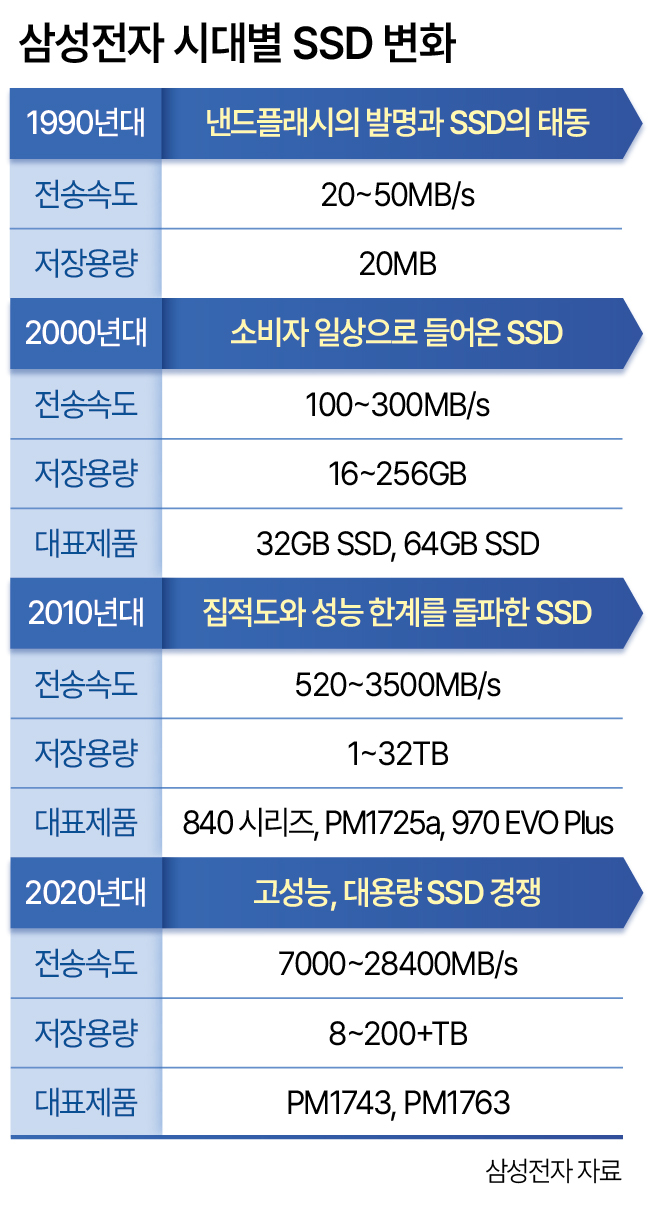
The drive comes in three capacities — 4TB, 8TB and 16TB. The 16TB model delivers industry-leading performance, with sequential read and write speeds of up to 28,400MB/s and 21,900MB/s respectively, roughly double those of its predecessor, the PM1753.
That translates to transferring a 40GB large language model (LLM) in approximately 1.4 seconds. Fast SSD transfer speeds are essential for on-device AI services, as they minimize data latency between accelerators and processors and improve overall AI workload efficiency.
The PM1763 is also optimized for the liquid cooling environments used in next-generation AI servers. It employs a D2C (Direct to Chip) cooling method that attaches a cold plate directly to components, allowing the drive to sustain peak performance under heavy loads over extended periods.
Power efficiency has also improved by more than 1.8 times compared with the previous model, helping reduce data center operating costs.
Security has been reinforced to meet the demands of an AI era in which data protection is increasingly critical. The drive incorporates a post-quantum cryptography (PQC) algorithm that addresses weaknesses in conventional encryption, guarding against attacks from quantum computers.
"The PM1763 has met the next-generation AI platform requirements of global customers with industry-leading performance and has successfully completed product validation," said Choi Jang-seok, a senior vice president on the product planning team of Samsung Electronics' Memory Business Division. "This product will serve as a core solution that expands memory capacity to support the efficient operation of customers' AI models."
jeongwan@heraldcorp.com