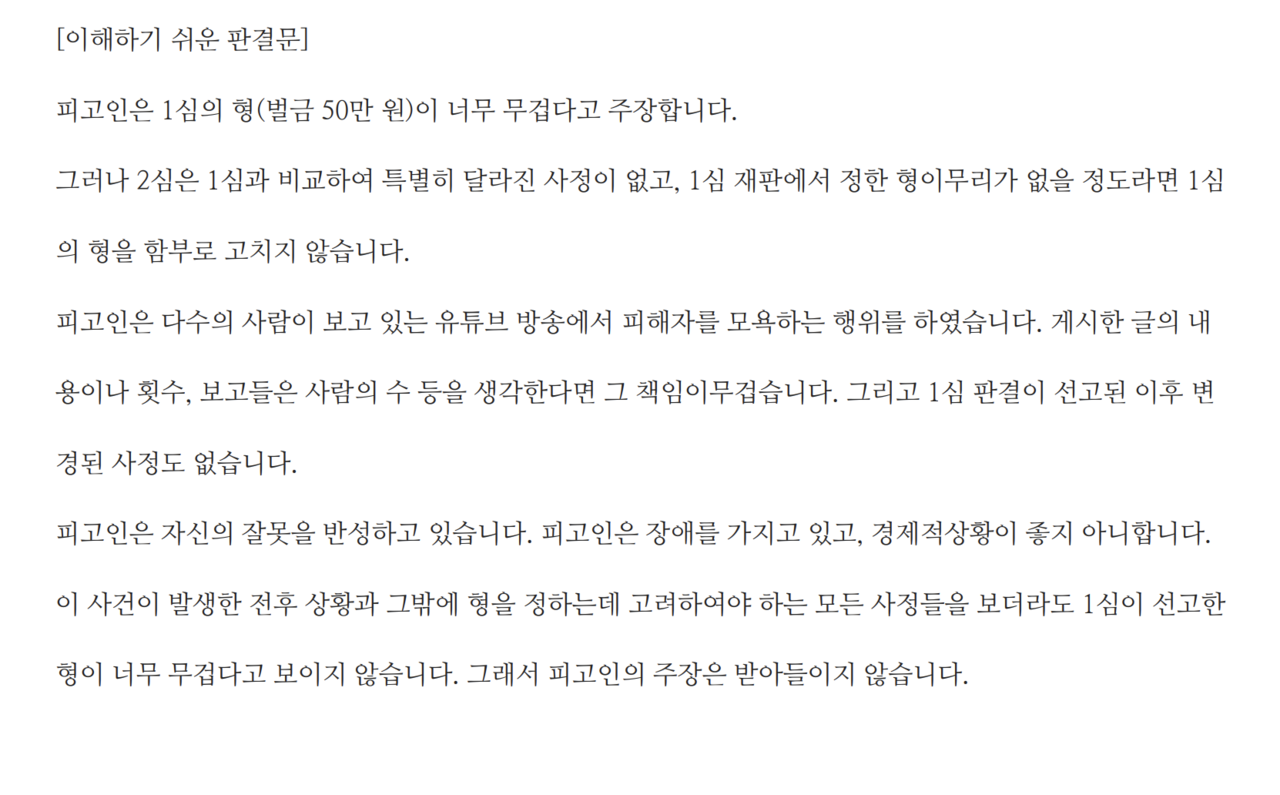
"There are no circumstances that have changed significantly compared to the first trial, and if the sentence set at the first trial is reasonable, we do not change the first-trial sentence without good reason.
The defendant bears heavy responsibility. There are also no changed circumstances since the first-trial sentencing."
Amid the Supreme Court's rollout this year of regulations on judicial access and support for people with disabilities, the elderly and pregnant women, easy-read rulings — written in plain, accessible language — have now appeared in criminal cases as well. While an easy-read ruling in an administrative case on June 25 had drawn attention, it has since emerged that a criminal ruling of the same kind was handed down a month earlier, in May.
The Seoul Southern District Court's Criminal Division 3-3, presided over by Judge Yoo Hwan-woo, appended a separate "easy-to-understand ruling" section at the end of its appellate decision in a case involving defendant A, a person with an intellectual disability charged with insult. While standard rulings are filled with complex legal terminology, Judge Yoo rendered the content in plain language using polite speech. The ruling was handed down May 28.
In the ruling, the court replaced the legal term for the lower court — "original trial" — with "first trial," and substituted "appellate trial" with "second trial." Phrases such as "without merit" and "dismissed" were rewritten as "we do not accept the defendant's argument." The court also rephrased the standard formulation "the original court's sentence does not appear to have exceeded the reasonable bounds of discretion" as "the sentence handed down at the first trial does not appear to be too heavy."
The plain-language ruling follows regulations on judicial access and support for people with disabilities, the elderly and pregnant women that the Supreme Court put into effect on Jan. 1. The regulations are designed to support those who face barriers to judicial services due to disability, illness, age, pregnancy or childbirth. They cover improvements to physical facilities and information environments to ensure accessibility, the organization of judicial support units at courts of all levels including judicial access centers, and the full range of procedures and types of judicial support available.
Defendant A, whose intellectual disability is assessed as significant, was fined 500,000 won ($328) at the first trial on insult charges after being found to have posted abusive language in the live chat of a YouTube channel. During the appellate proceedings, A personally filed a judicial support request with the court, stating that a mental disability made it difficult to understand complex legal terminology.
In response, the appellate court appended a separate "easy-to-understand ruling" section at the end of its decision so that A could fully grasp the content of the judgment.
A spokesperson for the Seoul Southern District Court said the case "can be described as a concrete example of a so-called easy-read ruling, part of an effort to substantively guarantee judicial access rights for socially vulnerable groups such as people with disabilities," adding that "significance can also be found in the fact that this is a case where the court actively responded to a judicial support request from a party to the proceedings."
The spokesperson added that "the judiciary has been working since this year to establish regulations and comprehensively reorganize the judicial support system for socially vulnerable groups such as people with disabilities, with the aim of ensuring it takes stable root."
Meanwhile, the Seoul Administrative Court's Administrative Division 7, presided over by Judge Kang Woo-chan, ruled in favor of plaintiff B — a person with an intellectual disability — on June 25 in a suit filed against the head of Seoul's Yangcheon-gu district office seeking to overturn a decision that B did not qualify for disability status. The court provided B with a plain-language ruling alongside the standard judgment.
In B's case, the administrative court created a separate section at the front of the ruling explaining: "This text tells you why the court reached this decision. It is recommended reading for the person who filed the case."
The section then laid out in accessible terms the outcome — that B had won the case — the district office's arguments, the court's reasoning for finding the district office's decision to be wrong, and the consequence that the district office's decision would be nullified as a result of the ruling.
In consideration of the fact that B would be reading the ruling directly, the plaintiff was referred to as "you" throughout. The ruling also included a note reading: "If you have further questions, please contact your legal aid attorney."
notstrong@heraldcorp.com