
Samsung Electronics topped the world in operating profit in the second quarter and South Korea's current-account surplus hit a record high — yet the Kospi has fallen into a bear market for the first time in four years. The root cause is the government's failure at sensemaking. Chasing a surging exchange rate, authorities rushed single-stock leveraged ETFs to market, but attaching leverage to Samsung Electronics and SK hynix — which together account for half the Kospi's market cap — only exploded volatility. Foreign investors took profits at the peaks that retail buyers had propped up, leaving many individual investors nursing losses. Products already on the market are hard to pull back. The time has come to build a deeper, more resilient market that can share its gains with the public for the long term.
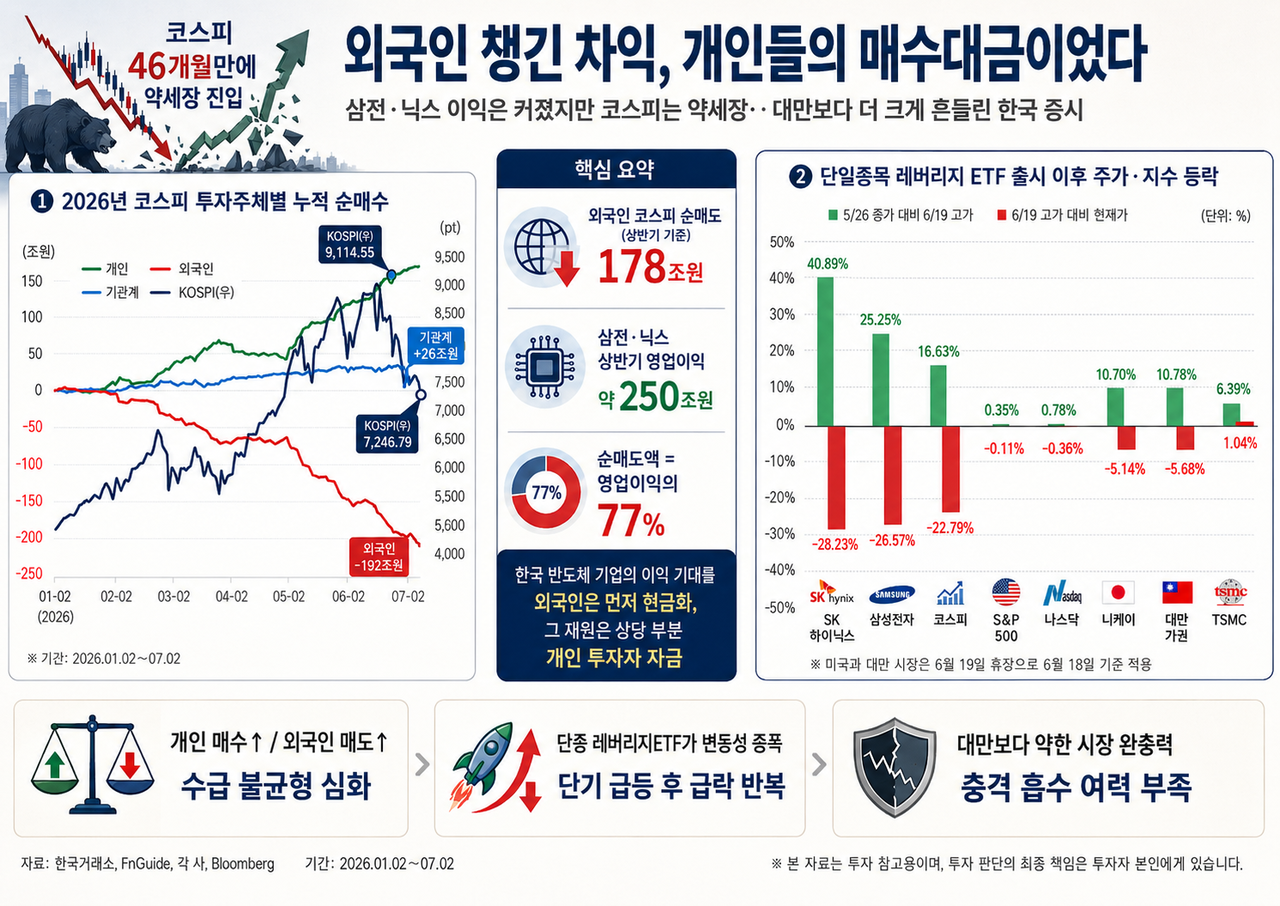
Kospi breaks 60-day line, enters bear market for first time in 46 months
South Korea's current-account surplus for May, released Wednesday, set yet another all-time record. The day before, Samsung Electronics reported the world's highest operating profit among all companies for the second quarter. Yet the Kospi plunged 22.8 percent from its June 19 peak of 9,385.59, falling back below its medium-term trend line — the 60-day moving average. The index's entry into bear-market territory, defined as a drop of 20 percent or more from a peak, is the first since September 2022, nearly four years ago. None of this makes sense. So what exactly happened?
The late organizational psychologist Karl E. Weick, one of the towering figures in his field, is best known for the concept of "sensemaking." Weick argued that in a crisis, the problem is not a lack of information but an overabundance of contradictory information. What matters, he believed, is not the ability to know the right answer but the ability to construct a workable interpretation. For Weick, a leader is not someone who predicts the future with precision but someone who learns by acting, catches weak signals early and keeps an organization from becoming trapped in a flawed reading of reality — someone who helps an organization see things as they actually are.
Foreign investors sold as much as Samsung Electronics and SK hynix earned
The Kospi's decline is a story of foreign selling. As part of portfolio rebalancing, foreign investors recorded net selling of 178 trillion won ($117 billion) on the Kospi in the first half of this year alone. Extending the period through Wednesday, the figure exceeds 193 trillion won. Samsung Electronics' preliminary operating profit for the first half came to roughly 147 trillion won, while SK hynix is expected to post around 102 trillion won. Foreign net selling amounted to about 77 percent of the two companies' combined first-half operating profit of roughly 250 trillion won.
Compare that with Taiwan, whose current-account surplus has also surged on the back of a semiconductor boom. Foreign net selling on the Taiwan exchange in the first half totaled about $29.6 billion — roughly 68 percent of TSMC's estimated operating profit of $43.6 billion.
Yet the Taiwan Weighted Index currently stands at 45,479, down only about 5 percent from its June 23 peak of 48,219. TSMC, which hit a record 2,535 New Taiwan dollars on June 23, now trades around 2,440 New Taiwan dollars — a pullback of roughly 4 percent from its high, even amid concerns about an AI bubble. Why has the Korean market fallen so much more than Taiwan's?
Single-stock leveraged ETFs: the main culprit behind volatility in Samsung Electronics, SK hynix and the Kospi
Part of the answer is that the Kospi's ascent was steeper than Taiwan's to begin with. Single-stock leveraged ETFs — products that track a single company's share price with leverage — widened the gap further. In less than a month after their launch on May 27, SK hynix and Samsung Electronics surged as much as 40.1 percent and 25.2 percent, respectively. The Kospi itself climbed as much as 16.6 percent. Over a comparable period, US markets — the S&P 500 and Nasdaq — were roughly flat, while Japan and Taiwan rose at most 10.7 percent. TSMC's gain was limited to 6.4 percent. Neither Taiwan nor Japan has single-stock leveraged ETFs. The United States does not have the same degree of concentration in a handful of names. Taiwan caps the daily price movement of sector-type leveraged ETFs at 10 percent.
The exchange rate is the other factor. Taiwan's currency has held steady against the US dollar all year, trading in a narrow 31–32 range. The won-dollar rate, by contrast, was below 1,440 won at the end of last year and recently surpassed 1,550 won. A weakening currency represents currency-loss risk for foreign investors. Taiwan's foreign-exchange management is superior to South Korea's in several respects. [See the June 6 column: 'The curse of success' and the exchange-rate turmoil it caused — and how Taiwan, in a similar position, avoided it (Hwaseok Yeoljeon, No. 897)] The standard playbook calls for reducing exposure to a depreciating currency. With rebalancing demand on top of that, it is little wonder that selling pressure has been intense.
Government tried to stabilize the exchange rate but only amplified market volatility
Consider the sequence of events. Why did South Korea introduce single-stock leveraged ETFs in the first place? On Jan. 28, Financial Services Commission Chairman Lee Bok-hyun announced plans to allow them, citing the existence of similar products overseas. Two days later, a legislative notice was issued, and by April 21 — less than three months later — the relevant enforcement decree under the Capital Markets Act had been amended. The first products hit the market on May 27, exactly four months after the announcement.
Late January was a period of alarm over a surging exchange rate. The government rolled out a raft of measures, including foreign-exchange hedging by the National Pension Service and the introduction of a domestic equity return account. The Kospi had also just broken through the 5,000 level on Jan. 27. The apparent intent was to use single-stock leveraged ETFs to discourage overseas investment, stabilize the exchange rate and draw more money into domestic equities to push the Kospi higher. Did it work as planned?
When war broke out involving Iran at the end of February, foreign selling and exchange-rate pressure continued through March. Hopes for an end to the conflict brought foreign selling under control in April and pulled the won-dollar rate back below 1,400. But conditions shifted starting in early May, just before the leveraged ETF launch. As US-Iran ceasefire negotiations progressed, the market rebounded, and retail investors net-bought a staggering 42 trillion won in May alone, driving the index higher. The Kospi stood at around 7,000 in early May. After the single-stock leveraged ETFs launched, retail net purchases in June exceeded 56 trillion won, and the Kospi surged to the 9,400 level on June 19, powered by sharp gains in Samsung Electronics and SK hynix.
Retail buying money became the source of foreign investors' profits
Share prices rose as retail investors bought, and foreign investors sold into the rally, converting the proceeds into dollars. The won-dollar rate, which had rebounded in May, briefly approached 1,560 won after the leveraged ETF launch. Retail investors net-bought more than 133 trillion won on the Kospi in the first half of this year, concentrated in Samsung Electronics and SK hynix. Extending the period through Wednesday, the figure exceeds 147 trillion won. Of the roughly 59 trillion won attributed to financial investment firms, a substantial portion also represents retail money that flowed in through ETFs. The shares retail investors bought were the shares foreign investors sold. Most of the profits foreign investors pocketed came, in effect, from retail investors' money.
Had single-stock leveraged ETFs not been launched, the Kospi and the two stocks would likely have risen less. When massive leveraged investment concentrates in a short period on two names that together account for half the Kospi's market cap, it is only natural for the index to overreact. Foreign investors who sold during that period would have reaped smaller gains; retail investors who bought would have paid lower prices.
The government's stated goals in introducing single-stock leveraged ETFs were to stabilize the exchange rate and strengthen the Kospi's upward momentum. Instead, foreign investors walked away with the equivalent of 77 percent of Samsung Electronics' and SK hynix's combined operating profit, the exchange rate rose further against the government's intentions, and the Kospi's volatility expanded so abnormally that The Wall Street Journal ran a column on Monday comparing it to "Squid Game." The piece argued that speculative retail participation was amplifying swings and driving the market's wild gyrations.
About 117 trillion won of retail money invested above 7,000 is now at risk of loss
Despite record corporate earnings, the Kospi has lost momentum as foreign selling has intensified, and customer deposits held at brokerages — which once reached 140 trillion won — have fallen to around 110 trillion won. Retail net purchases made at or above Wednesday's closing level of 7,246 are estimated at roughly 117 trillion won, meaning that amount of capital is currently sitting at a loss.
Foreign investors, by contrast, still hold large positions despite their aggressive selling, and nearly all of those holdings remain in profitable territory. Compared with the end of the first half of last year, foreign ownership of SK hynix fell 5 percentage points to 50.06 percent as of Wednesday's close, from 55.51 percent. Samsung Electronics saw foreign ownership decline by less than 3 percentage points, from 49.64 percent to 46.58 percent. Because foreign investors accumulated large positions at low prices long ago, selling at high prices has generated enormous proceeds while barely reducing the number of shares they hold.
Foreign-exchange crisis trauma has blocked currency market reform
One of the papers that made Weick famous was his 1993 study "The Collapse of Sensemaking in Organizations: The Mann Gulch Disaster," which analyzed a 1949 wildfire in Mann Gulch, Montana, in which 13 of 15 firefighters died. The firefighters needed to drop their equipment to escape, but they could not bring themselves to do it. Their shovels and axes were symbols of their identity.
The exchange-rate instability that flared last year was not merely a question of dollar supply and demand — it was a question of the won's global credibility. Foreign-exchange market reform has been necessary since 2008, when MSCI placed South Korea on its watch list for potential upgrade to developed-market status, but the government has never fully escaped the trauma of the 1997-98 foreign-exchange crisis. It has been unable to abandon a trade-centric, 20th-century foreign-exchange system. That failure of perception led authorities to fixate on immediate supply-and-demand pressures and ultimately reach for the dangerous tool of single-stock leveraged ETFs. South Korea's 20th-century foreign-exchange system may have been its shovel and axe.
Government failed to examine the consequences of allowing leverage on mega-cap stocks
The government's sensemaking failures did not end there. It also failed to properly assess the consequences of permitting single-stock leveraged ETFs. Outside the United States — which has the deepest liquidity and the broadest derivatives market in the world — almost no country allows them. Even in the US, single-stock leveraged ETFs must meet fairly stringent conditions. It defies common sense to allow leverage on stocks that account for more than half the market's total capitalization and have already surged sharply in price.
The reasoning that "similar products exist overseas, so we should allow them here" is also flawed. Overseas and domestic products do not have the same reach. For overseas products, taxes, currency conversion, time-zone differences and transaction costs all act as barriers to entry. In hindsight, at a moment when the market needed a brake pedal and a seatbelt to manage overheating and concentration risk, the government instead pressed the accelerator, amplifying speed and volatility alike.
Regulating products already on the market is difficult — the focus must shift to building market resilience
Realistically, it is difficult to regulate single-stock leveraged ETFs that are already on the market. Financial authorities say they will tighten oversight, but no clear remedy is in sight. When there is no cure, the only option is to build up strength and immunity to outlast the symptoms. Reducing volatility requires drawing more long-term investment capital into the market and deepening the market further than it is today.
Household assets concentrated in real estate must be redirected toward equities, and a wider range of products and vehicles must be developed to improve investment stability. In Taiwan, 20 percent of household assets are in marketable securities and 30 percent in deposits; real estate accounts for only 30 percent. In South Korea, more than 75 percent of household assets are in real assets such as real estate, deposits account for roughly 20 percent, and marketable securities represent less than 6 percent. Attracting foreign capital also matters. Channels must be developed to give global investors easier access to the Korean market. Inclusion in the MSCI Developed Markets Index should be pursued with greater urgency.
These may sound like abstract principles, but realizing them requires creating and reforming a great many systems and regulations. With that in mind, there is one thing — borrowing Weick's words — that this column would ask of the government and the National Assembly.
"Argue for what you believe to be right, but listen as though you might be wrong."
kyhong@heraldcorp.com





