![South Korea's monthly exports hit a record $102.25 billion in June, surpassing $100 billion for the first time, with semiconductors accounting for 44 percent of total exports and driving the milestone. Pictured is a domestic semiconductor manufacturing facility. [Herald DB]](https://wimg.heraldcorp.com/news/cms/2026/07/09/news-p.v1.20260701.9be879b68b614f9883d0b52460ce5ef7_P1.jpg)
The Asian Development Bank has raised its growth forecast for the South Korean economy this year to 2.6%, following a similar move by the International Monetary Fund.
The revisions reflect strong semiconductor exports driven by surging global AI investment, as well as a domestic demand recovery that has proven more resilient than expected. Rising international oil prices, US tariff policy and geopolitical risks stemming from the Middle East were flagged as variables that could weigh on the second half of the year.
According to the Ministry of Economy and Finance on Thursday, the ADB raised its 2026 growth forecast for South Korea to 2.6% in its Asian Development Outlook Supplement, up 0.7 percentage points from its April projection of 1.9%. The bank also lifted its outlook for next year by 0.1 percentage points, from 1.9% to 2.0%.
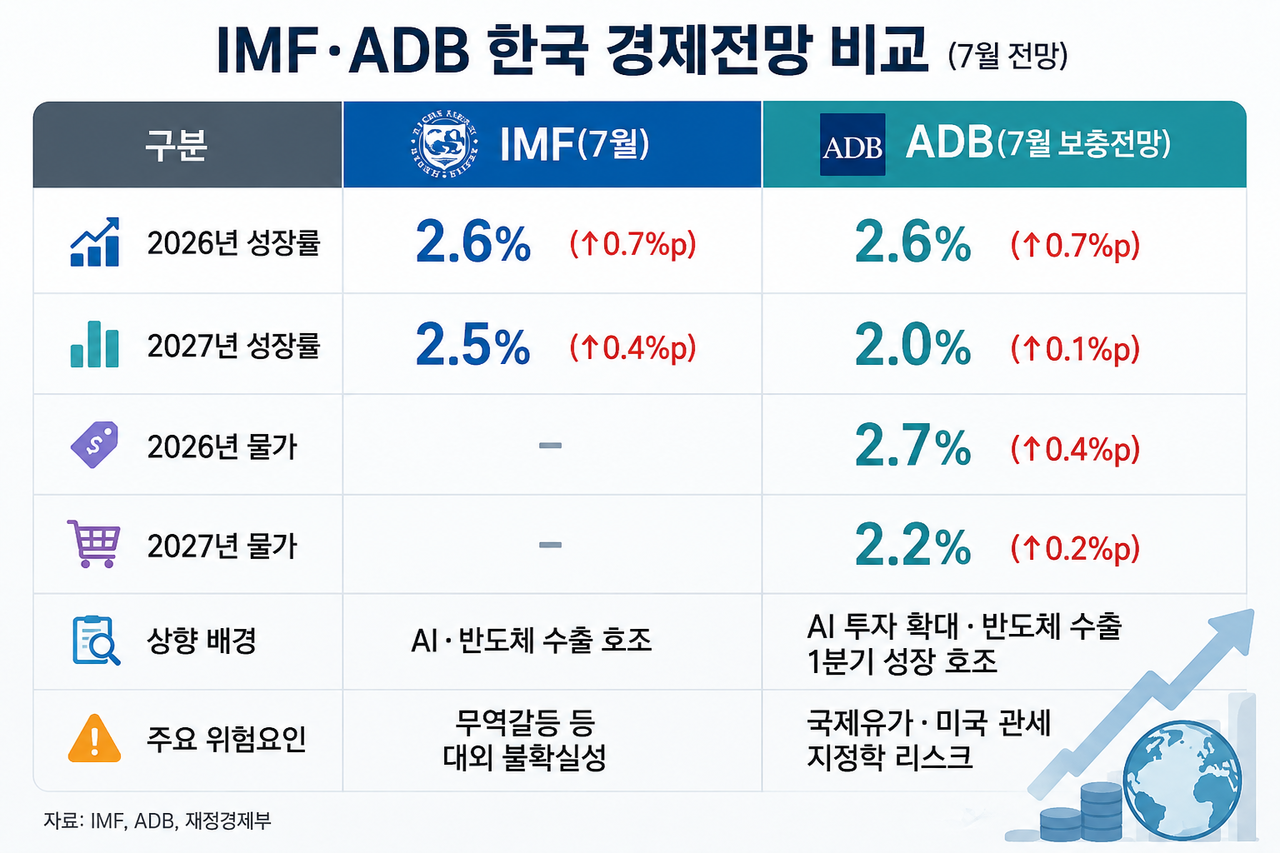
The ADB's revised figure matches the IMF's World Economic Outlook update released Wednesday. The IMF also raised its South Korea growth forecast by 0.7 percentage points, from 1.9% to 2.6%, and upgraded its projection for next year from 2.1% to 2.5%. The fund projected that South Korea would post the highest growth rate among major advanced economies this year.
Semiconductors and AI are at the heart of the successive upward revisions. The IMF identified South Korea as a leading net exporter of AI-related hardware and attributed the country's growth momentum to rising exports of semiconductors and AI hardware. The ADB similarly cited growing semiconductor demand fueled by global AI investment, along with stronger-than-expected first-quarter growth, as the primary reasons for its upgrade.
The government's price-stabilization policies also contributed positively, in part, to the improved growth outlook. The ADB nonetheless raised its consumer inflation forecast for this year by 0.4 percentage points, from 2.3% to 2.7%, citing higher international oil prices. Its inflation outlook for next year was also lifted, from 2.0% to 2.2%.
The ADB identified rising global energy prices and resulting supply chain disruptions, additional US tariff measures and increased volatility in global financial markets as key downside risks. At the same time, it projected that South Korea's growth momentum would be sustained for now if semiconductor- and AI-led export strength continues.
With the latest revisions, the growth forecasts of major domestic and international institutions — the Bank of Korea, the IMF and the ADB — have all converged at 2.6% for this year. The government is also expected to present a revised growth forecast in its second-half economic policy direction, to be announced soon.
fact0514@heraldcorp.com