
![Consumer prices rose at their fastest pace in two and a half years in June, driven by a surge in oil prices following the Middle East conflict and a reversal in agricultural prices due to poor harvests. Everyday living costs also posted their steepest increase in more than two years. Agricultural, livestock and fishery prices climbed 3.2 percent, pushing overall inflation up by 0.24 percentage points. A vegetable section at a hypermarket in Seoul is seen Thursday. [Yonhap]](https://wimg.heraldcorp.com/news/cms/2026/07/09/rcv.YNA.20260702.PYH2026070210910001300_P1.jpg)
Prolonged high oil prices and a weak won have pushed up grocery costs for South Korean households in the first half of this year, data show.
Prices of croaker — a staple fish for major holidays — along with rice and potatoes surged by double digits, while food and restaurant businesses facing higher raw material and logistics costs moved to raise prices. At the same time, some farm produce saw prices collapse due to oversupply, leaving farmers caught in a double bind of rising production costs and falling sale prices.
According to the Ministry of Statistics' consumer price trends released Thursday, the price of croaker rose 16.9 percent in the first half of this year compared with the same period last year. International oil prices spiked after the Middle East conflict escalated in February, reducing fishing vessel operations and cutting domestic supply of yellow croaker. Import volumes of Chinese croaker and African varieties also became more expensive as the weaker won drove up import costs.
According to the Korea Agro-Fisheries and Food Trade Corporation's agricultural distribution information system, the average retail price of imported frozen croaker this month reached 4,850 won per fish, surpassing the 4,800-won mark for the first time this year.
Prices of other domestic farm products also rose sharply — rice by 15.1 percent, ginseng by 14.6 percent and potatoes by 10.5 percent. South Korea relies heavily on imports for chemical fertilizer raw materials, and the weaker won pushed fertilizer prices higher. Rising international oil prices also drove up fuel costs for farm machinery, heating costs for greenhouse facilities and the price of other agricultural inputs, adding to overall production cost burdens.
Imported fruit has not been spared. Mango prices climbed 13.1 percent in the first half compared with last year, as climate-related production declines combined with a weaker won and higher air and sea freight costs. The average retail price of a single mango this month stands at 5,791 won, up 36.3 percent from the same period last year.
![Sungsimdang's mango siru cake [Sungsimdang SNS]](https://wimg.heraldcorp.com/news/cms/2026/07/09/news-p.v1.20260709.7417531eea1d403f8af589644bf20944_P1.jpg)
The supply uncertainty has already forced Sungsimdang, a well-known Daejeon bakery, to end sales of its summer-limited mango siru cake earlier than usual. "We are ending the sales schedule early depending on the mango supply situation," the bakery said.
Meanwhile, prices of other produce fell sharply — carrots dropped 37.8 percent, cabbage 35.0 percent, radish 33.7 percent, garlic chives 21.4 percent, pears 20.9 percent, onions 19.8 percent and napa cabbage 18.5 percent. Favorable weather boosted output, but fertilizer, fuel and labor costs kept rising, eroding farm profitability. Farmers from across the country held a rally at Gwanghwamun in Seoul on Tuesday to demand government action on the collapse in farm produce prices.
The rise in agricultural prices is also feeding through to processed food and restaurant prices.
Among processed foods in the first half, dried pollack strips recorded the steepest increase at 15.1 percent above last year's level. Gochujang (12.1 percent), salted seafood (10.5 percent) and pickled radish (10.4 percent) all posted double-digit gains. Doenjang rose 8.8 percent and soy sauce 8.4 percent. The increases reflect a combination of higher imported raw material costs, rising energy costs at manufacturing facilities and more expensive packaging materials.
Restaurant prices are also rising steadily. According to the Korea Consumer Agency's price monitoring service, the average price of samgyeopsal in Seoul — based on a 200-gram serving — has exceeded 21,000 won ($14) for the first time this year. Other popular dining options have all crossed the 10,000-won threshold: samgyetang at 18,154 won, naengmyeon at 12,615 won, bibimbap at 11,769 won and knife-cut noodle soup at 10,038 won.
Price hikes across the food and beverage industry continue. Lotte Chilsung raised the factory prices of 44 products — including Chilsung Cider — by an average of 5.3 percent, while Mega MGC Coffee and Ediya Coffee also raised prices on select items. The Born Korea raised prices on some menu items across 11 restaurant brands — including Yeokjeon Udon, Rolling Pasta and Saemaul Sikdang — by an average of 11 percent. Hotel buffet prices have also been trending upward.
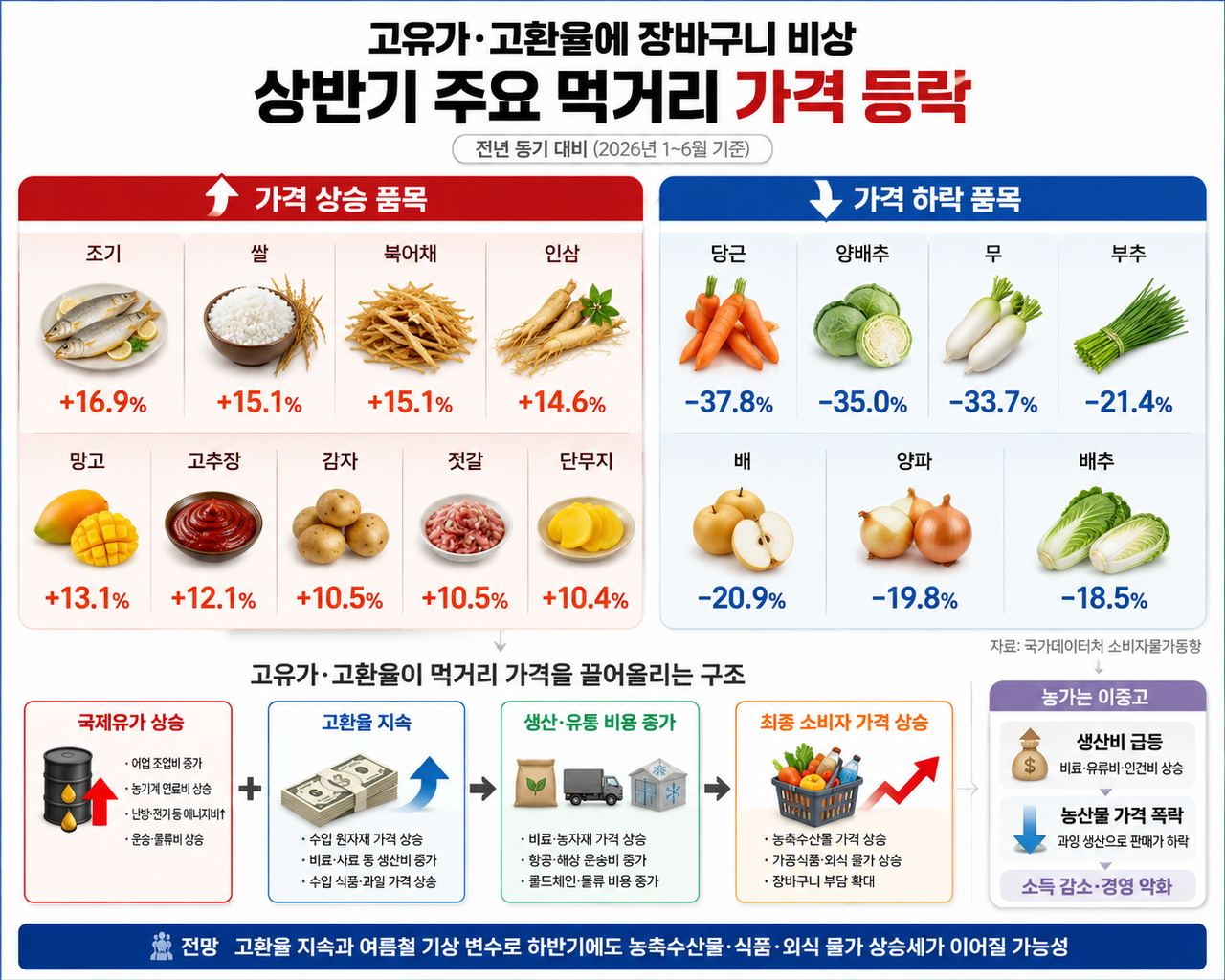
Experts say price pressures are likely to persist through the second half of the year.
The Korea Rural Economic Institute said in a recent report that the rise in agricultural and food prices stems not from any single commodity spike but from a complex interplay of cost increases across the entire supply chain, including energy costs and wages in the food manufacturing sector. The institute estimated that a sustained 10 percent rise in agricultural prices would push the consumer price index for food and non-alcoholic beverages up by 7.56 percent and the index for agricultural, livestock and fishery products up by 9.0 percent.
Experts warn that if the won remains weak and summer heat waves or heavy rains damage crops, vegetable and fruit prices could surge again. The government is also closely watching the possibility that food companies — which have so far deferred price increases by drawing on imported raw material stockpiles — may begin passing on accumulated cost pressures in earnest in the second half.
The government announced a plan last month to inject 1 trillion won into the entire production, distribution and retail chain to stabilize everyday living costs including food prices. But with external variables such as international oil prices, exchange rates and weather conditions still unresolved, analysts say the burden on household grocery budgets is unlikely to ease quickly in the second half.
fact0514@heraldcorp.com





