
South Korean stocks have begun to recover after two days of panic selling. But analysts say Wednesday's across-the-board selloff — in which every single sector on both exchanges fell — exposed a deeper vulnerability: retail money is flowing into leveraged exchange-traded funds rather than ordinary stocks, draining the buying support that would normally cushion the market.
On Thursday morning, the Kospi surged more than 3 percent in early trading, buoyed by bargain hunting after the recent plunge and a rebound in US semiconductor shares, clawing back some of Wednesday's losses. Still, securities industry analysts say the rebound does not change their reading of Wednesday's rout as a sign of fragile market conditions.
Data from the Korea Exchange's KRX Statistics System confirmed the breadth of Wednesday's damage: all 50 Kospi sectors and all 39 Kosdaq sectors posted negative returns. On the Kospi, the KOSPI 200 Heavy Industry sub-index led declines with a drop of 7.58 percent, followed by KOSPI 200 Industrials (-7.38 percent) and KOSPI 200 Construction (-7.33 percent). On the Kosdaq, the Technology Growth segment fell 7.34 percent, with Kosdaq 150 Industrials (-6.80 percent) and Kosdaq 150 Healthcare (-6.71 percent) close behind.
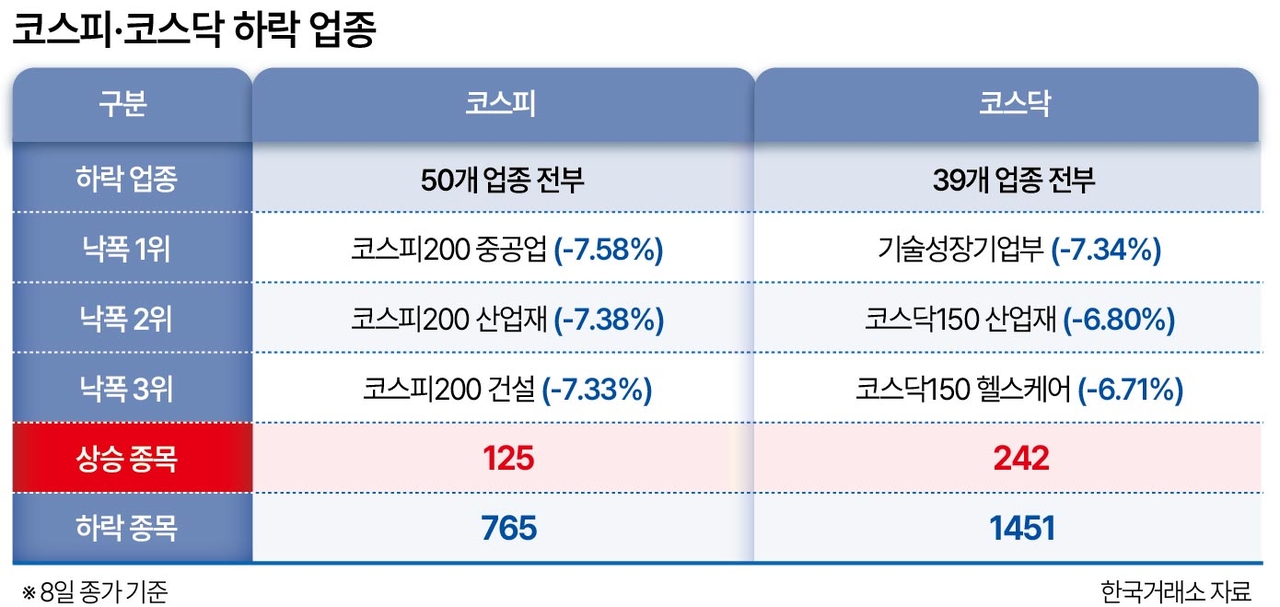
The broad-based selling was equally visible at the individual stock level. On the main board, only 125 stocks advanced while 765 fell. On the Kosdaq, just 242 issues gained ground against 1,451 that declined.
Foreign bargain hunting was not enough to stabilize the market. On Wednesday, foreign investors net bought 474.2 billion won ($314 million) on the main board, while retail investors and institutions net sold 394.1 billion won and 135.7 billion won, respectively. On the Kosdaq, foreign investors net bought 337 billion won, while retail investors and institutions net sold 197 billion won and 137.5 billion won, respectively.
"Foreigners stepped in to buy the dip on Wednesday, but not aggressively enough to lift the market," a securities industry official said. "A defining feature of the market lately is that retail money has been flowing into leveraged products, weakening the buying support for ordinary stocks." The official added that with fewer buyers willing to underpin regular stocks, even minor negative news can trigger selling that spreads rapidly across the entire market.
Retail flows into single-stock leveraged ETFs bear this out. From July 1 through Wednesday, individual investors net bought 563.8 billion won worth of the KODEX Samsung Electronics Single-Stock Leverage ETF and 208.6 billion won of the TIGER Samsung Electronics Single-Stock Leverage ETF. They also snapped up 1.11 trillion won of the KODEX SK hynix Single-Stock Leverage ETF and 469.3 billion won of the TIGER SK hynix Single-Stock Leverage ETF.
Over the same period, Samsung Electronics and SK hynix share prices fell 6.25 percent and 5.68 percent, respectively, pushing the related single-stock leveraged ETFs into double-digit losses across the board. Because leveraged ETFs are designed to deliver twice the daily return of their underlying asset, losses can compound sharply as volatility rises.
The retreat in investor confidence is also visible in cash on the sidelines. According to the Korea Financial Investment Association, investor deposits held at brokerages fell from 139.69 trillion won in early June to 112.33 trillion won on Tuesday — a decline of more than 27 trillion won in roughly a month, signaling a rapid withdrawal of potential buying power from the market.
Analysts say the recent sharp declines have been driven more by investor sentiment and fund flows than by corporate earnings fundamentals, and warn that volatility could persist for some time. "Investor sentiment has turned fragile amid a chain of corrections in semiconductor shares centered on the three major memory chip makers, and the breakdown of the US-Iran truce could continue to weigh on the market," said Han Ji-young, a researcher at Kiwoom Securities. "We are in a market where sentiment and fund flows — not earnings or fundamentals — are calling the shots." Han added that the Kospi's breach of its 60-day moving average and the Kosdaq's break below its 200-day moving average triggered additional technical selling, amplifying overall volatility.

hajun825@heraldcorp.com