
![A bank employee sorts 50,000-won ($33) notes at Hana Bank's counterfeit-response center in Jung-gu, Seoul. [Newsis]](https://wimg.heraldcorp.com/news/cms/2026/07/10/news-p.v1.20260413.c9c1b0c7b6bd44fb84334b3deca4b5f9_P1.jpg)
Lee, a stock-obsessed office worker in his 30s, spotted a buying opportunity when equities pulled back recently. With all his available cash already in stocks, he went looking for another source of funds and discovered savings-backed loans. The product let him keep earning deposit interest while borrowing against his account. He used his 10 million won in savings as collateral and took out a loan.
As the stock market has rebounded, demand for debt-fueled investing through unsecured credit loans has grown — and balances on loans backed by savings and time deposits have risen by roughly 700 billion won over the past year. Analysts say the increase reflects demand from so-called "frugal investors" who need cash for the market but want to hold on to their deposit interest or apartment subscription rights. Experts warn, however, that savings-backed loans still carry annual interest rates of around 4% and that indiscriminate borrowing warrants caution.
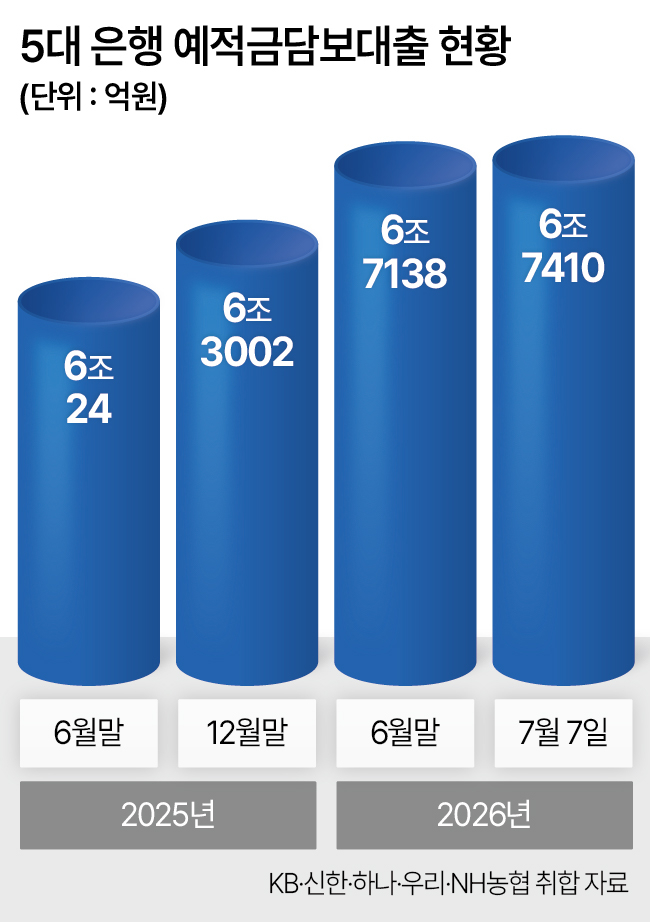
According to financial industry data released Friday, the combined balance of savings-backed loans at KB Kookmin Bank, Shinhan, Hana Bank, Woori and NH — the country's five largest banks — stood at 6.74 trillion won as of Tuesday. That is more than 700 billion won above the 6 trillion won recorded at the end of June last year.
A savings-backed loan, as the name suggests, uses a borrower's own savings or installment-savings account as collateral. While terms vary slightly by bank, borrowers can typically receive up to 100 percent of their account balance. Unlike mortgage loans, these products carry no early-repayment fee.
The upward trend in loan balances became pronounced late last year. The total climbed to 6.3 trillion won in December, when the stock market's rally gained momentum, then rose further to 6.71 trillion won at the end of last month. In the five trading days that followed, balances grew by an additional 27.2 billion won. The pattern suggests a growing number of investors are tapping not only unsecured credit lines such as overdraft accounts but also their own savings deposits to raise funds for the market.
Posts on some stock-market online communities reflect the trend. "Going to max out my savings-backed loan and buy SK Hynix," read one. "Scraping together everything from my savings-backed loan to hold on," said another.
Taking out a savings-backed loan does not affect the underlying deposit or installment-savings product — it remains intact, and the agreed interest continues to be paid at maturity. The arrangement effectively lets borrowers pursue stock investments while still collecting deposit returns, making it a popular tool among frugal investors. Notably, a growing number of people are reportedly pledging their housing subscription accounts as collateral. Doing so does not forfeit their apartment subscription eligibility.
"Savings-backed loans are usually taken out for emergency cash or living expenses, but lately there are quite a few cases of people pledging even their housing subscription accounts to get into the stock market," an official at a commercial bank said. "People see it as a way to raise investment funds while keeping their deposit interest and subscription rights intact."
Another factor reducing the burden on borrowers is that savings-backed loans are exempt from the debt service ratio regulation. Because the bank's principal is fully secured by the collateral, the product is seen as a lifeline for heavily leveraged investors who have run out of other borrowing options.
That said, the interest rate on savings-backed loans is not low. Lenders typically add 1 to 1.25 percentage points on top of the borrower's existing time-deposit rate.
According to Korea Federation of Banks data, the average rate on new time deposits at the five major banks last month ranged from 2.85 percent to 2.98 percent annually. A borrower who opened a time deposit last month and then takes out a savings-backed loan could face an annual rate of up to 4.23 percent. The Bank of Korea has signaled a benchmark interest rate increase, and market rates continue to climb, so savings-backed loan rates are expected to keep rising as well.
If a savings-backed loan is not repaid properly, banks can exercise their right over the collateral — just as they can with mortgage loans. In the worst case, borrowers could lose all the savings they have accumulated.
Within the banking industry, there is talk that lenders may tighten their criteria for savings-backed loans if balances continue to grow. Like unsecured credit loans, savings-backed loans are classified as "other loans" and fall under the financial authorities' cap on total household lending. As of Wednesday, the combined household loan balance at the five major banks had already reached 76.5 percent of the annual ceiling permitted this year.
hyuk@heraldcorp.com





