![[Generated with ChatGPT]](https://wimg.heraldcorp.com/news/cms/2026/07/10/news-p.v1.20260710.e951e8b185ba4615b0c626139a4073a9_P1.png)
Global memory chip share prices, which had been on a strong run, have fallen sharply for more than a week, prompting analysts to say stocks have entered a range suitable for short-term trading.
However, cautious voices have emerged alongside that view, arguing that the industry cycle has yet to peak and that investors should monitor earnings trends closely given the high volatility.
According to the financial investment industry on Thursday, Hanwha Investment Securities said in a report that Micron and SanDisk had fallen roughly 30 percent from their recent highs, entering what it described as a historically meaningful buying zone.
The Philadelphia Semiconductor Index has also pulled back about 15 percent from its peak amid the recent correction, while Nvidia and Broadcom have dropped around 20 percent. Memory chipmakers Micron and SanDisk have recorded declines of around 30 percent.
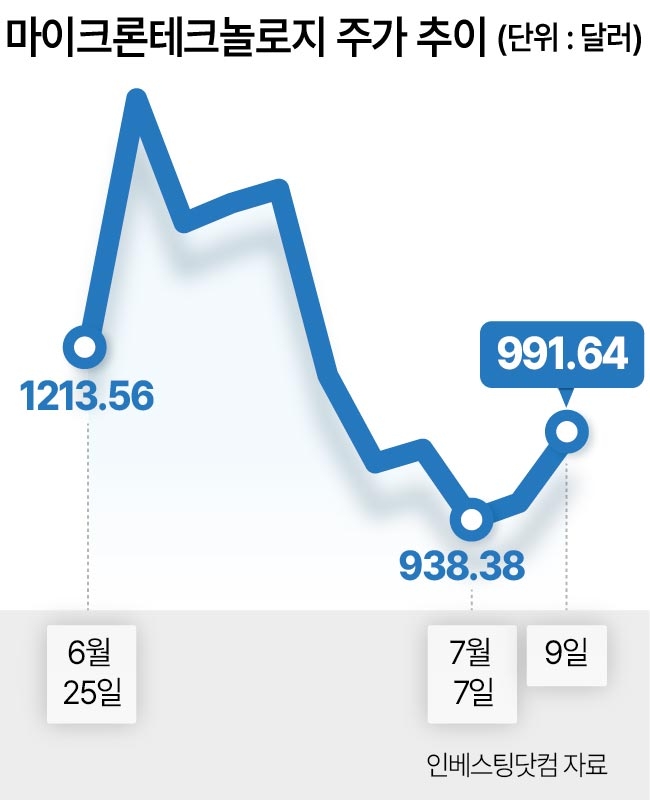
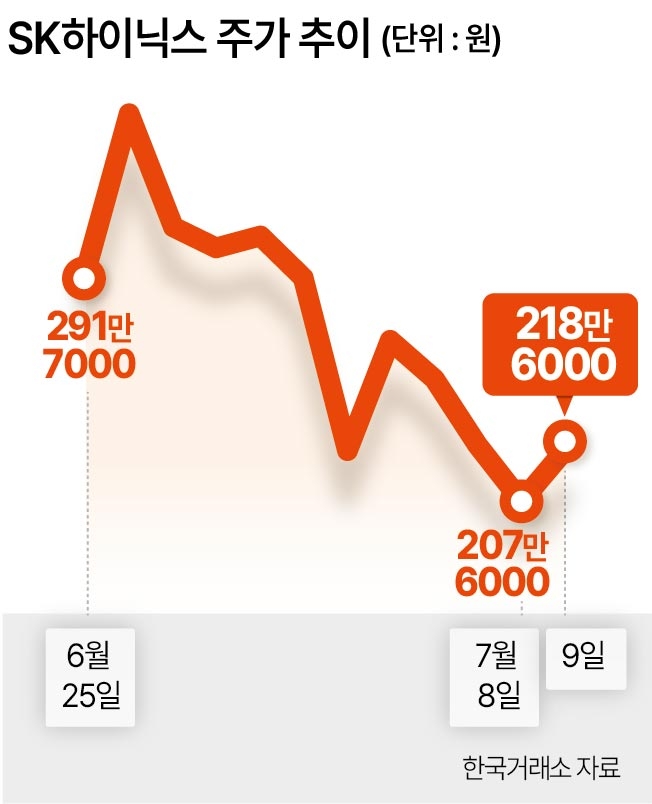
Drawing on historical precedent, the report said that unless US equity markets enter a full-blown bear market, the maximum drawdown for the semiconductor sector tends to cap out at around 20 percent at the index level and around 30 percent for individual stocks.
Excluding periods when the broader market fell into a bear market — such as the COVID-19 shock in 2020, the Federal Reserve's tightening cycle in 2022 and the tariff shock in 2025 — additional downside for semiconductor and memory stocks over the past decade has been limited, the report said.
Technical indicators also point to a potential rebound. The relative strength index of the Philadelphia Semiconductor Index has moved relatively close to the oversold threshold of 30, and the stochastic indicator has entered oversold territory. Micron, the benchmark memory stock, has seen both indicators fall into oversold territory, raising the likelihood of a short-term bounce, the report said.
The RSI is a technical indicator that quantifies how quickly a stock has risen or fallen over a given period. A reading above 70 is generally interpreted as overbought — meaning the stock has risen too much in a short time — while a reading below 30 signals oversold conditions, indicating an excessive decline.
The stochastic indicator shows where the current share price sits relative to the high-low range over a recent period. Readings between 0 and 20 are considered oversold, while readings between 80 and 100 are considered overbought.
Both indicators are technical analysis tools that measure short-term supply-demand dynamics and investor sentiment rather than a company's earnings or fundamentals. An oversold signal does not guarantee a rebound, but it is commonly used as a reference point for judging short-term buying opportunities.
Hanwha Investment Securities also cautioned that the recent decline in price-to-earnings ratios for memory chipmakers should not be read as a sign of undervaluation.
The firm explained that earnings-per-share estimate upgrades have outpaced the share price decline, meaning the actual earnings cycle is still improving. It said a strategy of buying at high P/E ratios and selling at low P/E ratios — based on earnings estimates from one year prior — should remain valid for now.
Han Sang-hee, an analyst at Hanwha Investment Securities, said memory chip stocks, including storage, have fallen about 30 percent from their highs, while non-memory chips and the broader semiconductor index have dropped nearly 20 percent. "This is a time when investors can increase their weighting in semiconductors," Han said. "Based on estimates from a year ago, there is at least one quarter left in which a buy-at-high-P/E, sell-at-low-P/E strategy can play out."
The view on domestic memory chipmakers is similar. KB Securities identified the core cause of the recent semiconductor correction as excessive concern over a slowdown in earnings growth. It added that in a phase of rapid earnings expansion like the current one, a deceleration in the growth rate due to base effects is a natural phenomenon and should not be interpreted as a signal that the industry cycle has peaked.
The firm also cited the historical example of SK hynix. In both 2013 and 2017, EPS growth peaked first, but the actual share price high came roughly 10 months and nine months later, respectively. Even as EPS growth slowed, the absolute level of earnings continued to rise, sustaining the share price rally.
KB Securities said the more important metric in the current market is not earnings growth but profit margins. Based on current consensus estimates, chipmakers' margins are expected to improve through the fourth quarter of this year, making it difficult to conclude that the industry cycle has already peaked, it said.
Still, some voices are urging caution against premature optimism. KB Securities itself said the key to future investment decisions lies in whether profit margins continue to improve, noting that margins can shift frequently and that investors should watch closely for changes in forward estimates.
Some brokerages believe current share prices remain stretched even accounting for a favorable industry outlook. BNK Investment Securities recently set a target price for SK hynix at 1.85 million won ($1,230) — below the current share price — signaling limited room for further upside.
Lee Eun-taek, an analyst at KB Securities, said the time has come to assess whether the share price correction can be viewed as an opportunity to add exposure. "Even if EPS keeps growing, does that mean the share price must fall if the growth rate stays below 800 percent? That seems unlikely," Lee said.

th5@heraldcorp.com