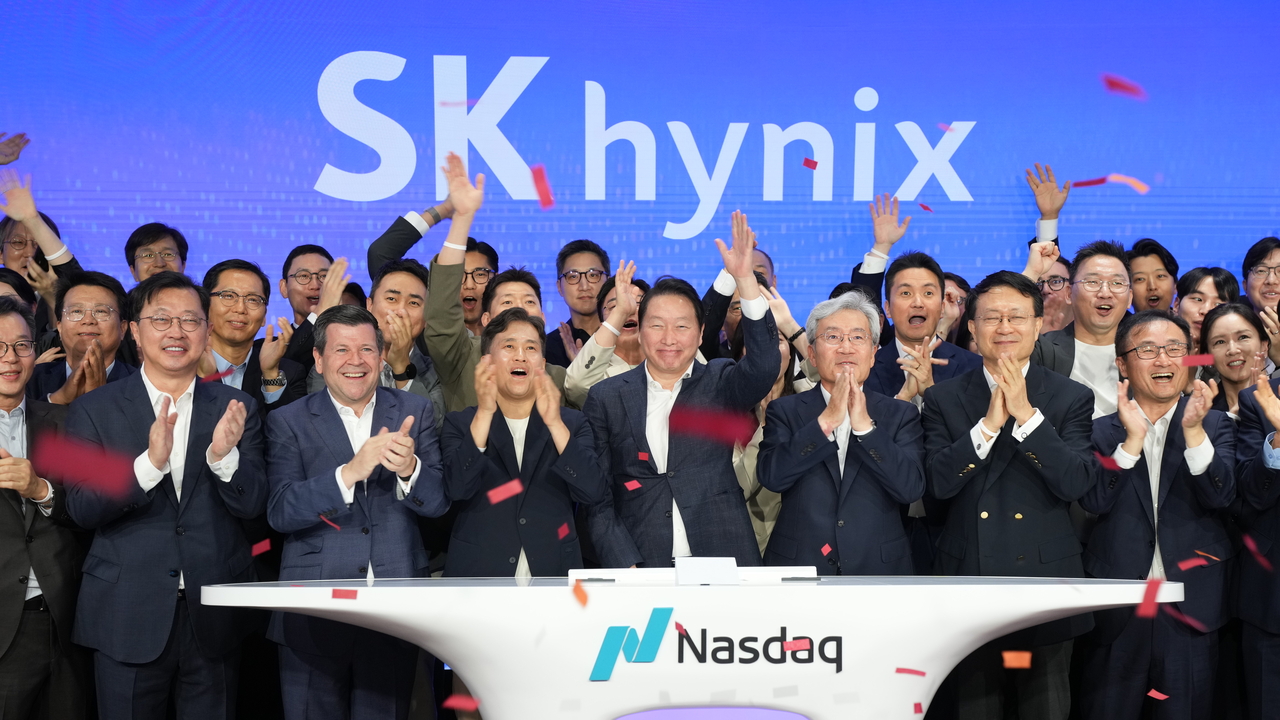
SK hynix left the door open to additional semiconductor investment in the United States even as it marked its Nasdaq debut. The remarks came immediately after the US government publicly called on Samsung Electronics and SK hynix to expand memory chip production on American soil, raising expectations that investment pressure between Seoul and Washington over the AI semiconductor supply chain could intensify further.
SK Group Chairman Chey Tae-won raised the possibility of further US investment during an interview with CNBC at a ceremony in New York on Friday marking SK hynix's listing of American depositary receipts on the Nasdaq.
Chey said the company is considering additional investment beyond its advanced packaging facility in Indiana, adding that building a memory production factory in the United States is possible "if conditions such as power, water, labor and supply chain are in place."
SK hynix is currently constructing an advanced semiconductor packaging production base in West Lafayette, Indiana, with an investment of $3.87 billion. Advanced packaging is considered a critical process for boosting the performance of AI chips such as high-bandwidth memory (HBM).
Chey also said that separate from any memory production facility, investments worth tens of billions of dollars could be made in AI data centers, related technology and joint ventures in the United States. The remarks signal that SK hynix could expand its US business footprint beyond semiconductor manufacturing to encompass data centers and solutions, in line with growing AI demand.
Chey's comments drew added attention because they came immediately after a public push by US Commerce Secretary Howard Lutnick. At an event Friday for a semiconductor factory that Micron is building in Clay, New York, Lutnick directly called for Samsung Electronics and SK hynix to expand their US production.
Lutnick said he is in discussions with the two South Korean memory chipmakers but declined to share details. "I want to bring Samsung and SK hynix — the competitors — to the United States and have them build production facilities," he said. "Micron is leading the way, so the competitors will ultimately have no choice but to follow."
He added that President Donald Trump "has made it clear that the United States is where business needs to be done," saying "there has never been a better time to invest in America."
Behind the US pressure lies a broader strategy to restructure the AI-era semiconductor supply chain around American industry. The Trump administration is pursuing a plan to secure more semiconductor manufacturing capacity on US soil and anchor the memory and advanced packaging supply chains needed for the AI industry within the United States.
Micron's announcement of a massive investment fits the same pattern. The company said it plans to invest more than $250 billion in domestic semiconductor factories and technology by 2035. The plan includes construction of a factory in New York and expansion of plants in Idaho and Virginia, with Micron setting a target of producing 40 percent of its DRAM output in the United States.
SK hynix now faces the challenge of balancing demands for expanded US investment against its domestic investment plans. Late last month, the company unveiled a plan to build a 1,100 trillion won domestic AI memory production belt centered on the Yongin semiconductor cluster, Cheongju and the Honam region, with the aim of developing its South Korean production bases into a core hub for AI memory.
The options available to South Korean companies are growing more complicated, however, as the US government appears increasingly likely to use semiconductor tariffs, subsidies and supply chain restructuring as negotiating leverage. While local US production offers advantages in customer access and reduced trade risk, a memory factory requires power, water, labor and a supplier ecosystem all in place — making it a difficult investment to commit to quickly.
Industry observers say that if SK hynix does move forward with building a memory production factory in the United States, the total investment could grow to hundreds of trillions of won over the long term. A memory production line rarely ends with a single factory, as follow-on capacity expansions, equipment investment and the buildout of a materials and components supply chain typically come with it.
Through its Nasdaq ADR listing, SK hynix plans to raise about $26.5 billion. The proceeds are expected to be used to expand production capacity for HBM and other AI memory chips and to strengthen the company's financial stability.
kwater@heraldcorp.com