
![[Created using ChatGPT and Mangoboard]](https://wimg.heraldcorp.com/news/cms/2026/07/11/9/news-p.v1.20260711.c0812dfe39d94f22ab011e824bd4f1fd_P1.jpg)
Chinese DRAM maker CXMT is seeking to raise around 6.5 trillion won ($3.99 billion) through an initial public offering. The company still trails far behind the three dominant players in the global DRAM market — Samsung Electronics, SK hynix and Micron — but is betting on a mainstream DRAM boom to close the gap.
CXMT filed a prospectus with the Shanghai Stock Exchange on Thursday and formally launched its IPO process, according to the semiconductor industry. Founded in 2016, the company has grown within a decade into China's largest DRAM maker and one of the world's top four producers.
In the prospectus, CXMT described itself as the No. 1 DRAM manufacturer in China by production capacity and No. 4 globally, while naming Samsung Electronics, SK hynix and Micron as its main competitors. It also acknowledged the gap with the leaders. "A certain gap still exists between us and the top three global players," the company said, citing differences in production capacity, research and development, and sales scale.
CXMT aims to raise 29.5 billion yuan, or about 6.5 trillion won, through the offering. The total investment plan amounts to 34.5 billion yuan, with any shortfall to be covered by internal funds.
The proceeds will go toward upgrading production lines and advancing DRAM technology. The breakdown allocates 7.5 billion yuan to production-line upgrades, 13 billion yuan to DRAM technology advancement, and 9 billion yuan to next-generation DRAM research and development.
Notably, CXMT is leading with mainstream DRAM rather than high-bandwidth memory. The HBM market is dominated by SK hynix, Samsung Electronics and Micron, which hold commanding technology leads. Rather than challenging them head-on in HBM, CXMT appears to have chosen to build market share through more accessible mainstream product lines such as DDR5 and LPDDR5X.
This strategy aligns with recent market trends. As investment in AI servers expands, demand is rising not only for HBM but also for mainstream DRAM used in servers, PCs and mobile devices. Analysts say that as the leading chipmakers concentrate their production capacity on HBM and advanced products, a supply gap in mainstream DRAM has opened up for challengers to fill.
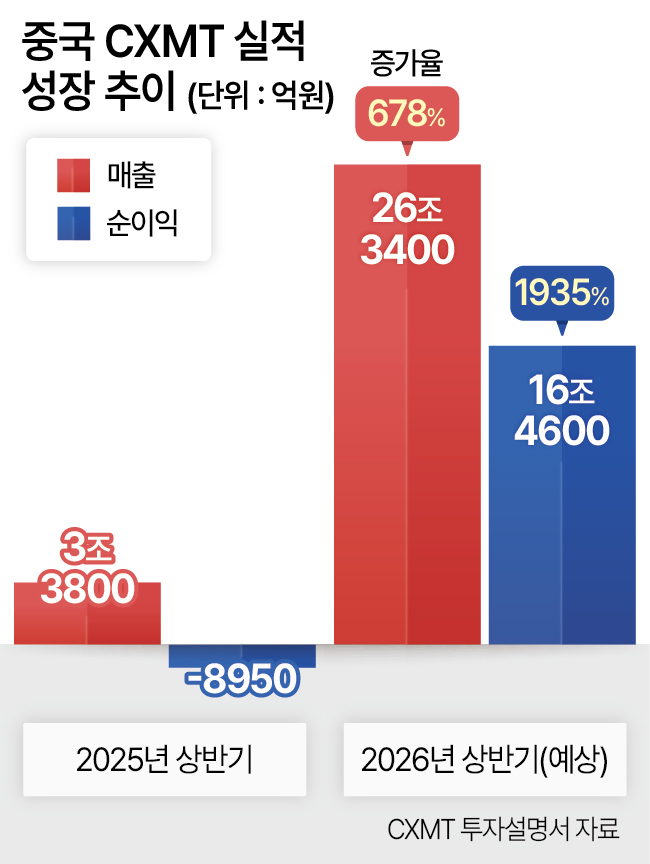
CXMT's revenue structure also reflects its mainstream DRAM focus. According to the prospectus, LPDDR products accounted for 66.4 percent of the company's sales last year, while DDR products made up 31.9 percent — meaning the vast majority of revenue came from general-purpose DRAM used in mobile devices, PCs and servers.
Its market share has also risen sharply. According to market research firm Omdia, CXMT held a 7.6 percent share of the global DRAM market in the first quarter of this year, up nearly 3 percentage points from 4.7 percent the previous quarter. Over the same period, Samsung Electronics led with 38.6 percent, followed by SK hynix at 28.8 percent and Micron at 22.4 percent.
Recent reports have also emerged that Apple is considering adopting CXMT DRAM in some of its products. While the extent of any actual adoption has not been confirmed, the mere mention of a potential global customer relationship signals a shift in the standing of Chinese memory chip makers.
SK hynix's recent listing of American depositary receipts on a US stock exchange further illustrates the broader industry mood, reaffirming strong investor appetite for AI memory. As global capital flows into AI semiconductors and memory supply chains, China is also moving to accelerate the development of its domestic DRAM industry.
"During a memory boom, the conditions are most favorable for late entrants to grow the fastest," an industry official said. "Right now, CXMT is filling the volume that the top three global players cannot supply, which is driving its market share expansion. Domestic companies are keeping a close eye on the Chinese challengers."
The official added that while Chinese government semiconductor funds had underpinned CXMT's growth so far, IPO proceeds would significantly expand its investment capacity. Once listed, the official said, CXMT's earnings and investment results would be disclosed publicly, putting its competitiveness to a real test.
![CXMT's DDR5 chip. The company trails Samsung Electronics and SK hynix by only one generation in mainstream DRAM technology. [Captured from CXMT website]](https://wimg.heraldcorp.com/news/cms/2026/07/11/news-p.v1.20260528.8d8391db2b5c4cb7b635e4c34877c592_P1.png)
With private capital now supplementing Chinese government support, CXMT's investment pace is likely to accelerate further. For China, which has made semiconductor self-sufficiency a national strategy, DRAM remains a critical priority. CXMT's decision to prominently highlight its status as the world's No. 4 producer also suggests it has markets beyond China in its sights.
Closing the technology gap with the top three in the short term will not be easy, however. The barriers to entry remain particularly high in HBM for AI servers, advanced process nodes, customer qualification and yield management — areas where Samsung Electronics, SK hynix and Micron hold strong advantages. Even as CXMT builds scale in mainstream DRAM, the real test will come when it tries to move into higher-value products.
The top three are not standing still, either. Samsung Electronics is expanding its AI memory investment centered on its Pyeongtaek campus and US operations. SK hynix is reinforcing its lead in HBM through the Yongin semiconductor cluster and advanced packaging investments. Micron is also pursuing production capacity expansion in the United States and Japan.
kwater@heraldcorp.com





