The Democratic Party of Korea and the government agreed Monday to push ahead aggressively in the second half of this year with three mega-projects — semiconductors, AI data centers and physical AI. They also laid out a second-half economic growth strategy covering three priority areas: managing the fallout from the Middle East war, reversing the decline in potential growth and addressing polarization.
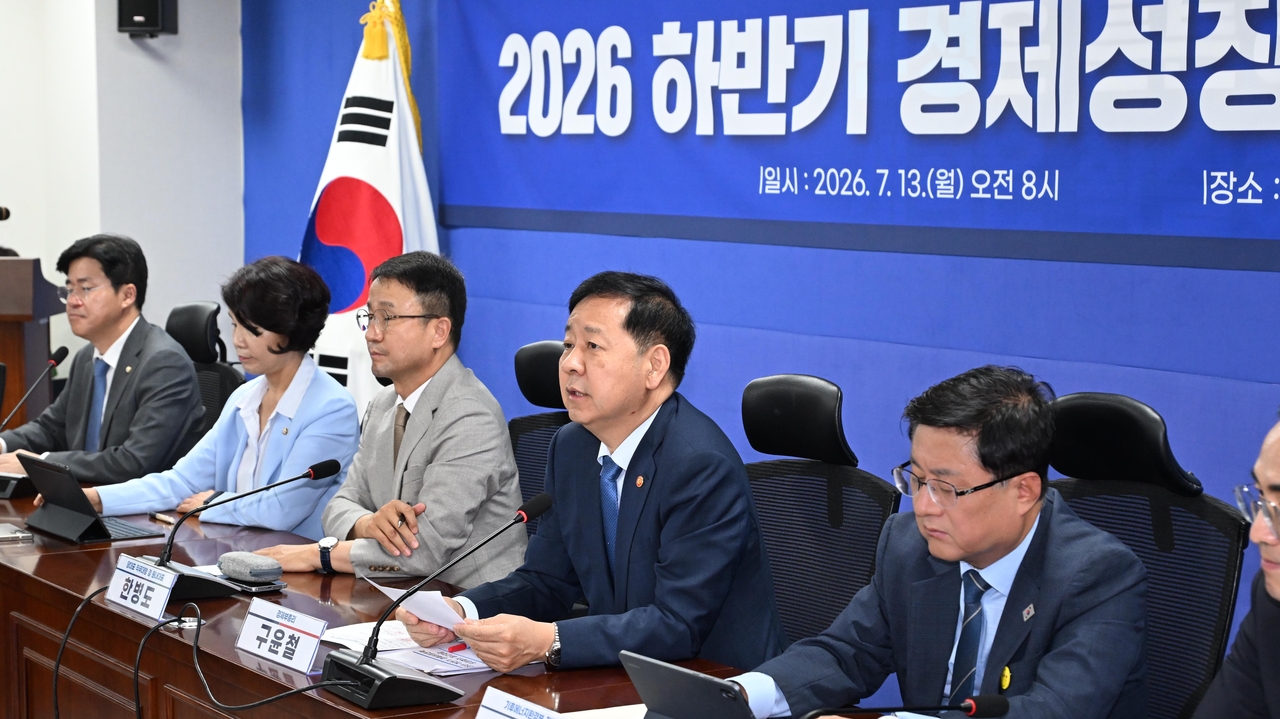
Deputy Prime Minister and Minister of Economy and Finance Koo Yun-cheol announced the plans at a party-government consultation on the 2026 second-half economic growth strategy, held Monday at the National Assembly Members' Office Building. "We will build an integrated response framework to stabilize overall markets — including the macroeconomy, financial and foreign exchange markets, and real estate — and rigorously manage risks such as inflation, exchange rates and interest rates," Koo said.
Koo added that the government would support housing stability through expanded housing supply while securing Korea's supply chain resilience and energy independence through strategic economic cooperation. "We will build a five-hub, three-special-zone growth engine to strengthen locally driven growth," he said. He also said the government would work to overcome K-shaped polarization by supporting vulnerable groups including youth and small and medium-sized enterprises, transform the financial sector toward productive ends, manage national wealth strategically and pursue structural reforms in fiscal and tax policy.
Minister of Climate, Environment and Energy Kim Sung-hwan said the three mega-projects — semiconductors, AI data centers and physical AI — all depend entirely on electricity. "They are only meaningful if powered by clean electricity from renewable energy, not electricity generated from coal," Kim said. "We will support the green transformation advancing alongside the AI transformation, so that Korea can lead the way into a new future."
Minister of Planning and Budget Park Hong-keun outlined three priority tasks for the second half: establishing a future-response fund backed by semiconductor windfall tax revenues, carrying out a high-intensity expenditure restructuring, and accelerating the five regional industries while supporting youth and small business owners. Park signaled that mandatory spending — long treated as off-limits in restructuring efforts — would now be squarely in the government's sights. "We will reform education grant allocations to reflect changing circumstances and improve investment stability, and will move in earnest to overhaul mandatory spending that has until now been considered untouchable," he said.
The Democratic Party also pledged to keep pace with the early push on the three mega-projects. Floor leader Han Byung-do said the party would pass key legislation — including a special act on mega special zones and a strategic export finance support act — by the end of this year. "In particular, since the party has set up a dedicated special committee to support the three mega-projects, we will provide solid backing through legislation and budgeting," Han said.
Democratic Party policy committee chairwoman Han Jeong-ae said Monday's party-government consultation would serve as an occasion to review policy tasks for driving people's livelihoods and the economy and to discuss implementation strategies. She said the agenda would include nurturing globally competitive growth engines — represented by the three mega-projects aimed at reversing the potential growth rate — as well as strengthening regional growth through the development of local economic drivers.
addressh@heraldcorp.com