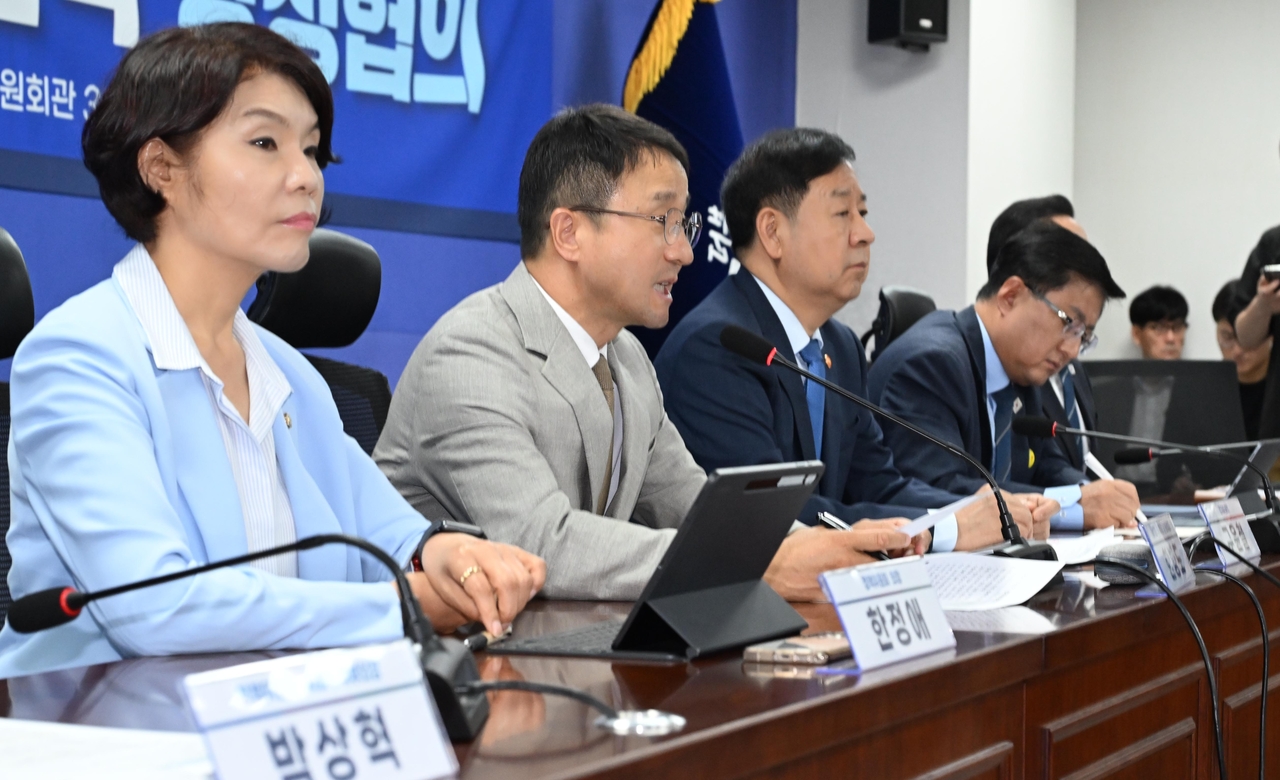
The Democratic Party of Korea and the government are moving to overhaul mandatory fiscal spending, including the local education finance grant system.
In particular, they agreed to accelerate three major mega-projects — semiconductors, AI data centers and physical AI — in the second half of this year, and to develop a second-half economic growth strategy across three areas: a post-Middle East war strategy, a rebound in potential growth and responses to structural challenges.
Han Jeong-ae, the Democratic Party's policy committee chairwoman, announced the plans after the "2026 Second-Half Economic Growth Strategy Consultative Meeting" held at the National Assembly Members' Office Building on Monday. "The ruling party and government agreed to push forward three mega-projects to build an irreplaceable Korea, and to designate regional growth engines under the '5 poles, 3 special zones' framework to strengthen local economic momentum," she said.
On the proposed "Future Response Fund" — designed to deploy additional semiconductor tax revenue — Han said the party is in discussions with the government and that the bill will be introduced as government-sponsored legislation. She said additional tax revenue beyond original projections will materialize from this year through around 2030, and that the party is working out how to channel the fund toward next-generation growth and youth-related priorities, with a focus on concentrated investment in education to support Korea's transformation and the three mega-projects.
Han also signaled that legislation would be introduced in the second half of the year ahead of revisions planned for next year. She said that given how additional tax revenue has traditionally flowed to local governments and education offices in the form of special grants, local governments expecting such transfers need to be taken into account when establishing the Future Response Fund. "We will hold in-depth discussions within the government, and once a position is reached, we will consult further and submit it as a government bill," she said.
Koo Yun-cheol, deputy prime minister for the economy and minister of Economy and Finance, said in his opening remarks that the government would build an integrated response framework to stabilize overall markets — including the macroeconomy, financial and foreign exchange markets, and real estate — and would rigorously manage risks related to inflation, exchange rates and interest rates.
Koo added that the government would support residential stability through expanded housing supply while securing Korea's supply chain resilience and energy independence through strategic economic cooperation, and would strengthen locally led growth by establishing the five-pole, three-special-zone growth engine framework. He also cited plans to overcome K-shaped polarization through support for youth and small and medium-sized enterprises, transform the financial sector toward productive ends, manage national wealth strategically, and reform fiscal and tax structures.
Kim Sung-hwan, minister of Climate, Environment and Energy, said the three mega-projects — semiconductors, AI data centers and physical AI — all depend entirely on electricity. "They are only meaningful if powered by clean electricity from renewable energy, not electricity generated from coal," he said. "We will support the green transformation advancing alongside the AI transformation, so that Korea can lead the way into a new future."
Park Hong-keun, minister of Planning and Budget, outlined three priority tasks for the second half of the year: establishing the Future Response Fund backed by excess semiconductor tax revenue, carrying out high-intensity expenditure restructuring, and launching five regional industries while supporting youth and small business owners. Park said the government would begin reforming mandatory spending items long treated as untouchable in restructuring efforts, including revising the education finance grant system to reflect changing conditions and improve investment stability.
Han Byung-do, the Democratic Party's floor leader, said the party would pass key legislation in the National Assembly by year-end, including a special law on mega special zones and a strategic export finance support act. "In particular, since the party has set up a dedicated special committee to support the three mega-projects, we will provide solid backing through legislation and budgeting," he said.
addressh@heraldcorp.com