Single-stock leveraged exchange-traded funds tied to Samsung Electronics and SK hynix hit all-time lows on Monday, yet trading in those products surged to around 12 trillion won ($7.97 billion). The 16 products collectively accounted for 33.87 percent of total ETF turnover, and the turnover rate on some reached 1,791.59 percent — meaning the freely tradable shares changed hands roughly 18 times in a single session. Financial authorities, alarmed by the growing volatility controversy, have begun discussions on tightening the regulatory framework for single-stock leveraged ETFs.
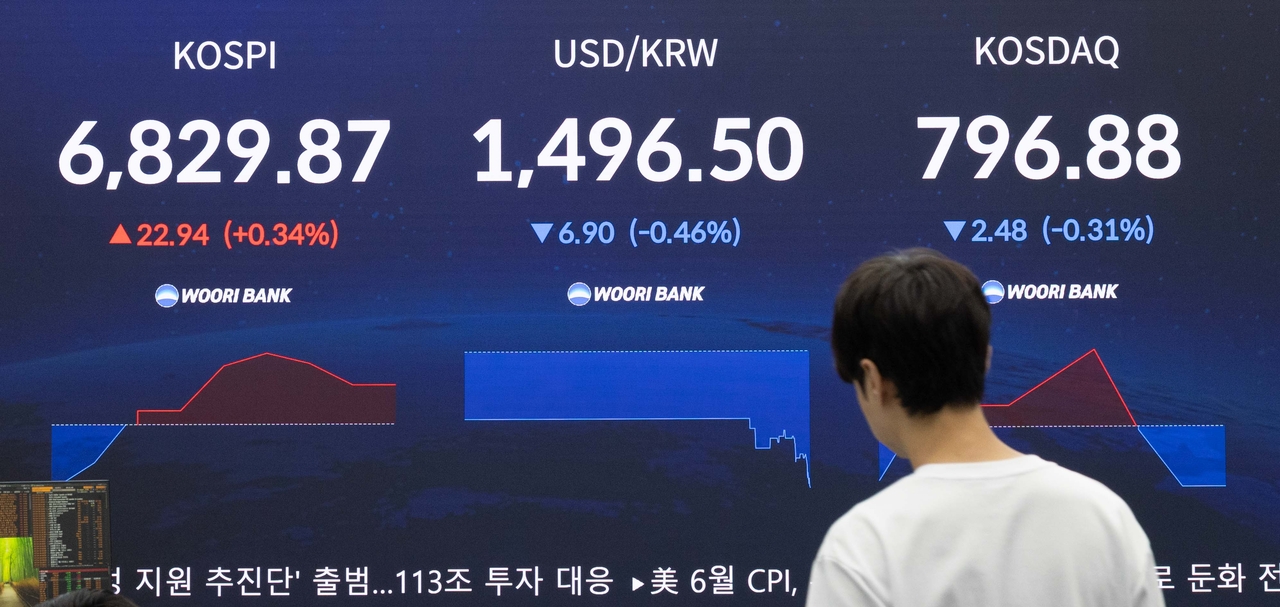
Samsung Electronics and SK hynix plunged 10.7 percent and 15.37 percent, respectively, on Monday, dragging the single-stock leveraged ETFs that track them to record lows since their listings. The Kospi fell 8.95 percent to close at 6,806.93, with the semiconductor selloff triggering the market's seventh circuit breaker of the year and its 35th sell-side sidecar during intraday trading.
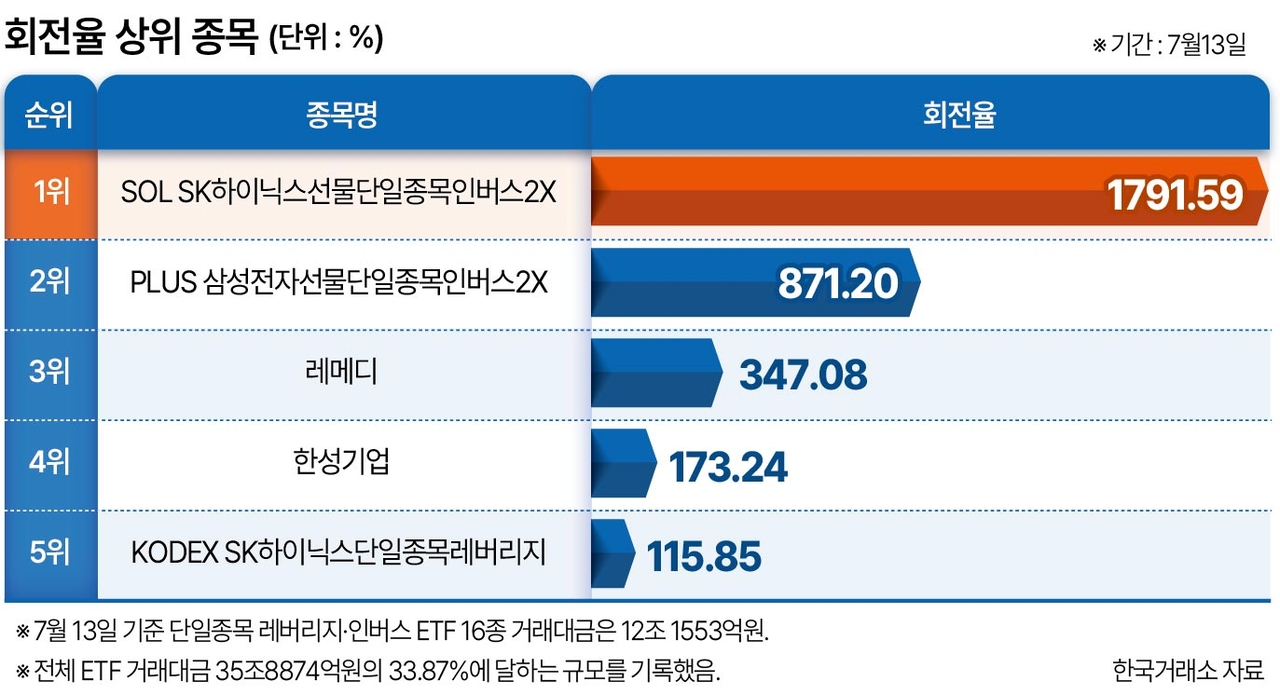
Despite the rout, combined trading in the 16 Samsung Electronics and SK hynix single-stock leveraged and inverse ETFs reached 12.16 trillion won — 33.87 percent of total ETF turnover of 35.89 trillion won. On Friday, the same group had already logged 10.12 trillion won in trades, or 31.6 percent of total ETF turnover of 31.98 trillion won. On Monday, when the products hit their all-time lows, trading rose by about 2 trillion won from Friday and their share of total ETF turnover climbed from 31.6 percent to 33.87 percent.
The ultra-short-term trading frenzy was most visible in turnover rankings. Samsung Electronics and SK hynix single-stock ETFs dominated the top spots. Turnover rate measures trading volume relative to shares in circulation — the higher the figure, the more actively investors are flipping positions.
The SOL SK Hynix Futures Single-Stock Inverse 2X ETF posted a turnover rate of 1,791.59 percent on Monday, while the PLUS Samsung Electronics Futures Single-Stock Inverse 2X ETF recorded 871.20 percent. The only non-semiconductor names in the top four were Remedi, which debuted that day at 347.08 percent, and Hansung Enterprise at 173.24 percent, buoyed by a wave of so-called "patriotic buying."
Beyond those two, Samsung Electronics and SK hynix single-stock ETFs swept the upper rankings — KODEX SK Hynix Single-Stock Leverage at 115.85 percent, TIGER SK Hynix Single-Stock Leverage at 84.47 percent, and SOL SK Hynix Single-Stock Leverage at 84.23 percent.
Even as trading enthusiasm runs high, retail investors are burning through their cash quickly. According to the Korea Financial Investment Association, investor deposit balances fell from 136.83 trillion won on June 23 to 105.58 trillion won on Friday — a drop of 31.26 trillion won. Over the same period, retail investors net-bought 34.89 trillion won worth of shares on the Kospi and Kosdaq, while foreign investors net-sold 42.65 trillion won. The rapid drawdown in sideline cash reflects retail investors absorbing the wave of foreign selling.
Losses are mounting quickly. According to Korea Exchange, the KODEX SK Hynix Single-Stock Leverage ETF fell to 14,915 won on Monday, its lowest since listing — down 66.4 percent from its all-time high of 44,385 won on June 23. The TIGER Samsung Electronics Single-Stock Leverage ETF also set a new record low that day, sliding to 12,175 won, a 59.94 percent drop from its peak of 30,395 won reached on June 2.
The single-stock leveraged ETF market has also shrunk rapidly. The combined market capitalization of the 16 single-stock leveraged and inverse ETFs, which had exceeded 16 trillion won on June 25, fell to 9.65 trillion won by Monday — more than 6 trillion won wiped out in less than a month. As the underlying assets, Samsung Electronics and SK hynix, tumbled, losses in the leveraged products snowballed.
Financial authorities and the industry are moving quickly to develop remedies. Financial Supervisory Service Governor Lee Chan-jin, at a meeting with asset management company CEOs on Monday, called for an end to false and exaggerated ETF advertising and demanded stronger oversight of price-to-net-asset-value discrepancy rates. On Tuesday, brokerage CEOs gathered independently to discuss recent market volatility — including single-stock leveraged ETFs — and investor protection measures.
Financial authorities have asked the industry to strengthen investor protection for single-stock leveraged ETFs. Options under discussion include raising minimum deposit requirements, tightening investor eligibility criteria, adjusting leverage multipliers, and capping daily turnover rates. The industry broadly expects regulatory changes to focus on reinforcing investor safeguards rather than pursuing delistings.
Market analysts point to both deteriorating investor sentiment and the supply-and-demand dynamics of single-stock leveraged ETFs as factors behind the recent market plunge. Because leveraged ETFs mechanically buy and sell their underlying assets during end-of-day rebalancing, they can amplify volatility. Analysts warn that the steeper the drop in semiconductor stocks, the more rebalancing trades are triggered — potentially creating a vicious cycle of escalating volatility.
"The sharp correction recently owes more to technical factors — specifically the short-gamma structure of leveraged ETFs — than to fundamentals," said Yoo Myeong-gan, a researcher at Mirae Asset Securities. "Leveraged ETFs are structured to buy when prices rise and sell when they fall, which can amplify market volatility."

hajun825@heraldcorp.com
kacew@heraldcorp.com