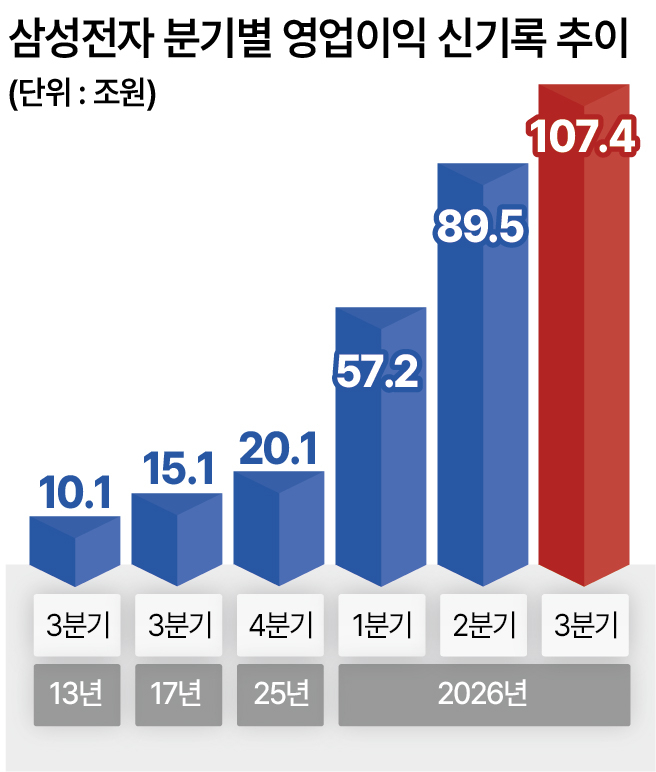
![Samsung Electronics' headquarters in Seocho-gu, Seoul, is seen Thursday. The company announced Thursday that its consolidated operating profit for the third quarter reached 107.4 trillion won, up 782.5 percent from a year earlier — marking the first time a domestic company has posted quarterly operating profit exceeding 100 trillion won. [Yonhap]](https://wimg.heraldcorp.com/news/cms/2026/10/08/rcv.YNA.20261008.PYH2026100801320001300_P1.jpg)
As Samsung Electronics wraps up a large-scale share buyback this month, market attention is shifting to earnings and shareholder returns as the key drivers of its share price going forward. While the end of the buyback program is expected to create a short-term supply gap, analysts say improving profit margin forecasts and expectations of additional shareholder returns should limit downside pressure on the stock.
According to the financial investment industry, the main variables supporting Samsung Electronics' share price after the buyback ends are earnings and shareholder returns. Samsung Electronics posted third-quarter operating profit of 107 trillion won ($79.9 billion), beating market consensus, and has set its total shareholder return for this year in the 90 trillion to 110 trillion won range. Following the third-quarter dividend, the size and specific details of the remaining shareholder return program are set to be decided in January next year.
Forecasts for operating profit margin — a gauge of future earnings quality — are also rising. Samsung Electronics' third-quarter sales came in at 195 trillion won, falling short of the market consensus of 200.28 trillion won, but operating profit exceeded the consensus of 106 trillion won. The operating profit margin reached 54.9 percent, roughly 2 percentage points above the market consensus based on FnGuide data.
Industry analysts say profitability improvements centered on HBM4 are likely to continue. Based on FnGuide's sales and operating profit consensus figures, Samsung Electronics' implied operating profit margin is projected to rise steadily over the next three quarters. Even in a high-rate environment, the margin is expected to climb from 55.8 percent in the fourth quarter of this year to 57.6 percent in the first quarter of next year and further to 59.7 percent in the second quarter. "The engine of growth in 2027 will be HBM4," said Park Jun-young, a researcher at Hanwha Investment & Securities. "The expansion of HBM4 shipments will be a turning point that changes not only Samsung Electronics' HBM market share but also the market's overall assessment of its technological capabilities."
Upward revisions to earnings estimates driven by an improving memory chip market are also seen as a positive factor for the share price. Meritz Securities on Wednesday raised its 2027 operating profit forecast for Samsung Electronics by 13 percent, from 562 trillion won to 632 trillion won. "Over the next one to two months, upward revisions to 2027 earnings estimates will coincide with growth appeal, undervaluation and shareholder return attractiveness all at once," said Kim Seon-woo, a researcher at Meritz Securities. "The shareholder return program, which had been centered on dividends, is expected to evolve to incorporate share buyback and cancellation as well."
The shareholder return pipeline extends well beyond the current buyback program. Samsung Electronics has set its total shareholder return for this year in the 90 trillion to 110 trillion won range, with a cash dividend of around 30 trillion won planned for the third quarter. The size and specific details of the remaining shareholder return program will be decided at the end of January next year. By simple calculation, after excluding the third-quarter dividend, roughly 60 trillion to 80 trillion won in additional resources remains. Since the company plans to consider not only cash dividends but also share buyback and cancellation, expectations for further returns remain high.
Expectations for additional share cancellations have already spread to preferred shares. From Sept. 24 through Wednesday, retail investors net purchased more than 1.6 trillion won in Samsung Electronics preferred shares, making them the top net purchase among domestic retail investors during that period. After proposals were floated within and outside the industry for Samsung Electronics to conduct additional share buybacks and cancellations — including canceling both common and preferred shares — the company said it would review the suggestions. This explains why buying interest has concentrated in preferred shares even as net selling of common shares continued.
Industry analysts believe the supply gap following the end of the buyback program is unlikely to significantly weigh on the share price. Lee Kyung-min, a researcher at Daishin Securities, noted that a substantial portion of existing institutional selling had already been absorbed during the buyback process. "If earnings come in strong, there is no need to worry about the supply gap," Lee said. "The cash dividend at the end of October and the remaining shareholder return decision in January next year will serve as events that fill the gap."
kacew@heraldcorp.com