
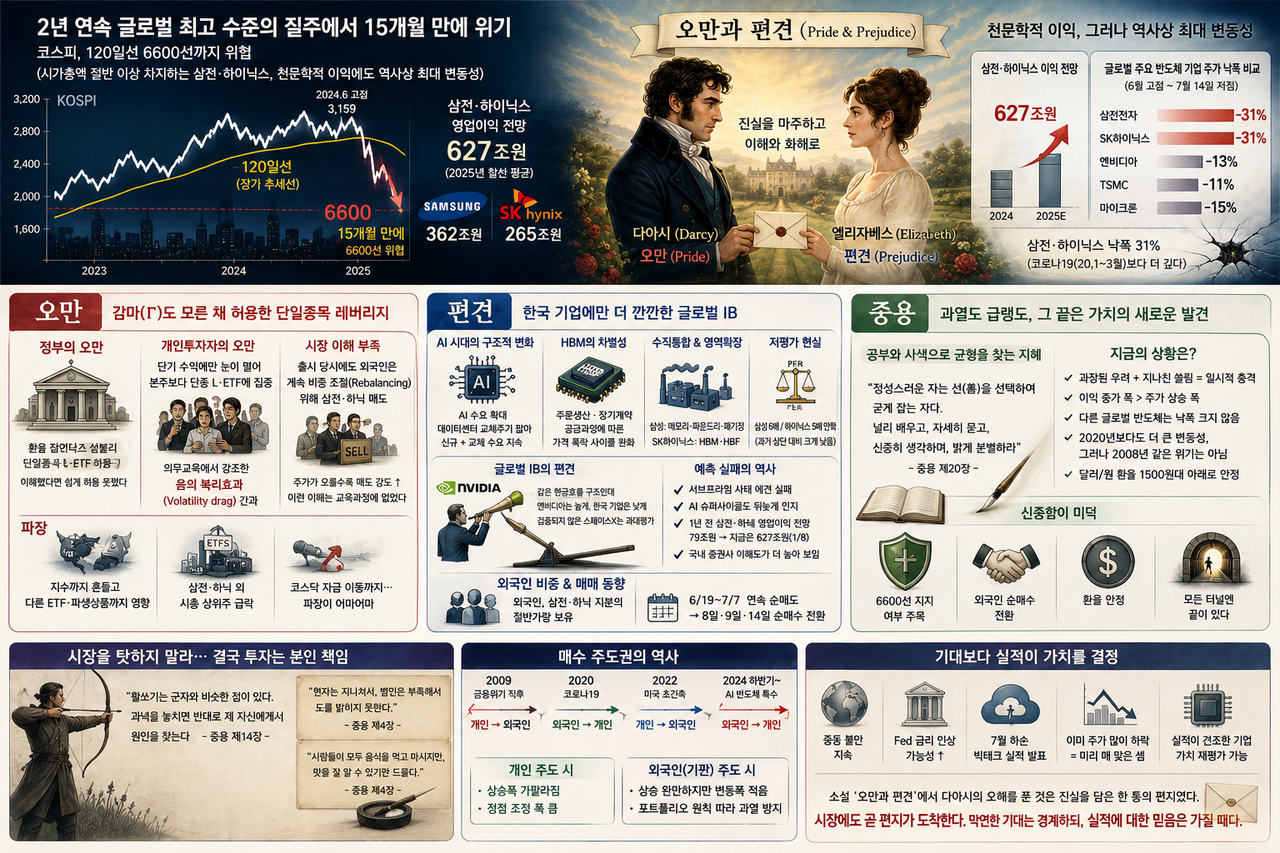
The Kospi, which had been running at the top of global markets for two consecutive years, has found itself threatened for the first time in 15 months by its long-term trend line — the 120-day moving average at 6,600. The irony is striking: Samsung Electronics and SK hynix, which together account for more than half of total market capitalization, are signaling astronomical profits, yet the index is showing some of the most extreme volatility in global stock market history.
Jane Austen's classic "Pride and Prejudice" comes to mind. The novel follows the arrogant Mr. Darcy and the prejudiced Elizabeth as they clash before ultimately confronting the truth and finding reconciliation.
Pride: single-stock leveraged ETFs approved without understanding gamma
The first act of pride belongs to the government, which hastily approved single-stock leveraged ETFs on Samsung Electronics and SK hynix in a bid to stabilize the dollar-won exchange rate. Anyone who understood the basic principle of gamma hedging — the sensitivity of an option's delta to changes in the underlying asset price — would never have so easily approved leveraged and inverse ETFs on mega-cap stocks that together represent more than half of total market cap. The sheer size of these two names means their moves ripple through the broader index, affecting not only other ETFs but derivatives as well. That is why other large-cap stocks beyond Samsung Electronics and SK hynix also tumbled sharply. A significant amount of capital is estimated to have migrated from Kosdaq into these single-stock leveraged ETFs. The fallout has been wide.
Some domestic investors were equally arrogant, fixating on single-stock leveraged ETFs in Samsung Electronics and SK hynix rather than on the underlying shares. The mandatory education course required to qualify for single-stock leveraged ETF investing placed the greatest emphasis on "volatility drag" — the negative compounding effect. Leveraged investments carry extreme risk when asset prices move contrary to expectations.
Notably, even at the time these single-stock leveraged ETFs launched, foreign investors were already continuously selling Samsung Electronics and SK hynix to rebalance their portfolios. The environment was one in which their selling pressure could intensify the higher prices climbed. Unfortunately, this kind of market dynamic was absent from the mandatory education curriculum.
Prejudice: global investment banks holding Korean companies to a harsher standard
Recent overseas commentary still judges Samsung Electronics and SK hynix by outdated metrics, despite the fundamental transformation both companies have undergone. The prevailing view is that global semiconductor demand will continue to grow, driven by increasingly sophisticated AI services, autonomous driving and physical AI. AI data centers also cycle through semiconductors faster than conventional servers, meaning replacement demand is substantial on top of new demand.
HBM is not the same as commodity DRAM. With commodity DRAM, unsold inventory piles up and crushes margins. HBM is made to order — volumes and prices are locked in advance with customers such as Nvidia — so the amplitude of price-collapse cycles driven by oversupply is far smaller. The earnings visibility of HBM resembles that of a foundry, not a commodity like DRAM.
Samsung Electronics is expanding beyond memory into vertically integrated foundry and packaging operations, while SK hynix is pushing into a new category of NAND called HBF after its HBM success. Yet the 12-month forward price-to-earnings ratios of the two companies sit at roughly six times and five times, respectively — well below the upper end of the multiples they commanded in their commodity DRAM days (13 times for Samsung Electronics, 10 times for SK hynix).
The two companies' push to expand long-term supply contracts reflects a deliberate effort to reduce earnings volatility. Their recently announced large-scale investment plans serve the same purpose. Without adequate capital expenditure to match growing demand, they risk ceding market share to rivals such as China's CXMT.
Global investment banks surely cannot be unaware of these changes — so is their stance simply arbitrary? The semiconductor profits being generated today are the direct result of hyperscalers such as Microsoft, Google and Amazon pouring money into AI and buying chips. The same cash-flow structure commands a premium valuation when it sits inside Nvidia, but that premium evaporates once the money arrives at a Korean company. It is a "prejudice" — the belief that no matter how much Samsung Electronics and SK hynix earn, it is never quite enough for those who consider themselves superior. The contrast with the treatment of SpaceX — an unproven narrative to which the market freely attaches its imagination — could not be starker. Would the two Korean chipmakers be valued the same way if they were American companies?
Foreign investors are not all sages. Global investment banks have a far from impressive forecasting record — they failed to foresee the subprime mortgage crisis they themselves helped create, and they only recognized the AI semiconductor supercycle after it had already begun in the second half of last year. The combined operating profit forecast for Samsung Electronics and SK hynix that global banks issued a year ago was 79 trillion won ($52.5 billion) — barely one-eighth of the current consensus of 627 trillion won. Domestic securities firms appear to have a better grasp of semiconductors and manufacturing than their global counterparts.
The golden mean: whether overheated or suddenly cooled, the end is always the rediscovery of value
Pride and prejudice are both one-sided. Only through study and reflection can one find the middle way.
"The sincere person chooses what is good and holds it firmly. Study broadly, inquire carefully, think prudently, and discern clearly." (Doctrine of the Mean, Chapter 20)
The recent sharp declines in the Kospi and in Samsung Electronics and SK hynix represent an amplified, temporary shock — the product of exaggerated fears colliding with excessive one-sided positioning.
The average combined operating profit forecast for Samsung Electronics and SK hynix stands at 627 trillion won this year — 362 trillion won for Samsung Electronics and 265 trillion won for SK hynix — with next year expected to surpass that figure. Share prices have risen considerably over the past year, but earnings have grown by an even larger margin. If concerns about a peak in semiconductor investment were truly serious, other players in the same ecosystem that trade at higher multiples — Nvidia, TSMC and Micron — should be falling just as hard. They are not.
The decline from the June peak to Tuesday's intraday low reached 31%, deeper than the volatility recorded during the COVID-19 outbreak from January through March 2020. Is the current level of uncertainty truly comparable to that period? Or does it resemble the crisis of 2008, when share prices were cut in half from their peaks? In 2020, the pain was broadly shared between the United States and South Korea; this time, the damage is concentrated in Korea alone.
In a market where volatility has become unusually extreme, caution is a virtue over rash action. For now, watch whether the long-term support line at 6,600 holds. That level, maintained since Donald Trump declared his tariff war last April, briefly broke intraday on Tuesday before recovering. Foreign investors, who recorded net selling for consecutive sessions from June 19 through last Tuesday, posted net purchases on Wednesday, Thursday and again on Tuesday. Corporate foreign-exchange conversions have also pushed the dollar-won rate back below 1,500 won. Every tunnel has an end.
Do not blame the market — ultimately, investing is your own responsibility
"Archery has something in common with the way of the gentleman. When the archer misses the mark, he turns and seeks the cause within himself." (Doctrine of the Mean, Chapter 14)
The crash and the investment losses that followed stemmed from the government's misjudgment, the greed of some individual investors and the bias of foreign players — but the failure to avoid those pitfalls ultimately rests with each investor.
"The wise overshoot it; the foolish fall short. That is why the Way is not made clear." (Doctrine of the Mean)
"People all eat and drink, yet few can truly appreciate the taste." (Doctrine of the Mean)
In hindsight, it will be all too clear that the launch of single-stock leveraged ETFs marked the top. Take this as a hard-won lesson in market reality.
Foreign investors have sold what they needed to sell — earnings, not expectations, will determine value
In the aftermath of the global financial crisis in 2009, during the COVID-19 pandemic in 2020 and amid the Federal Reserve's aggressive tightening in 2022, the dominant buying force in the Korean market shifted — from retail to foreign investors, then back to retail, then back to foreign investors again. Since the second half of last year, the AI semiconductor boom has shifted that leadership once more, from foreign investors to retail.
When retail investors hold the upper hand, market rallies are steep but corrections from the peak are severe. The pattern has been one in which retail drives prices up and foreign investors take profits. Conversely, when foreign investors lead, the pace of gains is more gradual but swings are smaller. Foreign investors, who are mostly institutions, rebalance according to portfolio rules and rarely trigger market overheating.
The situation in the Middle East has become murky again. The probability of a Federal Reserve benchmark interest rate hike is rising once more. In late July, US big-tech hyperscalers are expected to report second-quarter earnings, and there is speculation they may signal a moderation in AI investment spending. All of these are headwinds — but share prices have already fallen sharply, so in a sense the market has taken its punishment in advance.
Once these headwinds are fully digested, price discovery will resume, and there is ample reason to believe that chipmakers continuing to deliver solid earnings will be revalued accordingly. Markets sometimes deliver despair, but they always leave room for hope.
In "Pride and Prejudice," it was a single letter containing the truth that dissolved Mr. Darcy's misunderstanding. A letter is on its way to the market as well. This is the time to stay alert to vague expectations — while holding firm to confidence in the earnings.
kyhong@heraldcorp.com





