The Ministry of Land, Infrastructure and Transport said Wednesday it has established a detailed pilot operations model for the initial trial service of urban air mobility (UAM) and is launching a project to train the country's first UAM pilots and mechanics.
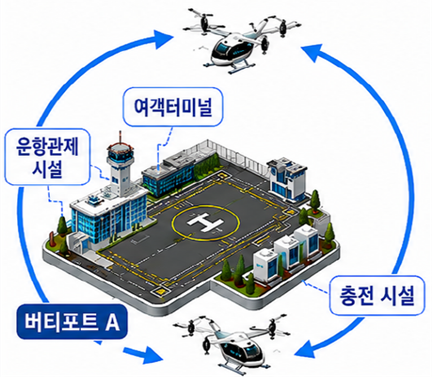
The pilot operations model sets out operating conditions, safety standards and other requirements for the 2028 initial trial program. It is the first to spell out the full range of criteria needed for early operations — covering service types, flight conditions, aircraft and personnel standards, vertiports, air traffic control systems and insurance.
Service models are divided into three types — tourism, regional connection and airport connection — and will be restricted to designated pilot operation zones.
The ministry plans to consult with relevant agencies, local governments and industry based on the model to prepare for the 2028 trial program, gradually expanding the operational scope after verifying safety through early trial runs, with the aim of establishing UAM as a mode of everyday transport.
The ministry is also partnering with the Korea Transportation Safety Authority to launch a project to train the country's first UAM pilots and mechanics, aiming to get ahead of commercialization and reduce early dependence on foreign specialists.
Recruitment will cover both piloting and maintenance, with public- and private-sector candidates trained separately to build a balanced pool of personnel suited to each sector's needs.
Those selected will receive support to enroll in specialized training programs offered by global UAM aircraft manufacturers and obtain the relevant certifications. However, in exchange for public funding and to build domestic expertise, participants will be required to serve as pilots or mechanics during early demonstration and trial operations, and to take part as initial instructors or advisers in developing the domestic UAM certification system and safety standards.
The ministry plans to finalize details — including the number of recruits and training schedule — this year after consulting with aircraft manufacturers, relevant agencies and industry.
"While discussions around UAM have largely focused on charting the direction of future air transport systems, this pilot operations model and the project to train our first pilots and mechanics are significant in that they move from vision to concrete action — spelling out the specific standards needed for actual flight operations," said Hong Ji-seon, second vice minister of land, infrastructure and transport.
smh@heraldcorp.com