![A job posting board at a university employment center in Seoul [Yonhap]](https://wimg.heraldcorp.com/news/cms/2026/07/15/rcv.YNA.20260513.PYH2026051308130001301_P1.jpg)
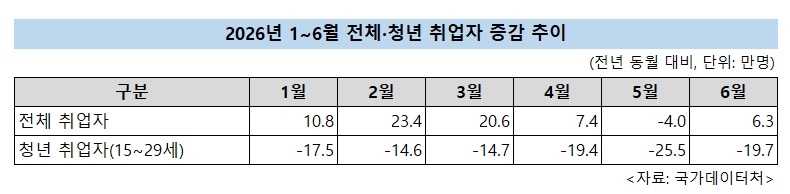
The number of employed people rebounded last month after a one-month contraction, but the gain was limited to 63,000. The overall employment rate fell for the third consecutive month, and the number of employed young people dropped by 197,000.
Concerns about "jobless growth" are mounting as the government sharply raised its economic growth rate forecast for this year — from 2.0 percent to 3.0 percent — while simultaneously trimming its job-growth outlook by 10,000, to 150,000. The number of discouraged workers also rose to 356,000, the highest since February, when it stood at 367,000.
According to the "June 2026 Employment Trends" report released Wednesday by the Ministry of Statistics, the number of employed people aged 15 and older stood at about 29.154 million last month, up 63,000, or 0.2 percent, from the same month a year earlier. Employment returned to positive territory within a month of the 40,000 decline recorded in May, but the gain fell short of 100,000.
Monthly job gains have been volatile this year: 108,000 in January, 234,000 in February and 206,000 in March before shrinking to 74,000 in April. Employment then turned negative in May with a loss of 40,000, and last month's rebound was limited to just 63,000.
The government has also lowered its expectations. In its "Second-Half 2026 Economic Growth Strategy" released Tuesday, the government projected that total employment this year would grow by only 150,000 from last year — 10,000 fewer than the 160,000 it had forecast in January. Over the same period, the government raised its economic growth rate outlook by 1.0 percentage point, to 3.0 percent, even as the jobs forecast moved in the opposite direction. The revision reflects a judgment that semiconductor-driven growth may not translate sufficiently into broader employment gains.
The employment rate also fell. The rate for people aged 15 and older came in at 63.4 percent last month, down 0.2 percentage points from a year earlier, marking a third consecutive monthly decline since April. The employment rate for the 15-to-64 age group, the OECD comparison standard, also slipped 0.1 percentage point to 70.2 percent. The number of unemployed rose by 10,000, or 1.2 percent, to 834,000, while the unemployment rate held steady at 2.8 percent, unchanged from a year earlier.
Youth employment was particularly weak. The number of employed people aged 15 to 29 fell by 197,000 from the same month last year, marking 44 consecutive months of decline. The youth employment rate dropped 1.7 percentage points to 43.9 percent, extending a losing streak to 26 consecutive months since May 2024. The youth unemployment rate rose 0.9 percentage point to 7.0 percent.
By age group, workers in their 20s saw the steepest drop, losing 199,000 jobs, while those in their 40s fell by 19,000. In contrast, workers aged 60 and older gained 211,000, those in their 30s added 65,000, and those in their 50s rose by 3,000. Older workers effectively carried the bulk of overall job gains.
By industry, health care and social welfare services added 214,000 workers, while arts, sports and leisure services and transportation and warehousing gained 55,000 and 48,000, respectively. Manufacturing shed 97,000 jobs, agriculture, forestry and fishing lost 95,000, and construction fell by 67,000. Manufacturing has now posted employment declines for 24 consecutive months, and construction for 26.
The quality of employment also showed signs of deterioration. The number of wage workers stood at about 22.497 million, down 81,000 from a year earlier. Regular workers increased by 16,000, but temporary workers fell by 51,000 and daily workers by 45,000. Non-wage workers rose by 144,000 — self-employed workers with employees up 95,000 and those without employees up 72,000 — while unpaid family workers declined by 23,000.
The Ministry of Economy and Finance said it would "analyze the causes of employment weakness in sectors such as manufacturing and construction through a dedicated jobs task force and develop countermeasures," adding that it would "actively push forward key tasks in the second-half economic growth strategy — including three mega-projects and five-pole, three-special growth engines — to strengthen job creation across the broader economy."
fact0514@heraldcorp.com