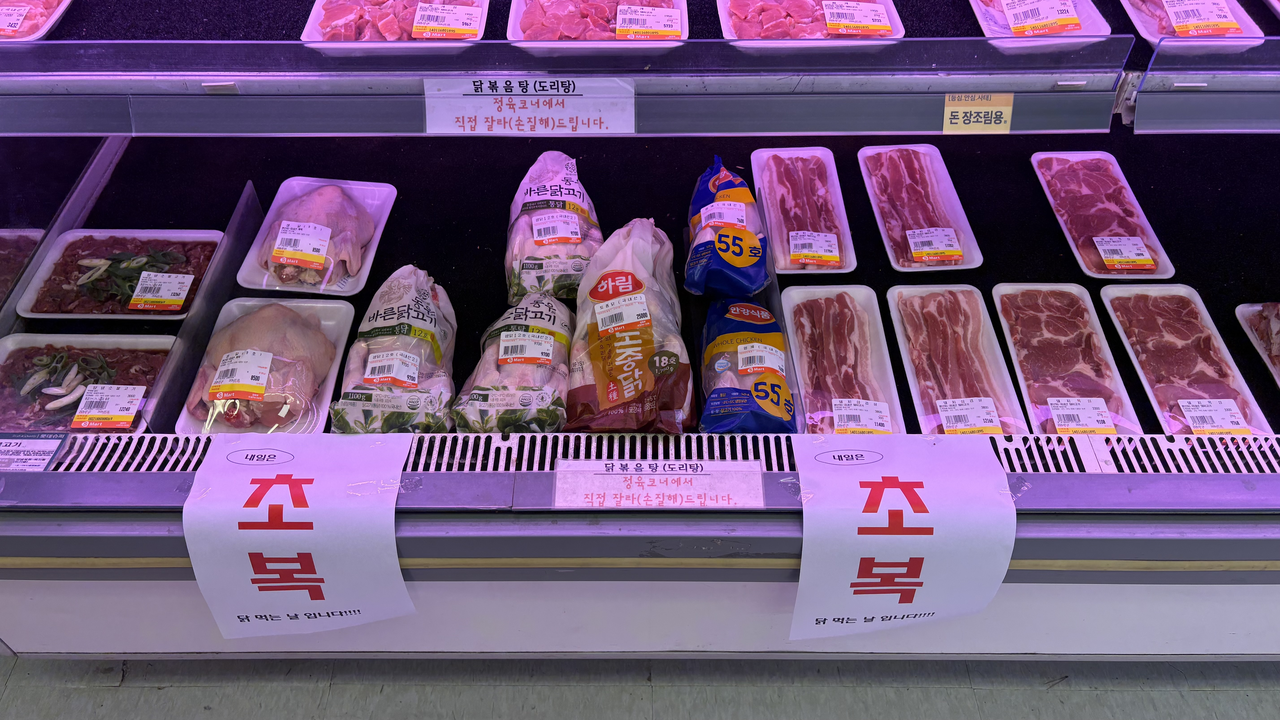
Kim, a worker in his 20s, picked up a 6,500-won "whole drumstick samgyetang" at a convenience store on his way home from work. Dining out for samgyetang — which easily runs more than 15,000 won ($10) — felt like too much of a stretch. "I plan to enjoy Chobok simply at home with the air conditioner on," he said. "Popular samgyetang restaurants are not only expensive but have long waits, so it's hard to just walk in."
Yun, a housewife in her 50s, also decided to make samgyetang at home. Eating out for a family of four would easily top 70,000 to 80,000 won, and ordering additional dishes could push the bill close to 100,000 won. "If I buy a whole chicken, glutinous rice and ginseng at the mart and cook it myself, the cost is much lower and the whole family can eat well," she said.
Samgyetang has entered the 18,000-won era. Soaring dining-out prices have changed the look of Chobok. Consumers are turning away from samgyetang specialty restaurants and heading to convenience stores and hypermarkets instead.
According to the Korea Consumer Agency's price information portal, the average price of a bowl of samgyetang in Seoul last month was 18,154 won — up 2.8 percent from 17,654 won in the same month last year. Prices have climbed every year, from 16,885 won in 2024 and 16,423 won in 2023.
Convenience store ready meals are winning over consumers burdened by high dining-out costs. A dosirak launched by GS25 on Wednesday — billed as its "July Boknal edition" — sold more than 100,000 units in its first six days. Sales of health-food products at the chain rose 112.8 percent year-on-year from June 1 through Friday.
CU's samgyetang sales in the week of July 6-13 surged roughly 47-fold compared with the same period a year earlier. Its signature "Boyang Samgye Samgak Kimbap," one of six health-food ready meals launched July 7, sold 30,000 units in a single week. At Seven-Eleven over the same period, sales of processed rice products rose 34 percent, shelf-stable pouch products including soups and stews climbed 23 percent, and dosirak sales increased 10 percent.
![Models introduce discounted health-food products at E-mart's Yongsan branch. E-mart is offering up to 50 percent off health foods through Wednesday, Chobok day. [E-mart]](https://wimg.heraldcorp.com/news/cms/2026/07/15/news-p.v1.20260715.e02646d2c246499cb37998762143bfbb_P1.jpg)
Competition in the home meal replacement market is also intensifying. Lotte Wellfood's ready-meal brand Siksaieron unveiled "Ilwoljeong Black Garlic Samgyetang," developed in collaboration with Ilwoljeong, a century-old restaurant in Daegu. CJ CheilJedang is selling Pyongyang naengmyeon and perilla oil makguksu developed with chef Choi Kang-rok, along with a samgyetang created with chef Yun Na-ra, all under its Bibigo line. Ottogi launched a ramyun inspired by Dongdaemun-style dak-hanmari kalguksu.
Demand for buying ingredients and cooking health foods at home is also growing. Making samgyetang at home costs nearly half as much as eating out. According to Korea Price Information, purchasing ingredients for four servings at a traditional market — including a young chicken, fresh ginseng, glutinous rice, garlic, chestnuts, green onions and medicinal broth herbs — comes to 35,260 won, or about 8,800 won per serving.
Sales of health-food ingredients at hypermarkets have also jumped sharply. At E-mart, from June through Monday, sales of whole chicken rose 117.3 percent year-on-year, native chicken climbed 147.1 percent and abalone increased 35.7 percent. Dried vegetables used as side ingredients were up 93.5 percent and ginseng rose 6.4 percent. At Lotte Mart, chicken sales grew 24 percent over the same period, while glutinous rice surged 61.9 percent, ginseng soared 207.3 percent, abalone jumped 361.4 percent, eel climbed 93.8 percent and Korean beef rose 20.6 percent.
Choi Cheol, a professor of consumer economics at Sookmyung Women's University, said that as more substitute products emerge for seasonally high-demand items, consumers now have a wider range of choices. "With so many cost-increasing factors at play, it will not be easy for dining-out prices to come down significantly," he said.

siuu@heraldcorp.com