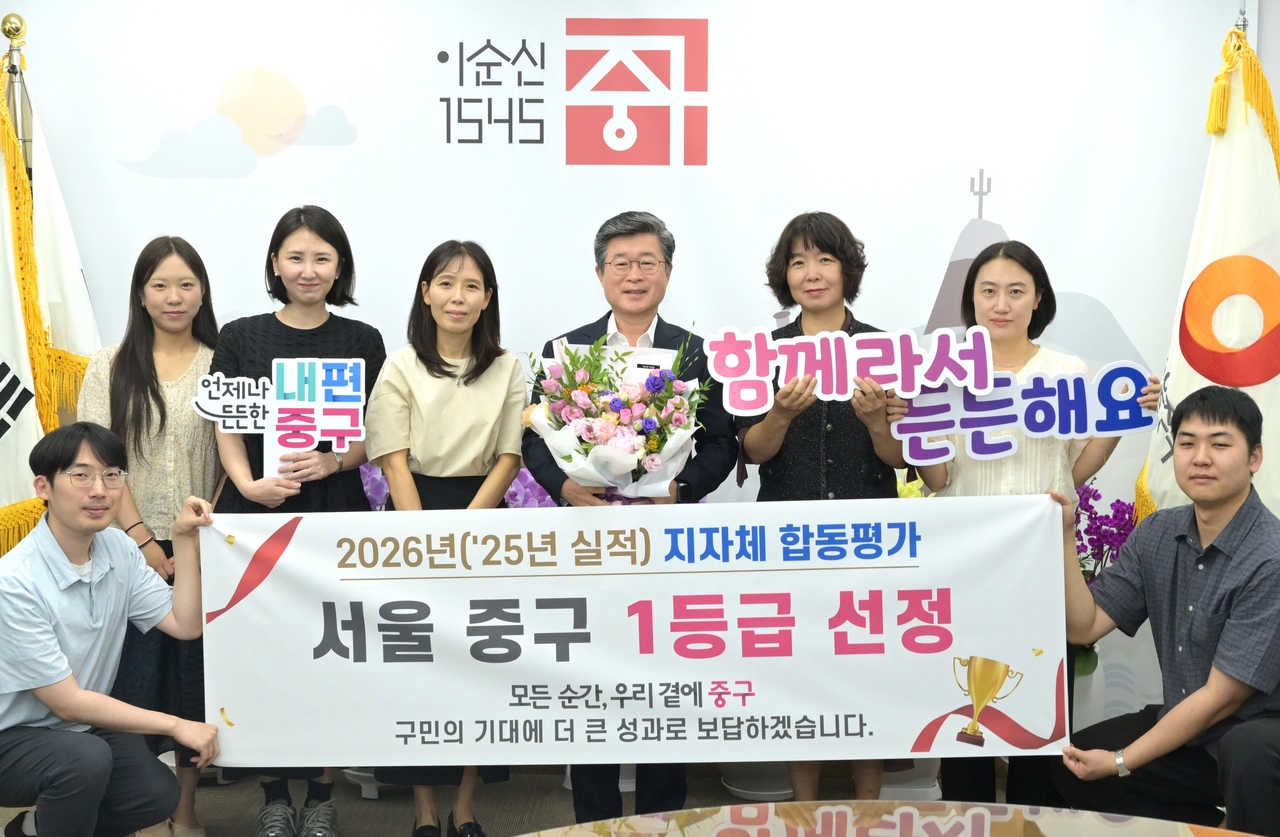
Seoul's Jung-gu district has achieved the top Grade 1 rating in the 2026 Joint Evaluation of Local Governments.
The district raised its achievement rate across 47 quantitative indicators by 2 percentage points from the previous year and received a perfect score in the effort category.
The evaluation was based on performance during 2025. Jung-gu scored a total of 95.17 points, placing it at the top tier among Seoul's 25 autonomous districts. It recorded 80.97 out of 85 points for quantitative indicator achievement and 4.2 out of 5 for qualitative contribution.
The achievement rate on the 47 quantitative indicators rose to 91.5 percent, up 2 percentage points from 89.5 percent the previous year. Individual departments worked actively to meet their targets, producing consistent results across areas closely tied to residents' daily lives — including safety, welfare, employment, the environment and public health.
The district posted strong results across a range of indicators, particularly in establishing and operating a youth harmful-environment monitoring system, running senior employment programs, managing government-funded job projects, increasing per-capita recyclable waste separation, reducing greenhouse gas emissions, and managing tuberculosis and dementia programs.
Two of Jung-gu's policies were also recognized as outstanding cases by the Seoul Metropolitan Government. The district's signature festival, Jeongdong Yahaeng, was selected as a best-practice example for reducing single-use plastics after it provided reusable containers to visitors to promote a resource-recycling culture.
A program called "Pregnant Women All Free Pass," developed in partnership with Woori Bank, was named a best-practice case for creating a pregnancy- and childbirth-friendly environment. The initiative earned recognition for improving convenience for expectant mothers through public-private cooperation — including dedicated teller windows and priority waiting areas at bank branches, as well as birth congratulatory payments and commemorative gifts.
Interdepartmental collaboration and systematic performance management also contributed to the Grade 1 result. Jung-gu held regular progress briefings chaired by the deputy district mayor to closely monitor implementation. The district maintained a systematic approach from drafting the evaluation plan through department-level performance reviews and staff training, strengthening its overall evaluation capacity. These efforts translated into a perfect score of 10 points in the effort category.
The district plans to manage progress and performance on each indicator even more closely to sustain this year's results next year. It also intends to actively identify and share best-practice cases, consistently delivering administrative outcomes that residents can feel in their daily lives.
The joint evaluation is a system administered by the Ministry of Interior and Safety to assess the performance of all 17 metropolitan and provincial governments nationwide in carrying out nationally delegated affairs, state-subsidized projects and key national policy initiatives. Based on the ministry's results, the Seoul Metropolitan Government divides its 25 autonomous districts into four grades — Grade 1 through Grade 4 — according to target achievement and effort.
"This Grade 1 achievement is the result of every department working as one, with residents at the center of everything we do," Jung-gu District Mayor Kim Gil-sung said. "We will continue to pursue policies that let residents feel real change in their everyday lives, and keep building a Jung-gu that is an even better place to live."
seouldream01@heraldcorp.com