![[Created using Gemini]](https://wimg.heraldcorp.com/news/cms/2026/07/15/news-p.v1.20260715.93dc2bfa19604721ab796287e91eb094_P1.png)
Warning lights flash daily on the 'roller-coaster Kospi' — what can be done?
South Korea's stock market is navigating unprecedented volatility. The Kospi, which closed last year at 4,214.17, surged to an intraday peak of 9,385.59 on June 19 before retreating to the 7,000 level in roughly three weeks.
As the market lurches between sharp gains and steep losses day after day, the two safety mechanisms built into the system — the circuit breaker and the sidecar — are being triggered at record rates.
In the entire history of the domestic stock market, the circuit breaker has been activated on the Kospi only 13 times — during the oil price spike of 2000, the Sept. 11 attacks of 2001, and the COVID-19 pandemic of 2020, among others. It was, in the truest sense, an emergency brake reserved for historic crises.
Yet this year alone, as of Wednesday, that emergency brake has been pulled seven times. It fired twice in March amid the US-Iran war and the resulting surge in Middle Eastern oil prices, twice more in June as fears of US interest rate hikes triggered a sharp selloff in semiconductor shares, and twice again in July on concerns about a semiconductor earnings peak-out.
The circuit breaker was also triggered once on the Kosdaq in March, during the US-Iran conflict, and once more in June over semiconductor peak-out fears.
The sidecar — a less severe measure than the circuit breaker — has been activated far more frequently. It has fired 36 times on the Kospi so far this year, accounting for more than one-third of the 96 total activations recorded throughout the market's entire history.
On the Kosdaq, the sidecar has been triggered 21 times this year, representing roughly one-fifth of the 105 total activations in history. In such extreme volatility, it has become equally difficult to commit to buying or to pull the trigger on selling.
7 of the Kospi's 13 all-time circuit breakers have come this year
When and how are circuit breakers and sidecars triggered — and how should investors respond? Both mechanisms were designed to cushion the market against sudden shocks.
The circuit breaker is the market's emergency brake — the more powerful of the two. When share prices fall sharply beyond a set threshold, all trading is temporarily halted to give investors time to step back and make calm, rational decisions.
The logic mirrors that of an electrical circuit breaker: just as cutting power prevents a fire when a circuit is overloaded, stopping trading before panic spreads gives the market a chance to breathe.
South Korea introduced the mechanism on Dec. 7, 1998, in the aftermath of the 1997 Asian financial crisis, when markets were still deeply unsettled. The circuit breaker was adopted alongside an expansion of the daily price limit from 12 percent to 15 percent as a measure to protect investors.
In its early form, the system had a single trigger: if the Kospi fell 10 percent or more from the previous day's close and held that level for at least one minute, trading was halted.
The framework was overhauled in June 2015, when the daily price limit was widened again to 30 percent, giving rise to the current three-tier structure of 8, 15 and 20 percent thresholds. The Kosdaq adopted the circuit breaker on Oct. 15, 2001.
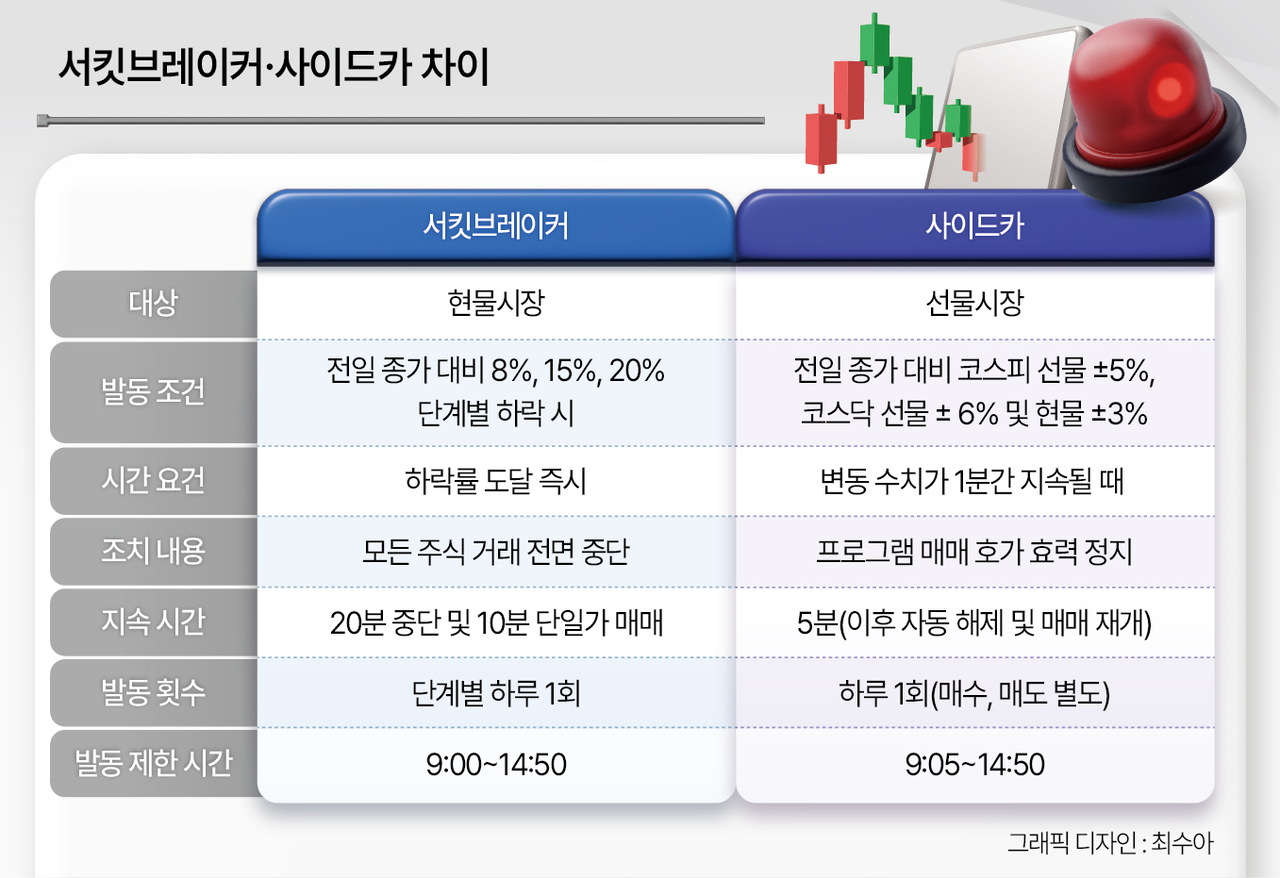
Level 1 is triggered when the Kospi — or Kosdaq — falls 8 percent or more from the previous day's closing price and holds that level for one minute. All trading is suspended for 20 minutes, after which it resumes for 10 minutes under a single-price auction system.
Level 2 is triggered when the index falls 15 percent or more from the previous close and drops at least 1 percent further below the Level 1 trigger point, sustained for one minute, halting all trading for 20 minutes.
Level 3 is triggered when the index falls 20 percent or more from the previous close and drops at least 1 percent further below the Level 2 trigger point, sustained for one minute. A Level 3 activation immediately ends trading for the rest of the day. Fortunately, Level 3 has never been triggered in the domestic market.
The key point is that when a circuit breaker fires, all trading stops — no one can buy or sell. The entire market comes to a complete standstill.
The circuit breaker originated in the United States. The New York Stock Exchange introduced it after "Black Monday" on Oct. 19, 1987, when the Dow Jones Industrial Average fell 22.6 percent in a single session. Its effectiveness was recognized, and the mechanism spread to markets around the world.
The sidecar: a speed bump that can sound once a day
The sidecar functions more as an early-warning alert than a full stop — it is designed to kick in before a circuit breaker becomes necessary. Its official name is the "temporary suspension of program trading order validity system." If the circuit breaker is an emergency brake, the sidecar is closer to a speed bump.
The key difference from the circuit breaker is whether retail investors are affected. When a sidecar is triggered, retail investors can continue trading. Only program trading — the automated transactions used by institutional and foreign investors — is briefly paused.
Another distinction: sidecars can be triggered in both directions, for surges as well as drops, whereas circuit breakers activate only in a falling market.
The sidecar trigger is based on the futures market. For the main equities market, it activates when the price of the most actively traded KOSPI 200 futures contract from the previous session moves 5 percent or more from the prior day's closing price and holds that level for one minute.
Once triggered, program trading by institutions and foreign investors is suspended for five minutes, after which it automatically resumes. The sidecar was introduced to the main equities market on Nov. 25, 1996.
The Kosdaq adopted the mechanism later, on March 5, 2001. On the Kosdaq, the sidecar requires the Kosdaq 150 futures to move 6 percent or more from the previous day's close, the Kosdaq 150 index to move 3 percent or more, and both conditions to persist for one minute.
The sidecar can be triggered only once per trading day and does not activate during the first five minutes after the market opens or in the final 40 minutes before the close.
Buy-side sidecars have typically been triggered when major positive news breaks in a key industry or when major markets such as those in the United States or China surge sharply.
Sell-side sidecars, by contrast, have tended to fire when US interest rate decisions or employment data come in well above market expectations and foreign capital exits en masse, or when geopolitical risks such as wars or oil price spikes emerge.
A sidecar activation does not change the market's direction. A rising market can keep rising; a falling market can keep falling. The sidecar only briefly slows the speed of price movement — it does not alter its course.
What happens the day after a circuit breaker?
Looking at past circuit breaker activations, the Kospi has rebounded the following day in many cases. Bargain hunters have typically stepped in at depressed prices.
Of the 13 activations on record, the Kospi rose on the next trading day in nine cases — roughly 70 percent of the time.
Notable rebounds include a 4.97 percent gain the day after the Sept. 12, 2001 activation, a 7.44 percent rise after March 19, 2020, a 9.63 percent surge after March 4 this year, a 5.35 percent rise after March 9, and an 8.18 percent rebound after June 8 — all examples of sharp technical recoveries immediately following steep drops.
This year, however, a different pattern has begun to emerge: the Kospi has at times fallen or posted only a weak recovery the day after a circuit breaker. The next trading day after the June 26 activation saw a decline of 0.20 percent, and the session following the July 7 activation fell 5.35 percent. After the Monday activation, the rebound was a modest 0.73 percent.
Analysts point to a confluence of factors driving this shift. The Kospi's unprecedented surge this year has made investors more skittish about sharp drops, while single-stock leveraged ETFs, margin call forced selling, national pension fund rebalancing and foreign investor outflows have combined to create market dynamics unlike anything seen before.
Securities analysts remain broadly optimistic over the longer term, citing solid earnings from major Kospi heavyweights such as Samsung Electronics and SK hynix. Two trading days after Monday's circuit breaker activation, the Kospi staged a sharp recovery on Wednesday.
Byeon Jun-ho, a researcher at IBK Securities, said "looking at key economic and financial market indicators, the current situation does not appear to reflect the kind of extreme, severe uncertainty comparable to the dot-com bubble collapse, the global financial crisis, or the COVID-19 period." He added that "given fundamentals and valuations, the current sharp index decline looks like excessive undershooting, and in the near term, the domestic market is expected to become more sensitive to positive catalysts than negative ones."
Kim Min-gyu, a researcher at KB Securities, said the Korean market had recently recorded declines of a magnitude not seen even during past periods of strong earnings. "What is needed for a rebound is the psychology that prices are low enough to buy again," he said. "The trigger for that shift in sentiment would be interest rate stabilization and an event that reassures capital providers."
jiyun@heraldcorp.com