Calls are growing for South Korea's agricultural policy to expand beyond supporting young farmers starting new businesses and begin addressing management succession at existing agricultural corporations. Analysts say policies focused solely on creating new ventures cannot guarantee the sustainable growth of the sector, and that a system to support generational transition is urgently needed.
The Korea Rural Economic Institute (KREI) proposed Saturday, in its newly published report "Capital Investment in Agricultural Corporations: Current Status and Policy Challenges," that management succession should be developed alongside startup support as a core pillar of agricultural policy to strengthen the competitiveness of agricultural corporations.
The report found that while agricultural corporations have driven the scaling and specialization of South Korean agriculture, their growth has recently been slowing. Declining capital investment is weakening the sector's growth momentum, and the aging of those at the helm is compounding the problem, dampening investment and innovation.
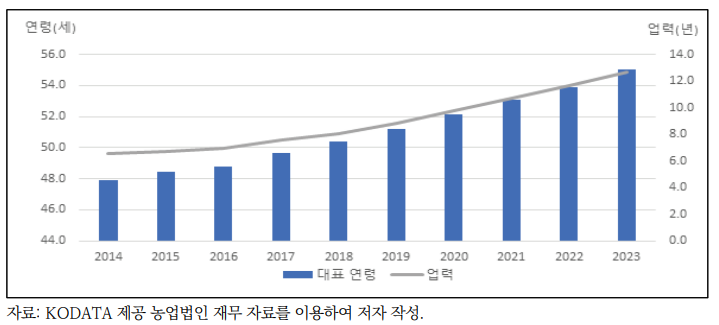
The average age of agricultural corporation heads rose from 47.9 in 2014 to 55 in 2023. Over the same period, the average years in operation climbed from 6.5 to 12.7. Researchers found that as corporations grow older and more established, their leaders become increasingly risk-averse toward new equipment investment and tend to favor stable operations over expansion.
Researchers said this structural dynamic exposes the limits of policies that focus only on expanding youth startups. Supporting the stable transfer of competitive, established agricultural corporations to the next generation, they argued, is just as important as creating new ones.
The report accordingly proposed including management succession as a policy target on equal footing with startup support. It said the government should support the entry of young successor managers and systematically develop financial instruments, tax incentives and education programs for the succession process. The report framed succession not as a simple transfer of a family business but as an industrial policy aimed at sustaining and developing competitive agricultural corporations.
The report also called for a shift in the growth strategy for agricultural corporations — away from expanding sheer numbers and toward qualitative growth. Policy should focus on creating an environment where corporations with strong technology and management capabilities can continue to invest and grow, rather than simply increasing the number of small-scale firms. To that end, it recommended building a support system that links the influx of young talent with generational transition, and expanding policy financing and consulting to help successor managers take over operations smoothly.
The report said sustainable growth in the agricultural corporation sector requires generational transition among management to proceed in tandem with increased investment. It particularly noted that because agricultural corporations serve as core business entities connecting not only production but also processing, retail and exports, delays in generational transition could erode the overall competitiveness of South Korean agriculture.
"Maintaining the growth foundation of agricultural corporations requires a policy shift that goes beyond startup-centered support to actively promote succession at existing corporations," the researchers said. "An institutional framework must be established so that competitive corporations can continue to invest and grow."
adastra@heraldcorp.com