New chief installed after two failed appointment bids over 20 months
Deputy minister exercises nomination right amid ministerial vacancy
M&A platform, technology commercialization face early tests under new leadership
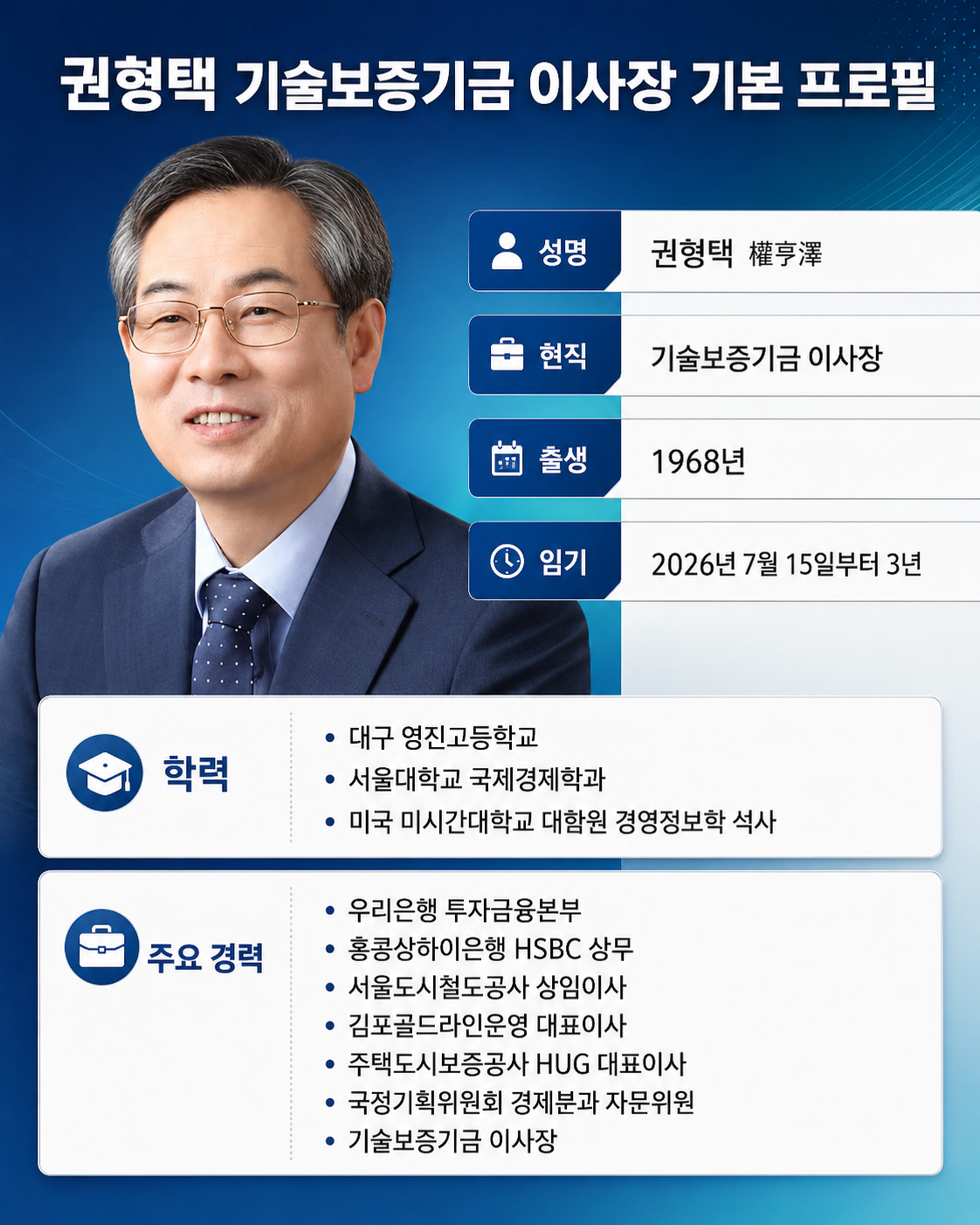
Korea Technology Finance Corp., known as Kibo, has ended nearly 20 months of acting leadership and formally transitioned to a new chief, Kwon Hyung-taek. Kwon, who brings experience in both the financial sector and public institutions, outlined AI and deep tech company development, technology commercialization, mergers and acquisitions, technology transfer and technology protection as his priorities upon taking office.
Kwon took office Wednesday as Kibo's 15th president, according to the organization. His term runs through July 14, 2029. The appointment came after two earlier attempts to select a new president had fallen through.
The term of former Kibo president Kim Jong-ho, who held a farewell ceremony Wednesday, had expired on Nov. 7, 2024. With no successor in place, Kim continued in the role past his term's end. The first selection process was halted amid the emergency martial law crisis of Dec. 3, 2024 and the subsequent presidential impeachment proceedings.
Kibo launched a second selection process in December 2025 and recommended three candidates to the Ministry of SMEs and Startups in March this year, but the minister's formal nomination to the president and presidential approval did not follow. A third open recruitment process ultimately produced Kwon's appointment.
Many in the small and medium-sized enterprise industry had expected the appointment to be delayed until a new minister took office, given that Han Sung-sook had left the Ministry of SMEs and Startups post to become prime minister, leaving the minister's seat vacant. Under the appointment process, Kibo's executive recommendation committee submits candidates to the minister, who selects a final nominee and recommends that person to the president for appointment.
The appointment moved faster than expected, however. Industry observers suggest the decision reflected a desire to avoid extending the acting leadership arrangement — which had already lasted about 20 months since Kim's term ended — any further. Noh Yong-seok, first vice minister of SMEs and Startups, exercised the nomination right in an acting capacity. There is also speculation that Han, as prime minister and someone well acquainted with the circumstances surrounding the Kibo presidency, may have pushed to accelerate the appointment.
In his inaugural remarks, Kwon said Kibo must lead the charge in driving growth in future strategic industries such as AI and deep tech, with the goal of positioning South Korea among the world's top four venture powerhouses. He added that the organization would strengthen support for innovation-driven growth across technology guarantees, commercialization, M&A, technology transfer and technology protection.
M&A is widely seen as the area where Kibo's role will expand most significantly during Kwon's tenure. The Ministry of SMEs and Startups is building a business succession M&A platform centered on Kibo to address the retirement of aging small and medium-sized enterprise owners and the lack of successors.
In the first half of this year, Kibo began piloting the platform, launching efforts to identify and match prospective sellers and buyers, conduct company valuations, and provide due diligence and consulting support. The Smart Tech Bridge platform has also been equipped with functions for M&A succession applications, connections to intermediary institutions and consulting support.
Simply registering companies on the platform will not be enough to produce results. Deals must be matched and contracts signed, and operational and facility funding must be provided after acquisition to sustain businesses and preserve jobs. The process also requires expertise to assess the appropriateness of acquisition prices, the repayment capacity of acquiring firms and the risk of key personnel departing from acquired companies.
Kwon also faces the task of upgrading Kibo's technology assessment framework to better screen AI companies. Firms that own proprietary technology and data are difficult to evaluate under the same criteria as those that deliver services by leveraging external generative AI models.
Kibo must factor in not only technological originality and patents but also data ownership, proof-of-concept results with clients, the potential for recurring revenue and whether a company's profit structure can sustain computing costs. The organization must also guard against the risk of policy funds deteriorating if guarantees become concentrated in companies that simply market themselves under the AI label.
Kwon's separate emphasis on technology commercialization is also notable. The intent appears to be managing guaranteed companies through to the stage where they actually launch products and services and generate sales. Kibo operates the BIRD program, which supports commercialization after research and development, and the technology transfer platform Smart Tech Bridge, which connects technology suppliers with companies seeking to adopt new technologies and provides guarantees for the funding required.
The key challenge is turning technology registrations and transfer agreements into genuine commercialization. Observers say performance metrics should focus less on the number of technologies listed on the platform or consultations held, and more on product launch rates following technology transfer, the number of companies generating revenue and the amount of follow-on investment secured.
Whether Kwon's background spanning both the financial sector and public institutions will help Kibo navigate its evolving role is also drawing attention. Kwon previously served at Woori Bank's investment banking division and as an executive director at HSBC, before going on to serve as chief executive of Gimpo Goldline Operations and as president of the Korea Housing and Urban Guarantee Corporation.
hong@heraldcorp.com