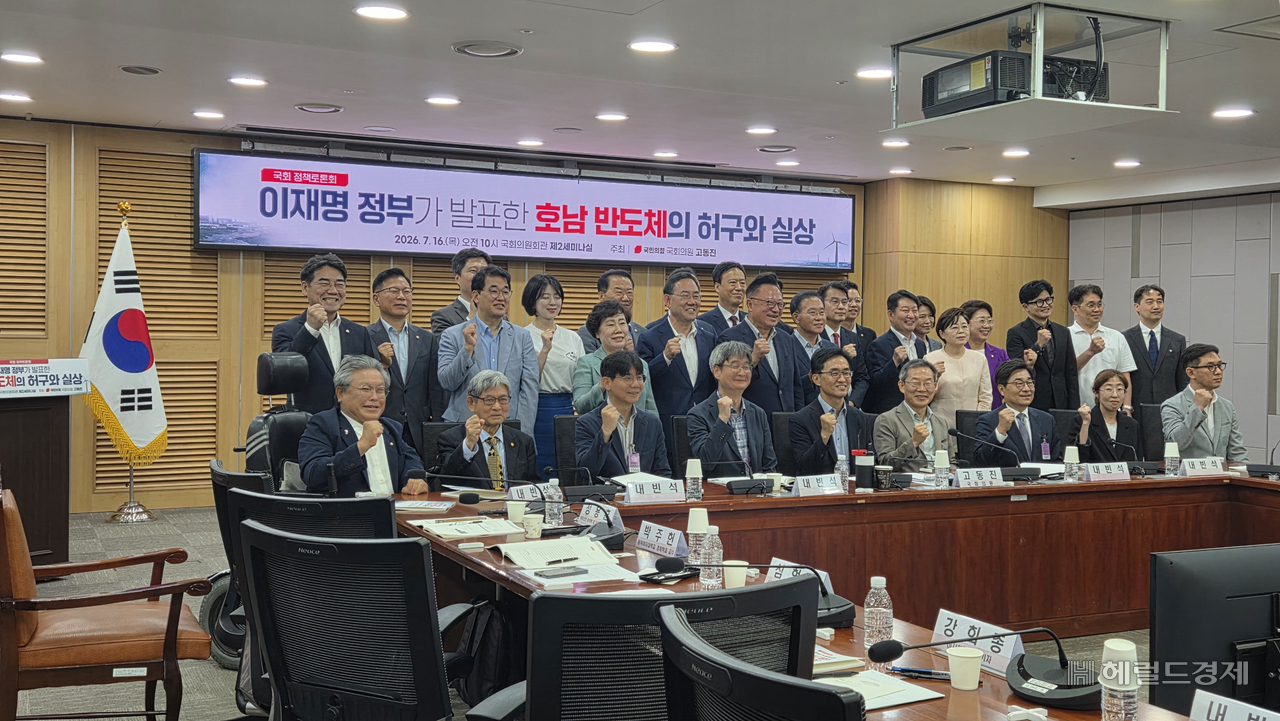
People Power Party lawmakers united Thursday in criticizing a plan for Samsung Electronics and SK hynix to invest about 800 trillion won ($537 billion) to build a semiconductor cluster in the Honam region, warning that the project lacks feasibility because it fails to secure the three essentials for a successful cluster: workforce, water and power.
Ko Dong-jin, a PPP lawmaker and former president of Samsung Electronics, hosted a National Assembly forum Thursday titled "The Fiction and Reality of the Honam Semiconductor Cluster Announced by the Lee Jae Myung Administration." Attending PPP lawmakers criticized the plan to build a fab in Gwangju, saying political misjudgments must not be allowed to destabilize the national economy.
"Designing the future of a national industry on the basis of political slogans or short-term regional-balance logic is an extremely dangerous idea," Ko said. "This is a critical matter that will determine the future of South Korea's semiconductor industry and the competitiveness of its advanced industries, yet no concrete plan has been presented for key infrastructure such as power, water and workforce."
Joo Ho-young, another PPP lawmaker, said there was no shortage of cases in which important national policies had failed because of political decisions. "Those who were involved in such decisions must be held accountable, but those who knew it was wrong and failed to stop it are not without responsibility either," he said. "We must never become bystanders."
PPP lawmaker Yoon Sang-hyun said the Lee administration claimed to be a pragmatic, market-oriented government but was in practice a coercive one. "The president says he personally attracted and induced Samsung Electronics and SK hynix to commit 800 trillion won to Honam — that is, in a word, pressure," he said.
Lawmaker Yoon Jae-ok raised questions about whether the site selection had been made freely by the companies and whether it was a viable choice. "If we simply brush past these issues under the banner of political reasons or regional balance, it could end up being nothing more than false hope for the Honam region," he warned.
Independent lawmaker Han Dong-hoon said the project was "the most representative example of the Lee administration's policy approach of shooting first and thinking later." He said the plan contradicted the basic capitalist principle of guaranteeing corporate autonomy, was at odds with the administration's own legislation holding directors accountable to shareholders, and that mounting evidence cast doubt on its feasibility.
'Honam cluster would need enormous power — like building another KEPCO'
The forum featured presentations by Lee Jong-ho, a Seoul National University professor of electrical and computer engineering and former minister of science and ICT; Jeong Yong-hoon, a KAIST professor of nuclear and quantum engineering; Park Ju-heon, a professor of economics at Dongduk Women's University; and Shim Hyung-jin and Park Seol-hye, professors of nuclear engineering at Seoul National University.
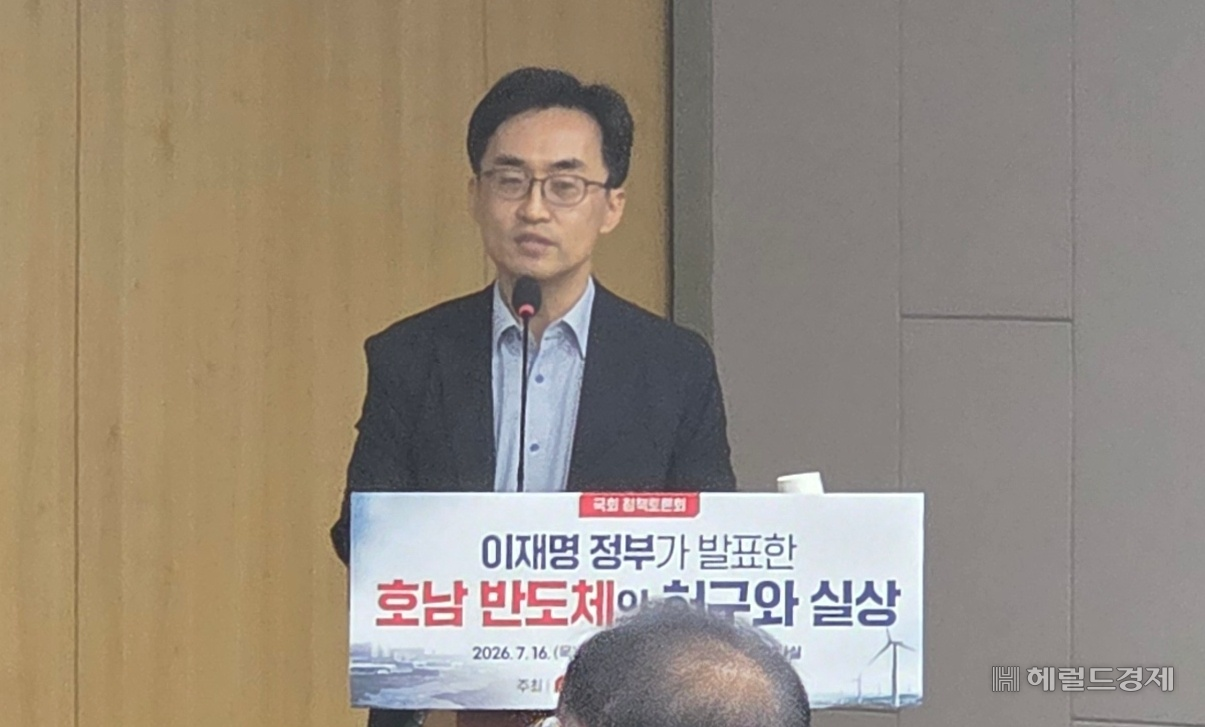
Jeong Yong-hoon, a KAIST professor of nuclear and quantum engineering who presented at the forum, said that if the Yongin semiconductor cluster, the three major mega-projects and AI data centers all come online, around 40 GW of power will be needed — far more than half of South Korea's total power demand. "That is the equivalent of building another Korea Electric Power Corporation," he said.
Jeong expressed particular concern about a power supply grid centered on renewable energy. "Solar power generates electricity for only four hours a day, and intermittency is the biggest problem," he said. "It is like fielding a starter who runs for four hours a day to power a semiconductor factory that must run 24 hours, while keeping a bench player on standby to cover the remaining 20 hours."
He also flagged problems with the power grid in the Honam region. "Honam has a weak grid that stops functioning unless it is continuously fed power," Jeong said. "If a large load like a semiconductor fab suddenly comes in and drains the grid, localized blackouts could occur."
Jeon Young-hyun, vice chairman and chief executive of Samsung Electronics, had made a similar appeal earlier at a national briefing on the southwestern region's advanced-industry development vision, attended by President Lee Jae Myung. "Please actively pursue the expansion of nuclear power and PPAs to compensate for the intermittency of renewable energy, and please ensure that LNG cogeneration is also carried forward," Jeon said.
Shim Hyung-jin, a Seoul National University professor of nuclear engineering, noted that Microsoft, after experiencing several power outages, had signed an energy PPA with Constellation Energy, the largest nuclear plant operator in the United States, to secure a stable power supply. "The government's policy direction is focused on expanding renewable energy, so there is no nuclear energy PPA available," he said. "For stable power supply, the policy direction and the law need to change."
Water supply, the second most critical factor after power, also drew scrutiny. Kim Jin-su, a legislative researcher at the National Assembly Research Service, said the Honam region draws its water from the Yeongsan and Seomjin rivers and has the weakest industrial water safety record of any region in the country. "The volume of available water is also smaller than in other regions, meaning the impact of any water shortage would be greater here than elsewhere," he said. "A dam would need to be built to secure the necessary water supply."
The shortage of skilled workers in Honam — another essential ingredient for a semiconductor cluster — was also raised. Park Ju-heon, a professor of economics at Dongduk Women's University, cited a 2023 report by the Center for Strategic and International Studies titled "The Role of Industrial Clusters in Semiconductor Reshoring," which concluded that clusters succeed only when built in places that already have an established ecosystem of education, research, companies and skilled workers. "The Honam semiconductor project is a greenfield cluster with no existing facilities or industrial base," Park said. "A thorough review of workforce, water and power is the only way the Honam cluster can succeed."
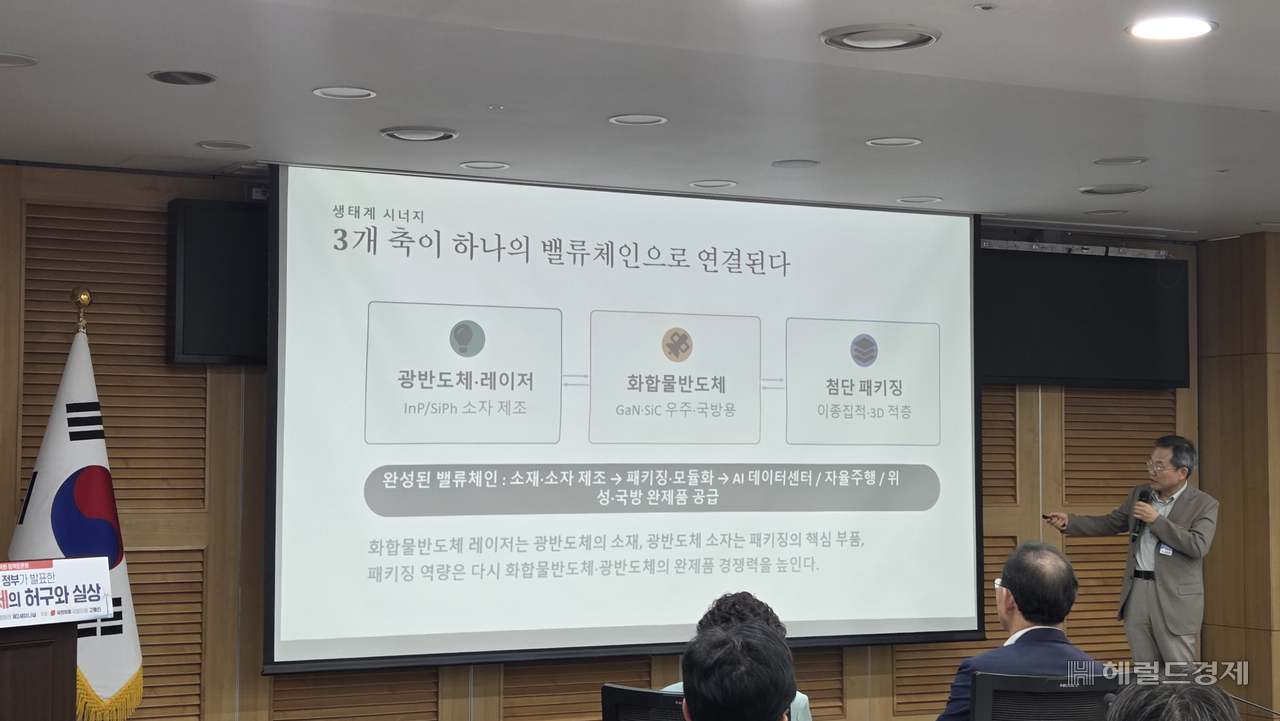
A more realistic alternative making use of the region's existing infrastructure was also proposed. Lee Jong-ho, a Seoul National University professor of electrical and computer engineering and former minister of science and ICT, said running a memory chip business in a region with no existing base would be difficult, and that building on the photonics industry infrastructure already rooted in the area would be far faster and more effective. He proposed three alternatives: optical semiconductors, which are key components that determine AI performance; compound semiconductors for space and defense applications, which are less vulnerable to boom-and-bust cycles because of their long-term contracts; and the development of sensor components and advanced sensor packaging.
Ahn Hong-sang, a semiconductor division official at the Ministry of Trade, Industry and Energy, pushed back. "Some argue that we should find a location where workforce, water and power are all already in place, but when it comes to power and water, it is difficult to draw up a supply plan without concrete investment plans from the companies," he said. "Each ministry is reviewing how to reflect the companies' requirements."
go@heraldcorp.com