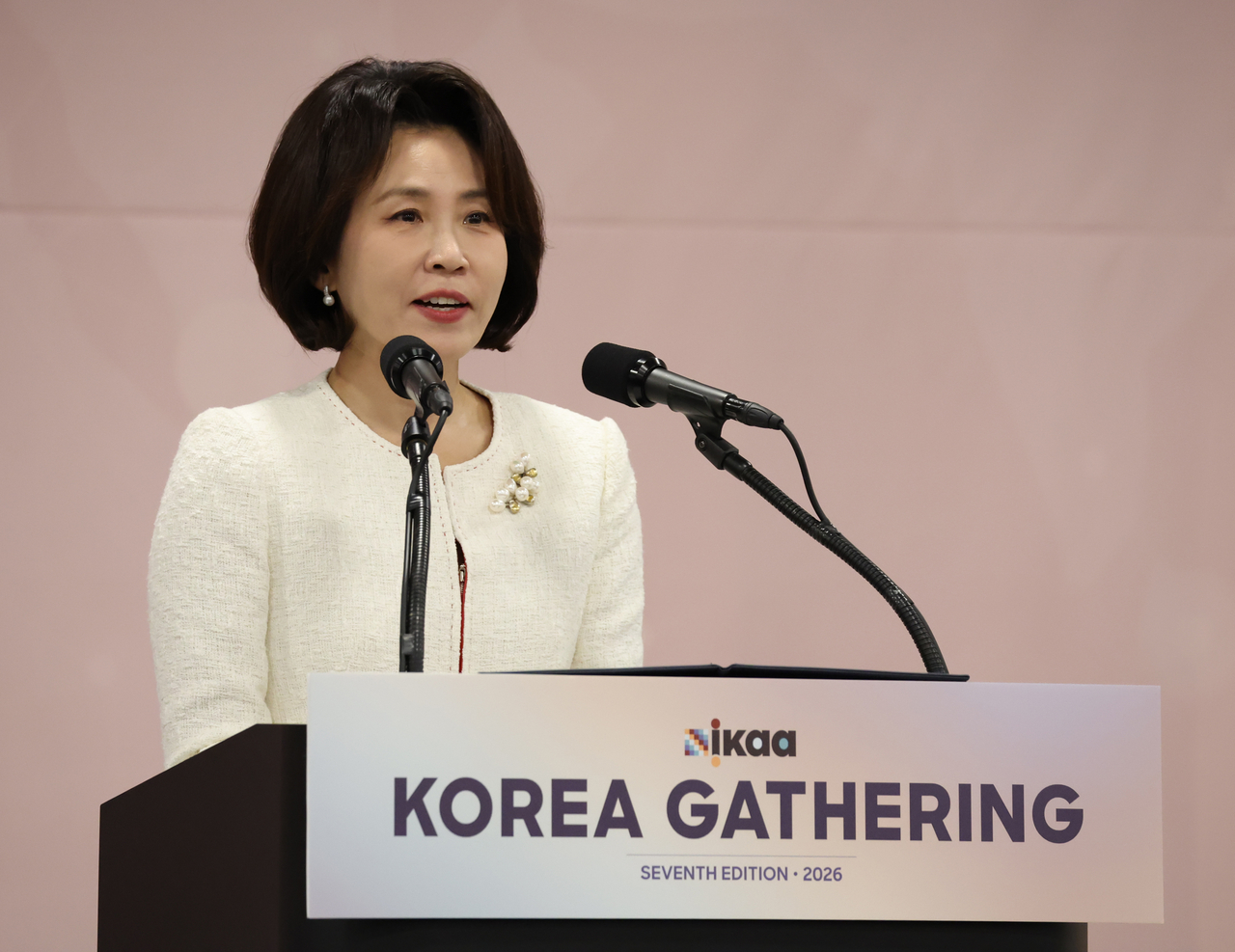
![Ha Jung-woo, former presidential chief of staff for AI future planning, delivers a special lecture titled "The New Role of Nations and Companies in the AI Era" at the 2026 FKI CEO Jeju Summer Forum at Lotte Hotel on Jeju Island on Saturday. [Federation of Korean Industries]](https://wimg.heraldcorp.com/news/cms/2026/07/18/news-p.v1.20260718.0a32be8906504f828bb58aad5c0c0d35_P1.jpg)
Ha Jung-woo, former presidential chief of staff for AI future planning, said countries are moving toward managing high-performance AI models the way they manage nuclear weapons, and warned that having at least one high-performance AI model of its own is what will allow a country to respond to export controls.
Ha made the remarks Saturday during a special lecture on the final day of the 2026 FKI CEO Jeju Summer Forum at Lotte Hotel in Seogwipo, Jeju Island, citing the US administration's recent decision to impose export controls on Anthropic's high-performance AI models "Mythos 5" and "Fable 5."
He said the US administration had been alarmed by the prospect of people worldwide relying on Anthropic's AI models and moved swiftly to restrict their export. He predicted that highly capable AI systems will continue to face export controls going forward.
He said AI models are becoming strategic export assets, making national strategy increasingly important, and advised that industry and government must work together to respond.
Ha noted that South Korean developers are paying 2.6 times more than cost to use Anthropic's Claude — the AI model most popular with developers in Korea — absorbing losses just to access it, and said the country must build its own competitive capabilities to compete on equal footing.
He pointed to the government's ongoing "Dokpamo" project — short for "independent foundation model" — aimed at developing a homegrown foundation model, saying it is set for release in August and is reported to be showing strong AI capabilities.
![Ha Jung-woo, former presidential chief of staff for AI future planning, delivers a special lecture titled "The New Role of Nations and Companies in the AI Era" at the 2026 FKI CEO Jeju Summer Forum at Lotte Hotel on Jeju Island on Saturday. [Federation of Korean Industries]](https://wimg.heraldcorp.com/news/cms/2026/07/18/news-p.v1.20260718.ecb76df1e5ac4b40893a6d871ba14504_P1.jpg)
Ha listed power, semiconductors, GPUs, AI data centers, cloud infrastructure and data as the key factors determining competitiveness in the AI era, but said no country can develop all of them on its own.
He said global cooperation is necessary but must be pursued on terms that give Korea the upper hand, adding that the country should leverage its strength in memory chips as a powerful card to secure that leading position.
He also identified manufacturing as another of Korea's strong suits, saying the country's highly developed manufacturing sector and the data-accumulation infrastructure built through digital transformation could serve as a powerful asset.
Ha said Korea should ultimately leverage its strengths in semiconductors, AI data centers and physical AI to become a nation that exports intelligence.
"It's not enough to just build data centers," he said. "We need to nurture companies and research groups capable of operating large-scale data centers and cloud infrastructure efficiently. Only then can we become an 'intelligence-exporting nation' — one that exports smart capabilities. That is the direction Korea must head."
He added that building intelligence factories outright, or exporting solutions such as AI-powered smart factories with robots, could become new export products and a fresh source of growth for the country.
joze@heraldcorp.com