
![A Korea medical tourism travel mart held at the InterContinental Hotel in Tashkent, Uzbekistan [Kim Myung-sang]](https://wimg.heraldcorp.com/news/cms/2026/07/20/news-p.v1.20260720.a8d64bc4d15b4fc69a89e4c612dc39bd_P1.jpg)
"There are many cases of Central Asian patients who were told they would go blind, came to a Korean hospital, underwent precision surgery and recovered their sight. We focus on providing treatment within the critical window for patients from countries where public healthcare wait times are long and specialist doctors and sophisticated surgical equipment are scarce." — Park Jong-min, head of international medical services at Hangil Eye Hospital
The 2026 Central Asia Emerging Market Korea Medical Tourism Road Show, held in Bishkek, Kyrgyzstan, and Tashkent, Uzbekistan, from July 10 to 13, brought together healthcare providers and travel industry players to develop tailored Korea-bound packages tied to medical services and carry out strategic promotional activities. A total of 17 domestic institutions — including university hospitals and specialized medical centers — participated, promoting Korea's medical infrastructure and building business networks with local buyers.
K-medical tourism sets its sights on Central Asia
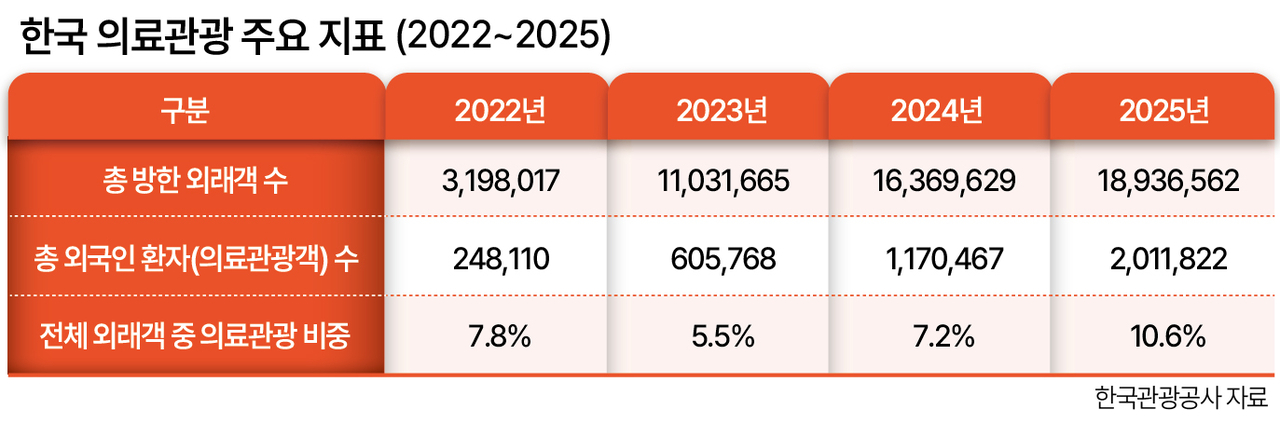
Korea's medical tourism market is enjoying its strongest performance on record. The number of foreign medical tourists who visited Korea last year reached about 2.01 million — a 71.9 percent increase from the previous year. The economic ripple effect, measured by production-induced output, reached 22.8 trillion won ($15.4 billion), with total expenditure tallying 12.5 trillion won.
Medical tourism generates significantly higher economic value than conventional tourism. According to a 2024 credit card spending analysis by the Korea Health Industry Development Institute, the average card expenditure per foreign patient came to about 3.99 million won — roughly twice that of a regular tourist. Of that amount, 1.53 million won went directly to medical services, while the remainder was spent at department stores, restaurants, duty-free shops, hotels and other related industries. The figures underscore how medical tourism has evolved into a high-value form of travel whose benefits extend well beyond the clinic.
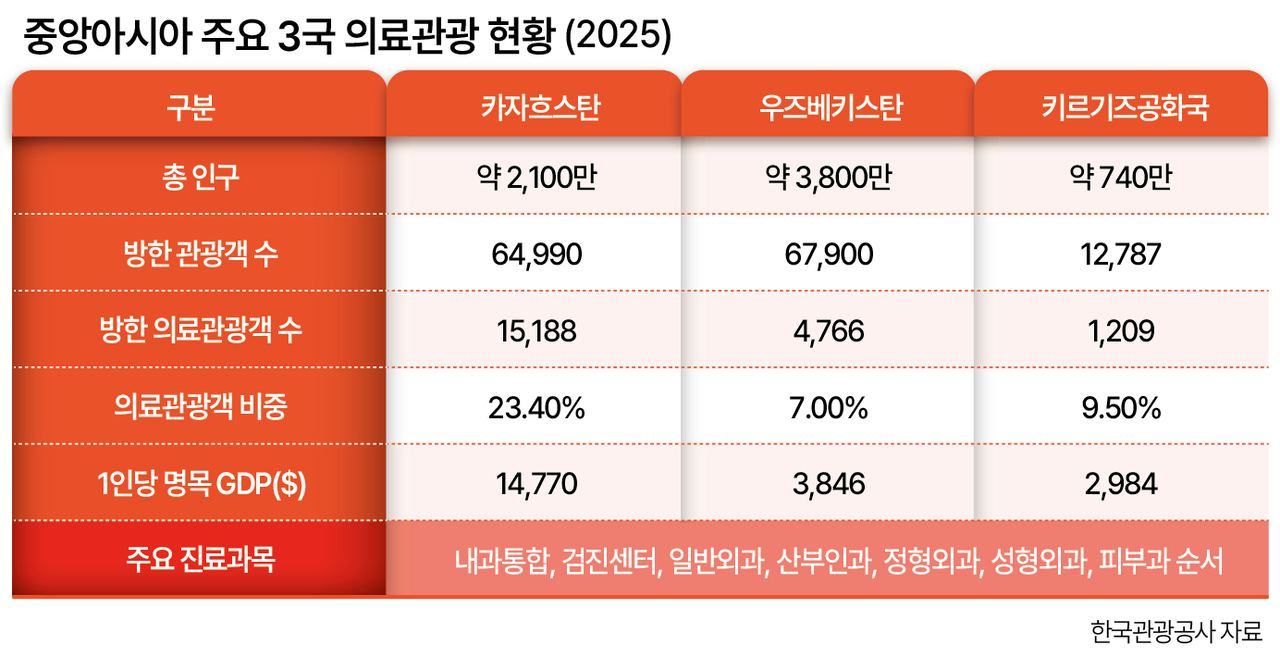
Korea's medical community and the Korea Tourism Organization are particularly focused on breaking into high-growth emerging markets in Central Asia. Kazakhstan already sends a substantial share of its Korea-bound travelers for medical purposes: of all Kazakh visitors to Korea in 2025, medical tourists numbered 15,188 — accounting for 23.4 percent of the total, meaning roughly one in four Kazakhs who came to Korea did so to seek medical care. They also spend heavily: their average medical expenditure came to about 6.08 million won, the highest among all foreign patient groups.
The strong numbers from Kazakhstan have raised expectations for neighboring countries. Uzbekistan recorded 4,766 medical tourists last year, a 43 percent increase from the year before, while Kyrgyzstan welcomed 1,209 visitors for medical purposes, growing more than 20 percent year on year.
![Representatives from an Uzbek travel agency consult with staff at the Sagwa Namu Dental Hospital booth during the Korea Medical Tourism Travel Mart [Kim Myung-sang]](https://wimg.heraldcorp.com/news/cms/2026/07/20/news-p.v1.20260720.916876094b5643f8aa0ba0e26df8eb12_P1.jpg)
Aizan Lee, chief executive of Luna Travel in Kyrgyzstan, said the typical itinerary for medical tourists runs about a week: patients receive a checkup on the first day, visit Gyeongbokgung Palace and Namsan on the second, then attend a results consultation and go shopping on the third day before heading home. "Inquiries about health checkups, cosmetic surgery and treatment for serious illnesses keep growing," she said. "When people cannot afford it, they save up until they can — they want to come to Korea that badly."
While cosmetic procedures are popular among Central Asian patients, a significant share travel to Korea for serious conditions — cancer, cerebrovascular disease, spinal and joint disorders, and retinal surgery. Because state-run regular screening programs are largely absent in the region, many patients arrive only after their condition has already become critical.
Joo Hyung-jin, chief executive of BT Medi, said that while Chinese, Japanese and Southeast Asian patients tend to visit for plastic surgery and dermatology, Central Asian patients have a much higher proportion of serious cases requiring general hospital care. "Turkey has recently emerged as a competitor, but the prevailing view is that Korea still holds the edge — comparable prices, superior medical technology and faster recovery," he said.
K-medicine's edge: competitive costs and high-efficiency systems
![Kim Su-jin, head of the Korea Tourism Organization's Almaty branch office, speaks with Uzbek media [Kim Myung-sang]](https://wimg.heraldcorp.com/news/cms/2026/07/20/news-p.v1.20260720.2da7fcfbd1ae4264bf67dc4e41fafef4_P1.jpg)
Strong preference for Korean healthcare and the marketing effort needed to convert that preference into actual visits are two separate challenges. The Korea Tourism Organization has been actively promoting Korean medical tourism to individual consumers and overseas travel agencies alike, tailoring its approach to each target market based on its level of maturity.
Kim Su-jin, head of the KTO's Almaty branch, said Kazakhstan has already established a solid preference for Korean medicine, but Uzbekistan — despite its large population — still sends only 6 to 7 percent of its outbound medical travelers to Korea, leaving wide room for growth. "We will continue targeting serious-illness cases while ramping up SNS-driven marketing, which carries strong reach, to capture the local market," she said.
![Cho Hye-yeon, a coordinator at Korea University Guro Hospital, poses for a photo with Luna Travel manager Adinai and Luna Travel CEO Aizan Lee after a consultation, alongside Choi Ha-yeon, head of the care coordination team at Korea University Guro Hospital [Kim Myung-sang]](https://wimg.heraldcorp.com/news/cms/2026/07/20/news-p.v1.20260720.aea49ad21a2d4c50bfe80a09bbce9d97_P1.jpg)
Industry players at the Korea Medical Tourism Road Show pointed to advanced technology and an efficient system as the twin pillars of Korean medicine's competitiveness. In Central Asia, where national health screening programs and the concept of preventive medicine remain underdeveloped, mild conditions often go undetected until they have progressed into life-threatening illnesses.
Choi Ha-yeon, head of the care coordination team at Korea University Guro Hospital, said patients in Uzbekistan and Kyrgyzstan frequently arrive having been diagnosed locally with a simple gastrointestinal complaint, only to be found at a Korean university hospital to have advanced-stage cancer. "Korea has built a one-stop system that takes patients from a comprehensive checkup through precision surgery to prescription in a short period of time, and that is what earns trust when it comes to treatment survival rates," she said.
In spinal and joint care — where patients often suffer from accident injuries or disease complications — as well as in cosmetic and plastic surgery, Korean providers are widening the gap over competitors by leveraging precise surgical techniques that shorten hospital stays and speed recovery.
Lee In-hwan, international medical team manager at Nanoori Hospital, said many patients come to Korea seeking corrective surgery after poor outcomes from emergency procedures performed locally. "Patients with less severe conditions can be discharged and resume daily life in as little as two to three days, and even serious cases can move to a hotel within one to two weeks — that speed of recovery is a major selling point," he said.
![Uzbek representatives consult with staff at the Elite Plastic Surgery clinic booth [Kim Myung-sang]](https://wimg.heraldcorp.com/news/cms/2026/07/20/news-p.v1.20260720.133c680144f340bbaaf30ca2c8e31a8b_P1.jpg)
Woo Seo-hyeon, a manager at Elite Plastic Surgery, said facelift and lifting procedures typically require a two-week stay, but advanced equipment allows swelling to subside quickly, enabling patients to shop or sightsee from the third day after surgery. "As treatment time shortens, we have been offering a healing tour program developed with Incheon city and the Korea Tourism Organization, and the response has been very positive," she said.
Market diversification and the evolution of tailored healing tours
![Consultations under way at the Rien Jang Plastic Surgery clinic booth [Kim Myung-sang]](https://wimg.heraldcorp.com/news/cms/2026/07/20/news-p.v1.20260720.b02bc6a4268244a29ab7c4ddea48b489_P1.jpg)
The domestic medical tourism industry is paying close attention to Central Asian countries as part of a portfolio diversification strategy — both to spread geopolitical risk and to secure a stable base of Korea-bound demand. On the cosmetic side, providers are shifting their focus toward dermatological procedures that encourage regular repeat visits, rather than one-off surgeries.
Bae Seong-jun, head of external business at Rien Jang Plastic Surgery, said over-reliance on a single large market carries significant risk, making it worthwhile to continuously cultivate promising second-tier emerging markets such as Kyrgyzstan and Uzbekistan. "Unlike plastic surgery, dermatological treatments like laser therapy and fillers bring patients back regularly, which is far more favorable for long-term revenue stability," he said.
As the overall skill level of Korean medical professionals has risen, patients are increasingly visiting cities outside Seoul. Tourist preferences, however, still lean heavily toward the capital. That has made tailored services for VIP long-stay patients and their accompanying family members an essential part of the offering.
Lee Yu-young, a team leader at Soonchunhyang University Bucheon Hospital, said Central Asian patients are mostly VIP clients — the hospital has recently treated officials at the vice-ministerial level. "For patients who come in groups with family members, we help arrange weekly outings every Saturday to destinations of their choice — the Korean Folk Village, Everland, Seoul — and offer a range of perks including water park passes and discounts at outlets and duty-free shops," she said.
Entry procedures and direct flights remain key hurdles
![A Korea Medical Tourism Travel Mart held at the Sheraton Hotel in Bishkek, Kyrgyzstan [Kim Myung-sang]](https://wimg.heraldcorp.com/news/cms/2026/07/20/news-p.v1.20260720.6aab0578a91e4e4cb906c92ec1daad1d_P1.jpg)
Streamlining cumbersome entry procedures is widely cited as the most pressing challenge for sustaining K-medical tourism's growth. Visa processing for nationals of some Central Asian countries, including Uzbekistan and Kyrgyzstan, currently takes at least a month — a delay identified as a key reason critically ill patients miss their treatment window.
One local medical tourism recruitment agency said the lengthy visa process makes it difficult to transfer patients quickly. "It is true that preference for Korean medicine is high, but when a visa is rejected or cost issues arise, the realistic alternative is to send patients to Turkey or Germany instead," the agency said.
Diversifying flight routes through regional airports is also seen as urgent, both to ease the concentration of traffic in the Greater Seoul area and to support balanced growth across the country. Busan in particular is a promising destination being held back by a lack of direct flights. Industry consensus holds that expanding direct routes is essential to spare foreign patients the inconvenience of transiting through Incheon Airport before traveling on to other regions.
![Kyrgyz representatives consult at the Busan booth during the 2026 Central Asia Emerging Market Korea Medical Tourism Road Show [Kim Myung-sang]](https://wimg.heraldcorp.com/news/cms/2026/07/20/news-p.v1.20260720.ed72ecc32ee2496498d9895c20145d75_P1.jpg)
Baek Mi-hwa, an official with Busan Metropolitan City's tourism and MICE industry division, said the city is working hard on promotion because its international profile still lags behind Seoul's, and that securing more flights is the top priority. "If suspended direct routes such as the Busan–Tashkent service are reinstated, we can expect rapid growth in the Central Asian market," she said.
The Korea Tourism Organization, which serves as the central coordinator for K-medical tourism, is working to remove barriers that deter inbound patients while developing measures to stimulate demand in Central Asian markets. Having confirmed the region's strong growth potential, the KTO plans to keep working with partner organizations to promote tailored medical tourism products.
Moon So-yeon, head of the KTO's medical wellness team, said the organization is designing segmented medium- and long-term marketing strategies that reflect the cultural characteristics of each target country. "We will work with our overseas branches to build market-specific strategies and use specialized marketing to further strengthen the trust and recognition of K-medical tourism on the ground," she said.
terry@heraldcorp.com





