
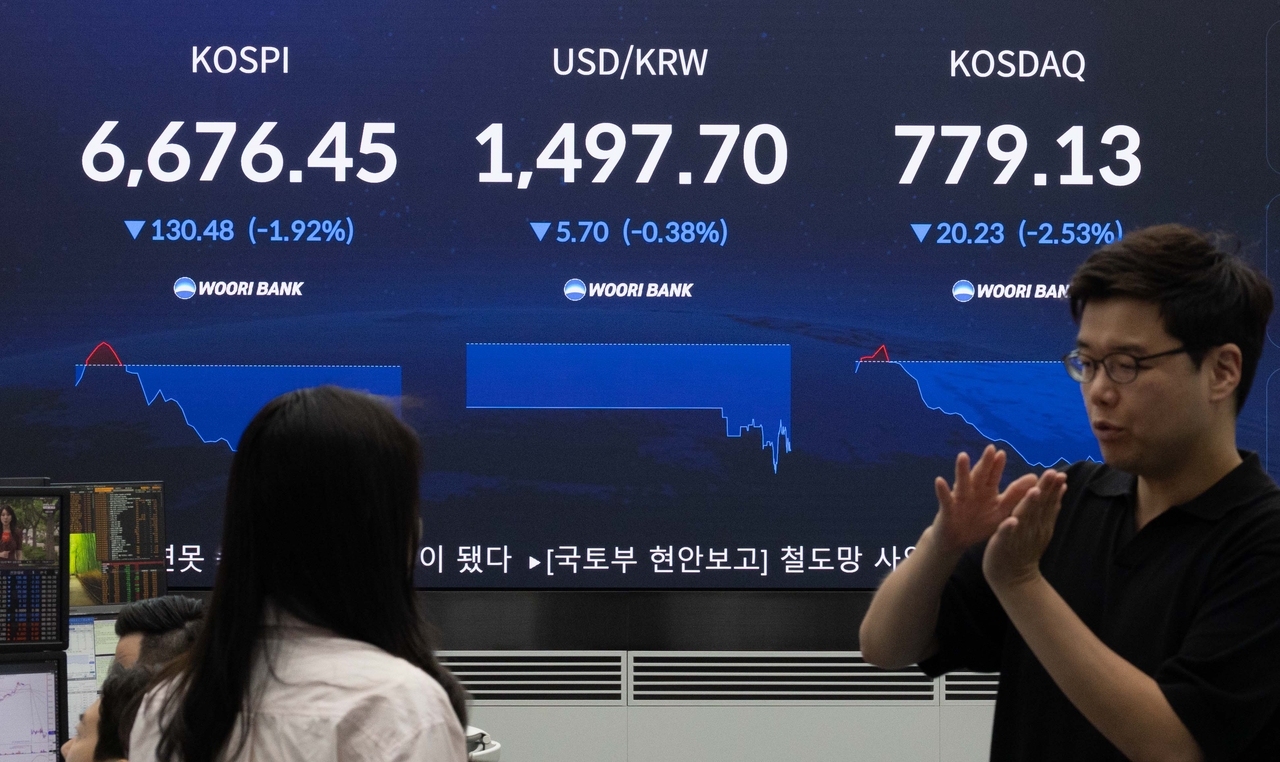
The Kospi fell Monday, dragged down by weakness on Wall Street during the Constitution Day holiday period, with intraday volatility reaching as wide as 4.4 percentage points.
As of 10 a.m., the Kospi was down 1.70 percent at 6,704.51, according to Korea Exchange. The index opened 2.60 percent lower at 6,643.58. It briefly slid as far as 6,515.24 before paring losses, with the gap between the intraday high and low reaching about 4.4 percent.
On the main Kospi market, foreign investors and institutional investors were net buyers of 403.7 billion won ($272 million) and 125.2 billion won, respectively, while retail investors were net sellers of 537.9 billion won.
All three major US indexes fell Friday as selling pressure on AI semiconductor stocks continued in New York. The tech-heavy NASDAQ Composite dropped 1.40 percent from the previous session.
A key factor weighing on the earnings outlook for major US AI companies was the release of "Kimi K3," the latest AI model from Chinese AI startup Moonshot AI. The model, made freely available, drew strong reviews and was seen as narrowing the gap with top-tier models from OpenAI and Anthropic.
Analysts noted that the rise of Chinese AI companies could erode the performance edge held by their US counterparts, potentially complicating large-scale infrastructure investment plans by AI firms.
Adding to the pressure, reports that three US soldiers were killed or went missing at a base in Jordan stoked fears of a full-scale resumption of hostilities between the United States and Iran, sending international oil prices sharply higher — a further headwind for domestic markets.
Lee Gyeong-min, a researcher at Daishin Securities, said the latest plunge in US and global semiconductor stocks, like the earlier drop in Korean chipmakers, was not driven by fundamental factors. "It is true that concerns about a semiconductor cycle peak are growing as expanded investment is being read as expanded supply, but earnings volatility has been limited so far and the earnings outlook through next year is expected to trend upward — so peak-out fears are still premature," he said.
Lee added that fluctuations in the Kospi's 6,000 range early this week represent an opportunity to build positions, with upside potential outweighing downside risk. "A strategy of accumulating leading sectors — semiconductors, IT hardware, IT appliances, secondary batteries, shipbuilding, chemicals and machinery — which are oversold in the short term and undervalued relative to earnings, would be effective at the 6,000 level by taking advantage of volatility," he said.
Samsung Electronics was trading down 1.37 percent at 251,500 won. The stock opened with a steep drop of 5.49 percent and briefly fell as low as 240,000 won in early trade before recovering some ground.
SK hynix was down 0.11 percent at 1.84 million won. It opened 5.27 percent lower but has since trimmed its losses.
Bargain buying during the session appeared to be providing a floor for share prices. Samsung Electronics and SK hynix had plunged 8.77 percent and 11.53 percent, respectively, on Thursday — the last trading day before the Constitution Day holiday.
SK Square fell 1.49 percent to 1.194 million won. Samsung Electro-Mechanics rose 2.27 percent to 1.306 million won. Most other large-cap stocks — including Hyundai Motor, LG Energy Solution, Samsung Biologics, Samsung Life Insurance and KB Financial Group — were trading lower.
The Kosdaq was down 3.36 percent at 765.20 at the same time. The index had opened 2.35 percent lower at 773.21 but extended its losses through the session.
Among top Kosdaq stocks by market cap, Alteogen edged up while Ecopro BM, Ecopro, Jusung Engineering and Rainbow Robotics were all lower.
Sam Chun Dang Pharm surged 29.82 percent after reports that it had received an official pre-ANDA response from the US Food and Drug Administration regarding the development of an oral semaglutide generic.
Han Ji-young, a researcher at Kiwoom Securities, said weakness in global semiconductor stocks and geopolitical uncertainty had weighed on investor sentiment. "However, the Kospi's 12-month forward price-to-earnings ratio has fallen to around 5.8 times — the lowest level in 20 years, including during the global financial crisis — so at the low-to-mid 6,000 range, the index is likely entering a support-testing phase where it consolidates a floor rather than falling further," Han said.

jiyun@heraldcorp.com





