"Two medical schools and hospitals must be established under the people's sovereignty government"
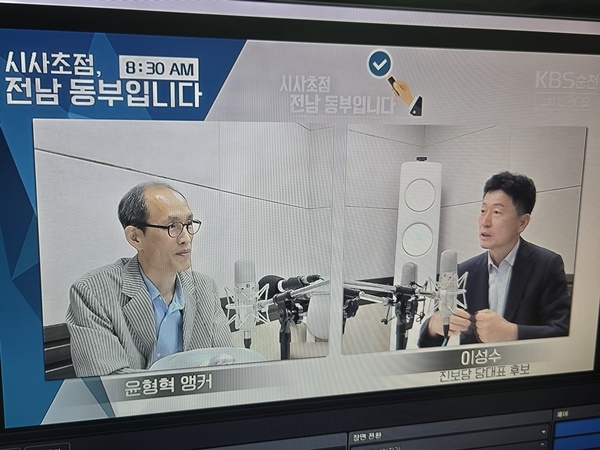
Lee Seong-su, 56, chairman of the Progressive Party's South Jeolla Province chapter and a candidate in the party's leadership election, on Monday criticized Min Hyeong-bae, mayor of the proposed Jeonnam-Gwangju Special City, for saying the entire 20 trillion won ($13.5 billion) in integration incentives could be channeled into a southwestern semiconductor cluster. "That is deeply irresponsible," Lee said.
Lee argued that the 20 trillion won the region stands to receive as an incentive for merging Gwangju and South Jeolla Province should not be poured wholesale into a semiconductor cluster. He said the funds should instead go toward the long-stalled establishment of medical schools and affiliated university hospitals in South Jeolla Province.
Speaking Monday morning on KBS Suncheon Broadcasting Station's current-affairs program, Lee said the dispute between Suncheon National University in the eastern part of South Jeolla Province and Mokpo National University in the western part over which institution should host a medical school and university hospital was degenerating into sub-regional rivalry. He said the deeper problem was that the Lee Jae Myung government — which calls itself the "people's sovereignty government" — was carrying forward the Yoon Suk Yeol administration's policy of approving only one medical school for South Jeolla Province without any change.
Lee then proposed that all political forces unite around a common framework and move quickly to establish two medical schools and university hospitals in South Jeolla Province, a region underserved in healthcare. He said 2 trillion won at most — out of the 20 trillion won in government integration funds — would be enough to do so.
Lee argued that before Mayor Min spoke of committing 20 trillion won to semiconductors, the right approach would have been to demand government approval to direct that funding toward the two medical schools and university hospitals, a long-cherished regional goal.
Lee also sharpened his criticism of Suncheon's political establishment, which he said was taking positions at odds with what local universities and residents actually want.
"Local politicians are not doing their real job — pressuring and coercing residents is no way to get things done," he said, adding that the real problem was that politicians representing the region could not bring themselves to say a word against the Lee Jae Myung government. The remarks were an indirect jab at Rep. Kim Moon-su, who represents the Suncheon-Gwangyang A constituency in the National Assembly and sits on its education committee.
The transition committee for the proposed integrated special city had put forward a compromise plan under which two national universities would be merged, with the main campus and medical school placed in Mokpo and a 500-bed university hospital in Suncheon. Rep. Kim has said he supports accepting that proposal.
Kim recently posted on his Facebook page a pointed attack on Suncheon National University President Lee Byeong-un and others, writing: "What exactly is the plan of the entrenched Suncheon National University president and others who have kicked away the last chance to establish a university hospital?"
Former Suncheon Mayor No Gwan-gyu, a longtime political rival of Kim's, took the opposite view, defending Suncheon National University's refusal to accept the plan. "The proposal put forward by the Gwangju integration committee was far too insulting to Suncheon National University and its community, and showed complete disregard for local residents," he said.
Lee also laid out his reasons for entering the Progressive Party's national leadership race.
"Our party's seat count has nearly doubled — from 21 four years ago to 41 in this year's June 3 local elections — surpassing the Rebuilding Korea Party to become the third-largest party, and those members won on their own strength, not through alliances or dependence on others," he said. "The Progressive Party must therefore pursue self-reliance through close engagement with local communities, and I intend to prepare for the April 2028 general election by dramatically expanding our membership to enroll 5 percent of the population as party members."
parkds@heraldcorp.com