Even as the government announced plans to advance completion of the Yongin semiconductor complex by up to 12 years alongside a push to develop a semiconductor cluster in the Honam region, calls are emerging for a ground-up reassessment of the Yongin project, citing insufficient power supply and water resources.
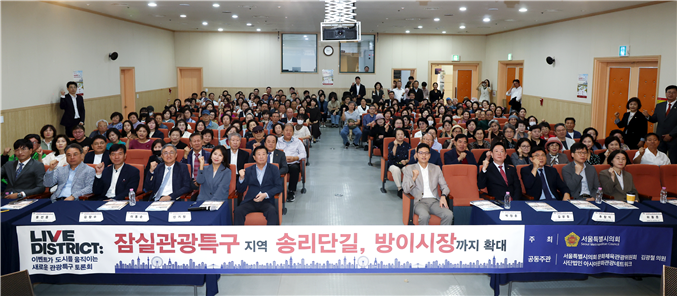
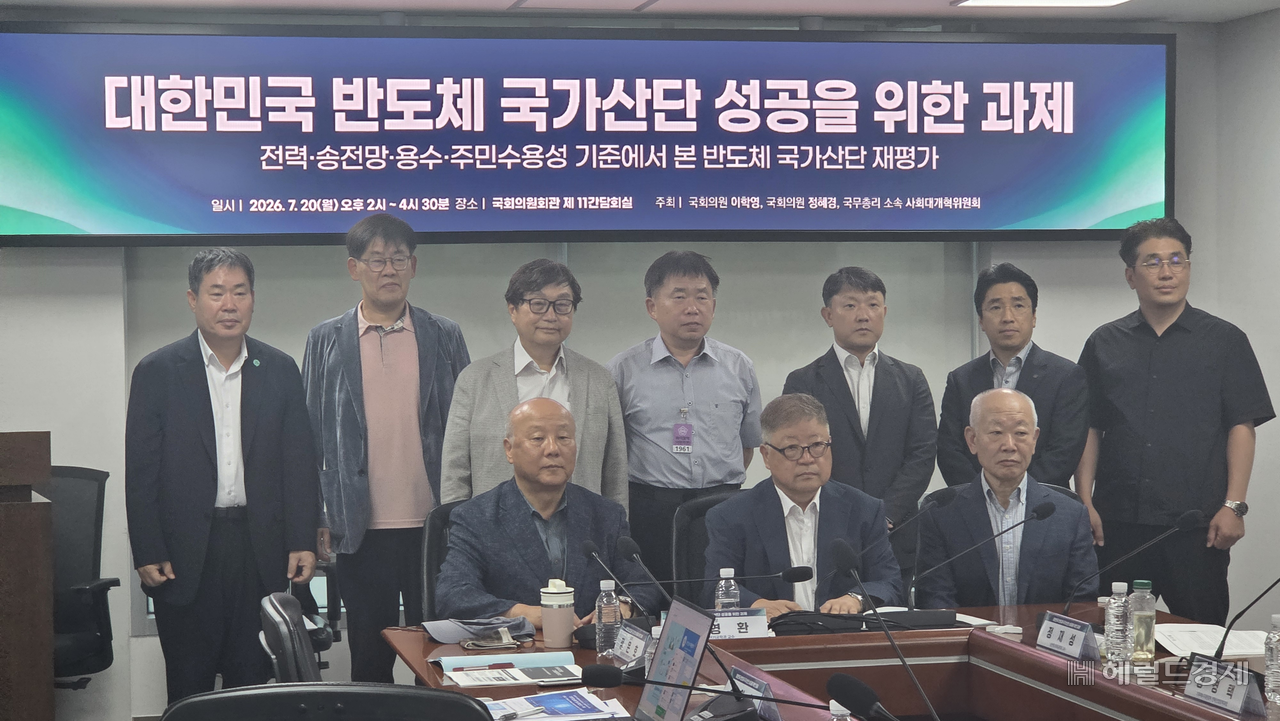
The National Assembly hosted a forum Monday co-organized by the Social Reform Committee under the Prime Minister and Democratic Party of Korea lawmaker Lee Hak-young and Progressive Party lawmaker Jeong Hye-gyeong. The forum was titled "Tasks for the Success of South Korea's National Semiconductor Industrial Complexes: A Reassessment from the Perspectives of Power, Transmission Networks, Water and Community Acceptance."
Park Seok-woon, chairman of the Social Reform Committee under the Prime Minister, said in his opening remarks that "there are calls for a proper review of the government's plan to simultaneously push ahead with the southwestern semiconductor cluster while also accelerating completion of the existing Yongin national semiconductor complex." He added that "some are calling for the Yongin national complex plan to be scrapped and reconsidered from scratch, while others argue the issues can be fully resolved if the government's infrastructure development plans proceed on schedule," underscoring the importance of the debate.
Progressive Party lawmaker Jeong Hye-gyeong said the country must thoroughly examine — and decide together with the public — how power will be secured, how water will be supplied, who will bear the burden of building transmission networks, how the lives and communities of local residents will be protected, and whether the industrial strategy is sustainable in an era of climate crisis. "I hope this becomes a starting point for establishing a new principle — one that does not require the sacrifice of residents in specific regions as a precondition for industrial and energy policy," she said.
Jeong Eun-ho, former head of the Korea Electric Power Corporation's economic and management research institute, argued that the Yongin semiconductor complex should be assessed by separating the general industrial zone from the national industrial zone, and that the time has come to weigh the cost-effectiveness of whether to press ahead or halt and withdraw.
Jeong said SK E&S plans to complete a liquefied natural gas combined heat and power plant near the Yongin cluster and to route surplus power from the east coast to Yongin through the East Coast–Singapyeong 500kV HVDC project. He warned, however, that "according to Greenpeace, operating the six LNG power plants planned for the Yongin semiconductor cluster at 75 percent capacity for 30 years could cause up to 1,161 premature deaths. There are no answers as to who will compensate for these social costs or how, and social conflict will repeat itself — just as it did with the Miryang transmission tower dispute."
He added that "the Yongin semiconductor cluster faces a serious problem in that renewable energy is also insufficient there," and said he believed "it is time to verify the cost-effectiveness of whether to continue the cluster or halt and withdraw now." He also noted that the general industrial zone — where the SK Hynix fab will be located — and the national industrial zone — where Samsung Electronics will be located — need to be assessed separately.
Kim Jin-su, a legislative researcher at the National Assembly Research Service, said that "under current law, the procedure for developing an industrial complex involves first selecting a candidate site and then planning the infrastructure — water and power supply — to serve it." He argued that both the Honam semiconductor cluster and other projects end up with infrastructure plans forced to fit a site already chosen, making it extremely difficult to reverse course once a location is decided, and called for a fundamental shift in the national policy paradigm.
Kang Gyeong-taek, director of industrial energy and power at the Ministry of Climate, Environment and Energy, said that if companies invest in the Honam region, more generation capacity than what is currently available as surplus will need to be secured, and that "the ministry holds the basic principle that any additional generation capacity will be met with carbon-free power sources."
He went on to say that "the Honam region has spare capacity equivalent to roughly three large nuclear power plants — around 3 GW — but the Honam semiconductor cluster requires more than approximately 6 GW, meaning additional power is needed." He added that electricity must be supplied without interruption, and that because renewable energy is not easy to store, sufficient nearby generation capacity and an external power interchange network are also necessary.
Lee Seong-hak, head of grid policy planning at Korea Electric Power Corporation, said that because renewable energy does not generate electricity in a stable manner, supplying it inevitably requires more capacity than demand alone would dictate. He said the company is preparing the 12th Basic Plan for Electricity Supply and Demand with the aim of securing 268 GW to meet demand of approximately 129 GW.
go@heraldcorp.com